Greener BRI set to benefit Africa, rest of the globe







The amazing Belt and Road Initiative remains a key element of China's policy for friendly, cooperative connection across vast tracts of our fragile planet. It's bringing opportunity and hope to millions.
We also seem to be hearing more and more about the United Nations sustainability goals, specifically in terms of finance, where the acronym "ESG"-environmental, social and governance (criteria)-is liberally sprinkled around like confetti.
Last month, the Hong Kong Special Administrative Region was the site for the annual general meeting of LEX Africa-an alliance of leading law firms across Africa but with close ties to Asia as well. One set of speeches concerned exactly this issue of ESG, but within the context of the BRI.
Africa is emerging as a vital component of the BRI, with enormous untapped potential. In addition, the China-Africa environmental, social and governance profile now looms large. A legal friend talking at the Hong Kong event described the BRI as a "green highway" for China and Africa.
In this fluid but rapidly evolving context, major economic progression, especially in developing nations, has to be seen in a global setting of sustainability, environmental protection, climate mitigation and human health, all wrapped up in the UN goals and ESG considerations.
So there is now a new opportunity for China and Africa to set a global example of good governance supporting green credentials and sustainability goals, powerfully bridging the divide between the often competing needs of development and environmental protection. This opportunity is BRIDGE-the Belt and Road Initiative for Development and a Green Environment.
Indeed, the funding and investment climate around the BRI are changing, as they must, to respond to the new realities emerging on the ground and in the air. Our atmosphere is fundamentally changing, and if we do nothing, the outlook is bleak for every living thing. So the collaborative atmosphere in discussion about the way forward for the BRI in Africa should also change to reflect this.
The China-Africa nexus can be a facilitating, cooperative, powerful international body for good. China and Africa can be global exemplars of how to responsibly invest in infrastructure and projects that improve lives and build bridges across cultures, nations and continents for sustainable advancement for all.
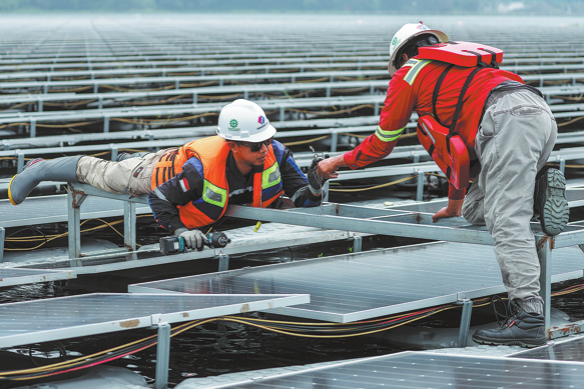
The BRI focus should now shift to different priorities around sustainably based and vitally needed infrastructure projects, such as renewable solar and wind power-from the industrial level down to small villages, where a simple wind turbine or solar panels can pump water from a well or power a home.
A much more environmentally benign approach is now required for our children's sake. It would be one that can grow opportunities for the population at large while protecting and sustainably exploiting, not destroying, precious natural assets. This would be set against a list of BRIDGE priorities that place good governance, benign resource management, universal healthcare, education, efficient and reliable public transportation and the burgeoning e-economy at the heart of it all.
As reported at the Hong Kong LEX Africa event, over 60 percent of Chinese investment projects are already in the green sector.
In the next 10 to 15 years, it will become so self-evident that we have broached key climate tipping points that every nation will have to double or triple down on climate change mitigation targets. This is if we are to avoid the worst predictions of exceeding the 1.5 C warming threshold that all climate scientists warn about. I think negative carbon will become the next big thing-removing CO2 from the atmosphere, not adding to it.
ESG principles will play an increasingly important role in reaching our sustainability goals. Sustainable cooperation must take root between Africa and China in order to flourish, so that China and Africa can enjoy lush pastures, forests and unpolluted streams together in mutual harmony and benefit.
The author is a professor on the faculty of science at the University of Hong Kong and the director of its Laboratory for Space Research.