A thread of hope







Sensing potential
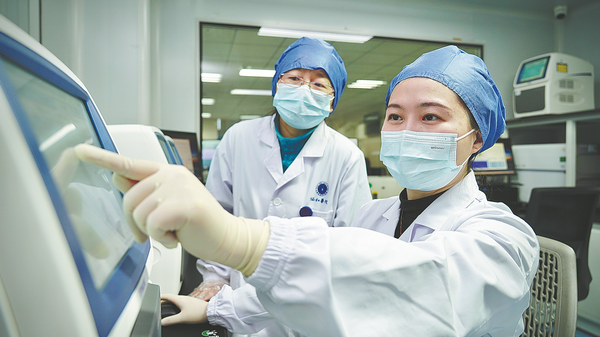
The first research topic of the regenerative medicine center of Union Hospital was to find a suitable material to repair damaged nerves.
"As we had no idea which material was suitable, we had to continue our research through trial and error. We experienced numerous failures, which finally led to success," she says.
"The silk industry has a very long history in China, but we hardly knew anything about the potential of sericin in biomedicine. An idea suddenly struck me that sericin might be the way to crack the problem."
After extensive reading, she found that, while much literature and research is based on the clinical application of silk fibroin, the information about sericin was lacking, and what little she found was obsolete.
Therefore, she decided to figure out whether it was possible to use sericin in clinical practice.
The variables of experiments are many, such as temperature, reagents and the types of silkworm cocoon used. A small change means many more rounds of experiments.
After more than three years of research, she and her team successfully purified structurally intact sericin, with active bioactivity, obtaining a national invention patent authorization.
Wang says the new biological material, based on sericin, can be used in different aspects of regenerative medicine, especially in wound repair caused by road accidents and earthquakes or it can be applied in repairing thorax, myocardium, cartilage and tumor injuries.
For example, when a patient suffers from peripheral nerve deficiency, the common method is to reroute one's own healthy and less important nerves into the injured areas.
Wang's method is to transplant a nerve conduit made of sericin, which is biocompatible and degradable. It takes about 12 weeks for the nerves to regenerate and repair. She says it can greatly reduce the pain of patient if it's used in clinical practice.
"It will also be a great boon to patients who need an organ transplant or suffer organ failure, the number of which outnumber donors," she says.
She says it's necessary to synthesize different forms of sericin to be used in different areas. For example, using injectable sericin to repair myocardium in a minimally invasive way and using a sericin hydrogel to repair skin.
She and her team have also delved into the potential of sericin as a multifunctional nanoscale vehicle for cancer therapy.
She and her team have published dozens of theses, showing the results of the research, in authoritative international journals.
However, they are still a very long time away from clinical trials on human beings, due to the current research process and China's strict supervision rules. Their experiments are currently only undertaken on mice.
"Only after very thorough research can we pursue the process of putting it into clinical application," she says.
Extracellular matrix plays an important role in tissue repair. She says the key is how to design better biomimetic materials with sericin-to create an extracellular matrix that's much the same as the primary tissue, in terms of aperture and structure.
The departments for burns, hand surgery, vascular surgery, orthopedics and neurosurgery are all involved in researching the field of regenerative medicine.
She says, from a clinical perspective, their focus is on the traditional method of repair and they know the demand of patients. She believes it's important to work with each other in developing such cutting-edge technology.
"We often communicate with clinicians. When they have some difficulties, we try to come up with a solution from our perspective," she says.