AI puts virtual beings on top







Firms vie to tap digital humans in finance, retail, governance, media, entertainment, auto sectors
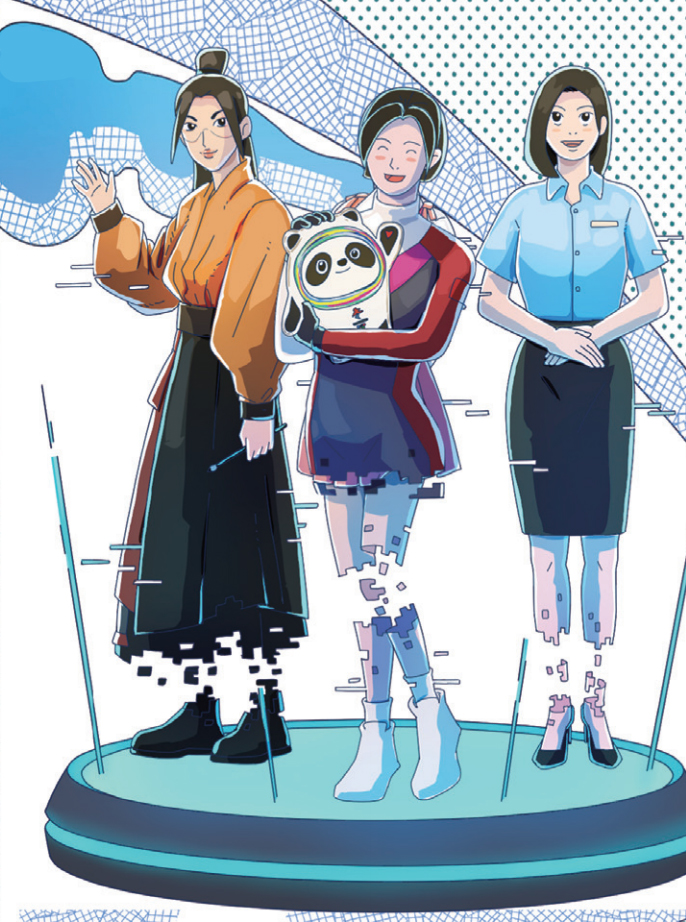
At a bank branch in Shanghai, an elegant female receptionist, dressed in a blue outfit, is welcoming customers. "Sensing" that customers are in a good mood, she becomes talkative and introduces more of the bank's wealth management services.
Aware that some customers are frowning, she becomes more cautious and does nothing more than answer the questions customers ask, such as how to print itemized bank account statements.
She was the first digital employee at the Shanghai branch of Bank of Ningbo. On a screen as tall as the height of normal human beings, she can also answer more than 550 common banking business questions and more than 3,000 supplementary questions.
Powered by an artificial intelligence system, she can learn to answer 50 new questions every day and with a camera on the screen, she can also tell whether customers are smiling or not, said Luan Qing, general manager of the digital culture and entertainment business at SenseTime, which developed the digital human technology.
The digital employee offers a peek into how a wider range of sectors are starting to embrace AI-powered digital humans to boost efficiency and increase resonance with customers.
Thanks to rapid technological progress, virtual humans, which used to be only seen in the cash-intensive entertainment industry such as movies, are becoming more prevalent in people's daily lives and work, experts and company executives said.
From virtual anchors who broadcast news 24 hours a day to virtual dancers and singers attracting fans all over the world to a digital employee winning a Chinese real estate developer's best new employee award in 2021, digital humans are becoming smarter.
The efforts showcase how Chinese startups and heavyweights are scrambling to put virtual beings to wider applications, they said.
During the Beijing 2022 Olympic and Paralympic Winter Games alone, about 20 digital humans made their debut.
They played different roles: AI sign language guides that explained the competitions to the hearing impaired among the audiences; weather forecast anchors; an Olympic public welfare ambassador; and livestreaming anchors that were selling Winter Olympics souvenirs online.
Currently, more than 280,000 enterprises in China engage in businesses related to digital humans, with the compound annual growth rate of enterprises registered in the past five years reaching nearly 60 percent, data from Qichacha, a company that tracks business registrations, showed.
The popularity of digital humans is closely related to the concept of the metaverse, a tech buzzword that has been gripping the global tech industry since last year.
Digital humans are the avatars of people to enter the metaverse, which promises an integration of virtual and real worlds, said Yu Jianing, coauthor of the book Metaverse and principal of Huobi University, an educational and research institution that focuses on frontier technologies.
Moreover, with the development and integration of AI, virtual reality, high-precision rendering and other technologies, digital humans are becoming more similar to humans, from image, facial expression, posture, action, to speech, semantics, voice, which advance their resonance with people, said Luan from Sense-Time.
"Digital humans produced by artists were common in movies and games. The production process was usually labor-intensive and required high artistic skill, thus was pretty costly. But now, assisted by AI, as the production process and operation of digital humans becomes increasingly automated, and the production cost falls, digital humans will likely enter more sectors such as finance, retail, governance and automobile," Luan said.
Based on the intelligence level and the automation level involved in their production, digital humans can be divided into five levels, according to a white book jointly released by Sense-Time and the Augmented Reality Core Technology Industry Alliance.
And digital humans that work at Bank of Ningbo are at level 4, which means they can have relatively natural interaction with humans.
Their production process can be greatly shortened thanks to AI, Luan said, adding that level 5 digital human is still a concept and considered as intelligent as humans. Its production process will be fully automatic.
The market for virtual celebrities hit 6.22 billion yuan ($933.34 million) in China last year, up nearly 80 percent year-on-year. It is expected to expand to 20 billion yuan over the next two years, according to a report by market consultancy iiMedia.
Xiaoice, another Chinese AI pioneer, is also scrambling to tap into the opportunities of digital humans. The company developed Cui Xiaopan, the first digital employee of Chinese real estate developer Vanke.
"She" is in charge of reminding employees to pay the company's bills on time and collect bills due. The resolution rate of the cases Cui handled was as high as 91.44 percent, and the new employee was ultimately chosen for Vanke's best new employee award in 2021.
Yu Liang, chairman of Vanke, said Cui joined the company in February 2021. Thanks to the support of powerful AI algorithms, "she" quickly learned how to find problems in processes and data and detect abnormal documents far more efficiently than human employees.
Li Di, CEO of Xiaoice, said, "With joint efforts with our partners, an era has arrived in which AI beings are becoming reliable, stable and indefatigable."
AI beings developed by Xiaoice now work as two video hosts or anchors for China's National Business Daily. They have been broadcasting news for more than seven months. Xiaoice said the virtual hosts' overall naturalness has been improved to a level that they are almost indistinguishable from humans.
Also, the news programs are developed entirely by AI technologies in an unmanned operation encompassing the entire process of video acquisition, editing and broadcasting.