Gumption overcomes environmental woes
Unwavering efforts lead northwest province of Gansu on a path to boost its socioeconomic development







Editor's note: China has seen tremendous changes nationwide, from economic growth to environmental protection, from social improvement to cultural progress. In this series, China Daily maps the changes and tells the stories of the people who lived through them.
On the map, the contour of Northwest China's Gansu province resembles a ruyi, a scepter or baton that has a long S-shaped handle and a head fashioned like a fist or a cloud.
In the head of that shape, its capital, Lanzhou, is located in the barren landscapes of the Loess Plateau, where long scars formed by water erosion run from the top of the mountains down to the surface. In the south, Gansu sits on the eastern edge of the Qinghai-Tibet Plateau, where China's mother river, the Yellow River, has its first big bend in Maqu county, Gannan Tibetan autonomous prefecture. Hailed as the "kidney of the Yellow River" and the "water tower of the plateau", Maqu sees the upper streams of the Yellow River and the Yangtze River, and their 122 branches, run across it.
The ruyi's long handle reaches far northwest, crossing the Yellow River, along the Qilian Mountains and the 1,000-kilometer Hexi Corridor-the artery connecting China with Central Asia that served as a conduit for Buddhism, trade and military ventures in ancient times-and meeting a part of the Kumtag Desert in Dunhuang, home of the UNESCO Cultural Heritage site Mogao Grottoes.
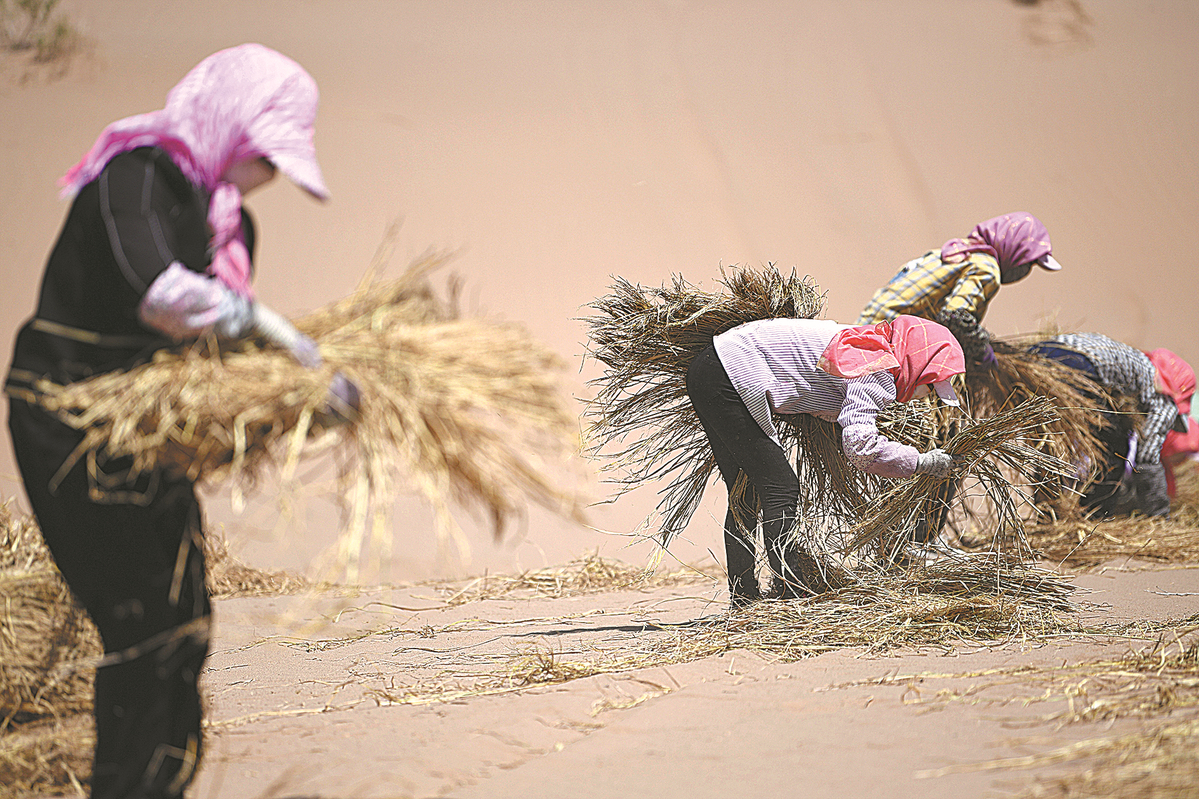
With deserts, semideserts, gobis, oases, grassland, wetland, mountains, glaciers, loess soil and plateau, Gansu is one of the most geographically diversified provinces in China. However, it is also one of the nation's most environmentally fragile areas. In 2017, more than 43 percent of Gansu's surface area, 195,000 square kilometers, was desertified land, and more than 27 percent was sandified. While severely hobbling the province's economic growth, the fragile environment also posed a serious challenge to people's livelihoods.
With unremitting efforts over the last decade, Gansu, once one of the most poverty-stricken provinces in China, has not only greatly improved its environment, but also has eradicated extreme poverty. "With tremendous efforts, we have won the war against extreme poverty," Yin Hong, Party secretary of Gansu, said at a news conference in May. "The goal to ensure people's daily needs, housing, medical care, education and water safety has been completely realized. We have greatly improved the lives of 5.52 million people from 7,262 villages of 75 counties who suffered from poverty."
Last year, the income of people lifted out of poverty exceeded 10,000 yuan ($1,474) per capita in Gansu for the first time. Their disposable income grew from 2,415 yuan in 2013 to 8,539 yuan in 2020.
Moreover, the disposable income of rural residents increased from 4,931 yuan in 2012 to 11,433 yuan per capita last year. More than 1.06 million people have moved into new homes with governmental support over the past 10 years. As an important environmental safety barrier, Gansu shoulders the responsibilities of supplying and conserving water for the country's biggest rivers, fighting desertification and protecting biological diversity. Since the 18th National Congress of the Communist Party of China, the province has exerted great efforts to improve its environment.
Samtan Kyab, deputy chief of the wetland management division of the Yellow River Shouqu National Natural Reserve in Maqu, said grassland degeneration and soil erosion caused by desertification were the major environmental problems around the river in the county. Wetland had shrunk to the point that its ability to conserve water had also declined, he said.
Over the past decade, Samtan Kyab said, the biggest changes have been that forests and grassland have been restored, the desertification of grassland has generally been put under control and the trend of environmental degradation has been reversed, due to the systematic treatment of the environments of mountains, rivers, forests, farmland, lakes, grassland and deserts.
The Hexi Corridor contains eight oases, the largest of which is Zhangye. Part of the Qilian Mountains and the Heihe Wetland national natural reserves, the city is a key part of the environmental safety barrier of the Qinghai-Tibet Plateau and the anti-desertification belt in the north.
In the past, inappropriate development in the Qilian Mountains led to environmental degradation, said Guo Jianping, director of the Zhangye ecology and environment bureau. "Prospecting and mining have destroyed the vegetation on the Qilian Mountains, increased soil erosion and caused surface subsidence," Guo said. "The construction of hydropower stations has also brought about damage to the water ecosystem."
To protect the environment, the city has planted about 160,000 hectares of forest and roughly 10,666 hectares of grassland, and has restored some 403,333 hectares of degenerated grassland. In addition, the forest coverage rate in Zhangye has reached 24.46 percent. "Some illegal mines have been closed, as well as some hydropower stations," said Ma Duifang, chief of the wildlife management division of the Qilian Mountains Management and Protection Center.

North of the Qilian Mountains, the Damaying Grassland in Zhangye is home to the Shandan Army Horse Farm. For years, overgrazing by the horses at the stud farm contributed to the degradation of the grassland. In recent years, the stud farm has implemented 13 key environmental programs that have improved the grassland, which occupies nearly 18,000 hectares.
"Ten years ago, we divided the grasslands into winter-spring and summer areas, so that horses graze in different grassland in different seasons," said Zhang Riming, president of the stud farm.
"Now, we reserve the stubble fields of barley and oats for horses to graze in winter and spring to reduce their impact on the natural grassland. So the horses graze in grassland for six months and in the stubble fields for the rest of the year."
The farm has also turned 21,333 hectares of farmland back into forests and has planted trees covering an area of 2,666 hectares, Zhang said. Now, the vegetation coverage of the area under the administration of the farm has reached 97.6 percent.
With more plants covering the land, the population of wild animals like snow leopards has also increased in the area. Last year, the stud farm made a net profit of 87.6 million yuan, up 70 percent year-on-year, according to People's Daily.