Innovative technology crucial to smart-city planning







During the past 25 years, information technology has made rapid progress in the Hong Kong Special Administrative Region. For example, the proportion of households with internet access has increased from about 30 percent in 1997 to more than 94 percent last year, while mobile phones have evolved from 2G to 5G.
Among the changes, there is one that many are not fully aware of, though it has an extensive impact on everyday life-digitization of urban planning. In simple terms, it is the transformation of paper maps to digital versions on a computer to enable processing of the increasing volume of data and making informed decisions.
As a result, people's livelihoods have been improved in many aspects, including mobility (Hong Kong's Intelligent Road Network and the routing and alignment design of the West Rail Line), housing and urban renewal (the renewal of old districts, and the location and orientation of public housing estates), and natural-disaster prevention and rescue (the platform that connects multiple departments for flood control and disaster relief, and real-time monitoring of tunnel water levels).
These have brought unprecedented benefits to society. Behind them is the use of the geographic information system, which has also been widely deployed in various areas, from identifying the best route for firetrucks rushing to the scene and designing the routing of trash-collection vehicles to reduce contact with the public, to assisting the Environmental Protection Department in investigating pollution complaints.
The system has also been used in the daily release to the public of COVID-19 epidemic information on an interactive map dashboard since the beginning of the outbreak, the planning of sewage inspection and the enforcement of restriction and testing operations since the fourth wave of the outbreak.
The advanced technology applications have also made Hong Kong one of the top smart cities in the world.
The core value of a smart city is promoting people-to-people connections through the application of technologies. The spatial layout of a city is particularly important, as it affects not only people's lives and behavior, but also social mobility. A comparison of two new towns in Hong Kong-Tin Shui Wai and Sha Tin-provides an example.
Hong Kong pioneered the use of advanced technologies such as the geographic information system 25 years ago. The city acted as a leader among its Asian peers in promoting the development of the smart city and the use of innovative technology.
However, in the past decades, Singapore, South Korea and some cities on the Chinese mainland have made a great deal of progress with smart cities. Hong Kong, on the contrary, appears to lag behind the prevailing global trends.
If we want to break through geographic boundaries, strengthen integration with the rest of the Guangdong-Hong Kong-Macao Greater Bay Area, and formulate long-term solutions for housing supply, the application of innovative technologies such as the geographic information system is indispensable.
The system is strong in sorting and analyzing huge amounts of data, and its visualizing function makes it easier for us to identify problems, discover hidden trends and identify solutions.
However, not only are government officials unfamiliar with geographic information system technology, but the general public also is not. Therefore, I started to promote it to local young people eight years ago. I encouraged them to identify problems and use this software to incorporate social conditions while finding suitable solutions.
Since 2015, a program called Map in Learning has allowed all primary and secondary students in Hong Kong to use professional geographic information system software for free. Up to this year, more than 220 schools have participated in the program, and over 1,700 students and teachers have been trained to use the software.
Since 2017, the annual Esri Young Scholars Award, or Esri Award, has been organized, aiming to encourage university students to analyze their chosen topics and make practical recommendations.
Looking back at the winning works of the Esri Award in the past six years, most of them focus on two areas: optimizing planning to improve economy and living, and tackling various travel problems.
The former include how to make good use of brownfield sites (previously developed land that is not currently in use) in the New Territories to develop modern logistics, assessing the potential of Kowloon East to become a commercial center, solving traffic-noise problems in old districts, identifying how public medical services in Sham Shui Po can be made more accessible to the elderly, and identifying the districts where public transportation and land use are not yet maximized.
The research on mobility is also very relevant. Subjects have included identifying the lack of interdistrict bus routes in the New Territories West, connecting industrial and commercial districts and reviewing obstacles that make it time-consuming for wheelchair users to travel in Kwun Tong compared with regular pedestrians.
Although the authors are young people, their broad visions, concern for society and innovative thinking are encouraging.
The GIS Academy is a one-stop platform for lifting young people's problem-solving skills and employability through enhanced geospatial knowledge.
Through classroom teaching, seminars and internships, students can deepen their understanding of the geographic information system's advanced technology, providing them with a chance to join this emerging industry in the future, and thereby driving Hong Kong to enhance its competitiveness and improve its residents' quality of life.
President Xi Jinping pointed out on July 1 at the assembly celebrating the 25th anniversary of Hong Kong's return to the motherland that "Hong Kong will prosper only when its young people thrive".
The GIS Academy aims to promote the spatial understanding and diverse development of local young people, help build a sustainable and smarter Hong Kong, and allow the city to be well prepared for the development of innovative technology in the Greater Bay Area.
The author, an adjunct professor on the faculties of engineering, social sciences and architecture at the University of Hong Kong, is founder and honorary president of the Smart City Consortium.



- Liaoning fire: Report urges legal action against restaurant operator and seven others
- Historical Han Dynasty slips go on display in Hohhot
- Shanghai unveils steps to build sci-tech innovation corridor in Yangtze River Delta
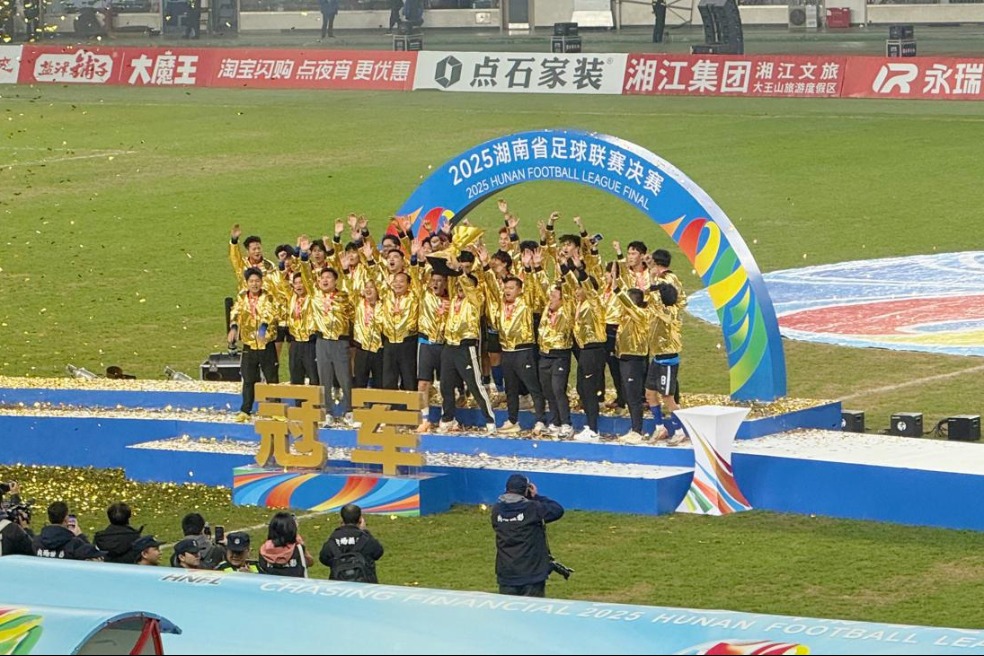
- Xiangchao concludes with Yongzhou claiming championship
- Answers
- CPC leadership meeting urges steadfast implementation of eight-point decision on improving conduct