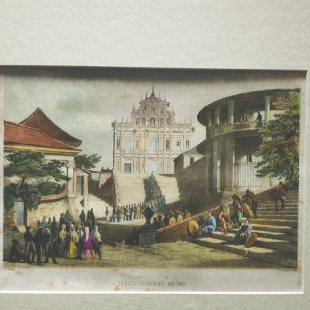



Exhibition at Palace Museum provides a historical view of Macao








Bright colors of Southern Europe flow on the walls and roofs of the centuries-old architecture, blending elements of the East and the West by the South China Sea. Various religions — Catholicism, Buddhism, Taoism, and Mazu beliefs — have coexisted in harmony in Macao, which enjoys a unique landscape bathed in lasting and kaleidoscopic glamour.
Artworks provide glimpses into the vicissitudes of the city, and these scattered jigsaw pieces of time thus become eternal. Thanks to an ongoing exhibition at the Palace Museum in Beijing, also known as the Forbidden City, the epitome of Macao's architectural heritage can be admired by visitors to the former imperial palace, hopefully stirring a cross-cultural dialogue.
In Centuries-Old Legacy: Macao's Landscape and Architecture Paintings from the Macao Museum of Art, which opened in the Zhaigong (Palace of Abstinence) Gallery earlier this month, 82 works present a panorama of the area around the Historic Centre of Macao, which was inscribed as a UNESCO World Heritage Site in 2005. It will run through Nov 6.
More than 20 inscribed locations across the city witness the assimilation of Chinese and Portuguese cultures. They have a wide spectrum, ranging from Catholic churches and temples, to traditional residences and infrastructure from the era under Portuguese governance. The Ruins of Saint Paul's, a 17th-century Catholic religious complex, for example, has become a symbol of Macao.
According to Noah Ng, curator of the exhibition, the paintings on display are created not only by local artists, but also by painters from home and abroad. From an 18th century map of the city, Macao's legend is gradually unrolled through various media, including oil paintings, ink-water paintings, woodcuts and sketches.
"These historical images in different styles connect the footprints of artists in Macao throughout different periods of time," Ng says. "It creates a travelogue amid the historic architecture in the gallery."
From the images, visitors can clearly see how the Portuguese communities and Chinese villages formed and developed across several centuries.
A-Ma Temple, where people worshipped Mazu, the goddess who protects sailors, is widely considered as the oldest extant temple in the city. Several 19th-century paintings depicting scenes around the temple may remind people of how life centered on this cultural root in the old days. Meanwhile, a 2001 watercolor work, which adeptly creates a sense of changing light, may reveal the rich stories experienced by the Mandarin's House, a former residence of Zheng Guanying, a well-known scholar of the 19th century.
William Prinsep, a 19th-century British merchant, traveled to Macao in 1838. As a prolific amateur painter, his work may not excel in artistic terms, but he has left us with crucial and vivid historical references thanks to his drawing pens.
Such an exhibition at the Palace Museum may have extra meaning as a way to pay homage to history. As Leong Wai Man, director, Cultural Affairs Bureau of the Macao Special Administrative Region, noted, Macao used to be a gateway for Westerners and Western culture through which they could reach the Chinese rulers in the Forbidden City between the 17th and 18th centuries.
Among them were Jesuits like German astronomer Johann Adam Schall von Bell, Portuguese mathematician Thomas Pereira, Flemish astronomer Ferdinand Verbiest and Italian painter Giuseppe Castiglione.
"They made great contributions to Sino-Western cultural communication," Leong says.
According to Leong, the close cooperation between the Macao Special Administrative Region and the Palace Museum has been continuous since the returning of Macao to the motherland in 1999. Cultural relics from the Palace Museum have been annually exhibited in the special administrative region, while the ongoing exhibition is the first time works from Macao have been exhibited on such a large scale at the Beijing venue.
Wang Xudong, director of the Palace Museum, also reveals that the upcoming collaboration between the museum and Macao will not only involve exchange exhibitions, but also greatly benefit the fields of academic study, relic conservation, and archaeology, among others.