More brands embrace eco-friendly building concept to create 'safer world'







Massive green winds of change are sweeping Chinese retail enterprises' approach to building design, with "low-carbon consumption" emerging as the overarching guideline for related products, services and even the location concerned.
The green building industry, experts said, is on the fast track in China. According to the 2021 annual report on China's green building industry, the 34 provincial-level administrative regions have embraced the new Leadership in Energy and Environmental Design or LEED certifications — a globally recognized green building certification system.
The annual report was published by the US Green Building Council and Green Business Certification Inc. The LEED rating system is a globally recognized index to evaluate green, healthy and resilient buildings.
LEED buildings are more environmentally friendly than normal ones, utilize energy-efficient equipment, and actively adopt renewable energies or other technologies that reduce negative impacts of buildings on the environment.
According to the report, in 2021, there were 1,439 new LEED registrations, up 21 percent year-on-year. There were 1,872 retail buildings or spaces participating in LEED.
Wang Jing, vice-president of the USGBC and GBCI North Asia, said: "No matter what business the companies are in, they need buildings and spaces to operate. The decarbonization of companies' operating facilities are therefore vital to realizing their carbon neutrality goal as many companies are committed to becoming carbon-neutral. That's why, we are seeing retail brands accelerating their LEED registration, not just for their retail stores but also for buildings and spaces along their value chains such as offices, factories, data centers, warehouses, et cetera."
For example, on Aug 23, Starbucks' first "green outlet" in Wuhan, Hubei province, opened. The green outlet recognition system was developed by Starbucks and organizations with authority to do so. Based on the recognition standard, every link related to operations, including energy saving, water consumption management and waste disposal, is strictly monitored. Compared to a regular Starbucks store of the same size, a green outlet is estimated to reduce carbon emissions by 10.57 metric tons per year and use of water by 301.7 tons.
Starbucks has opened green stores in other cities such as Beijing and Shanghai. The company plans to open 2,500 green outlets by 2025, China Economic Weekly reported.
On July 27, Swedish furniture conglomerate Ikea announced that its first carbon-neutral outlet in the world was put into operation in Tianjin. In April, fast-food chain KFC announced it will establish its first batch of green outlets in Beijing and Hangzhou, Zhejiang province.
Chinese home appliance giant Gome Retail Holdings Ltd issued green consumption coupons this year, guiding consumers to buy low energy-consuming home appliances.
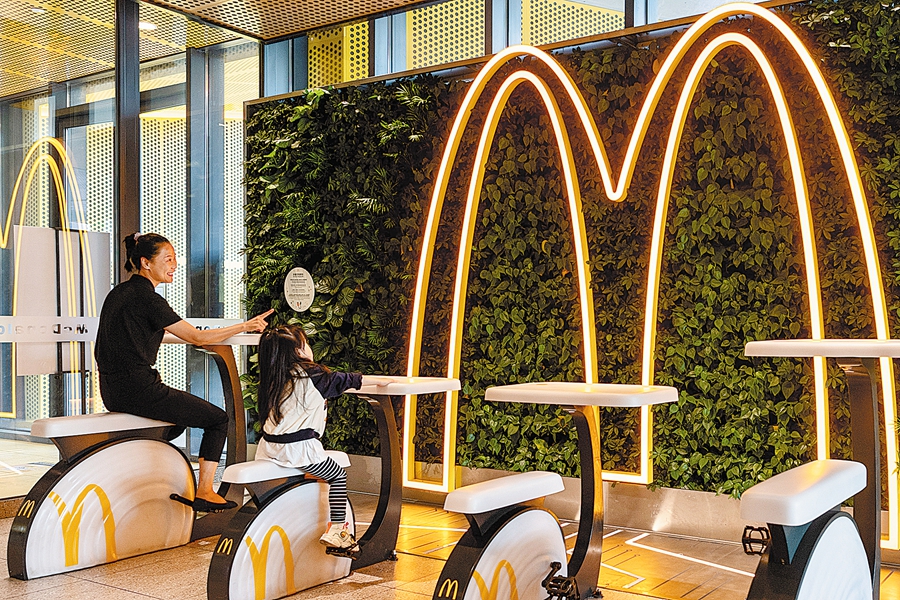
To date, McDonald's China owns 1,600 LEED-certified restaurants, three LEED-certified locations of Ronald McDonald House Charities, and its China headquarters in Shanghai also received LEED Platinum certification recently.
The McDonald's restaurant at the Shougang Park in Beijing is being designed and constructed according to LEED zero-carbon and zero-energy standards, aiming to be finally certified after one-year of operational data collection. It is expected to become the first restaurant in the Asia-Pacific region to receive both LEED Zero Carbon and LEED Zero Energy certifications.
"Currently, the sustainable trends are the most pronounced in China's commercial real estate sector as most of the new commercial projects are taking the green path. Compared with material innovations or changes in business models, the sustainability of the retailers' facilities is easier to be benchmarked with mature green building standards such as LEED," said Wang.
Guo Haifei, deputy director of the green innovation office at the Investment Consulting Special Committee of the Investment Association of China, said: "Under the country's dual goals of peaking carbon emissions by 2030 and achieving carbon neutrality by 2060, the development of sustainable buildings is expected to see rapid growth. The buildings offer not only environmental and social benefits, but great economic benefits.
"Taking advantage of green buildings, retailers can lower their costs, harvest carbon sink benefits, and also cut financing costs by using financial instruments such as green bonds and sustainability-linked loans."
To make better use of green buildings, retailers should pay attention to the monitoring of actual environmental benefits and information disclosure, so that their functions are more practical, Guo said.
"People on average spend 90 percent of their time indoors. If, one day, we can consciously recognize and choose green buildings in our daily lives just as we choose our zero-sugar and zero-carbon drinks nowadays, the world will be greener, safer and more resilient," said Wang with the USGBC and GBCI.