Rhetoric of hegemonic US underscores hypocrisy







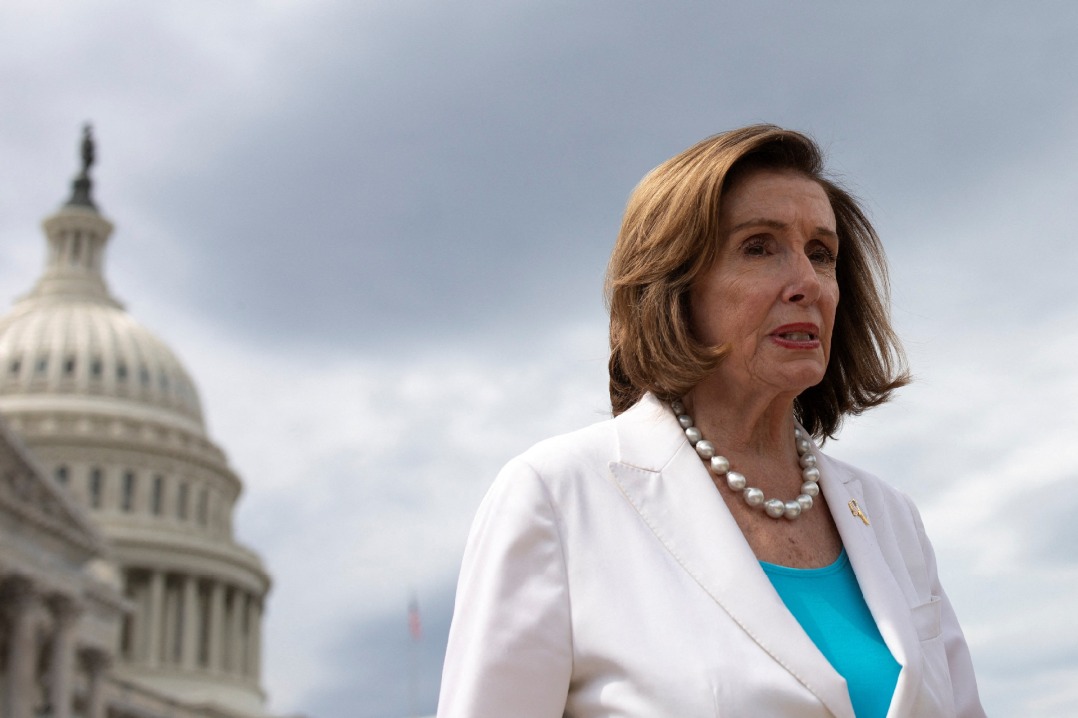
After United States House Speaker Nancy Pelosi visited Taiwan on Aug 2, her compatriots continued to stoke regional tensions and have sought to provoke China at every opportunity, hoping to trigger a response.
Whereas their rhetoric has been inflammatory, their hypocrisy has been blatant.
On Sept 27, for example, when US Vice-President Kamala Harris visited Japan for the funeral of former leader Shinzo Abe, she could not resist stirring things up. Instead of concentrating on the funeral rites, she chose instead to needle China, accusing it of undermining the "international rules-based order".This, of course, is code for US hegemony, and she even claimed, notwithstanding the US having done the same thing for years, that Beijing was "flexing its military and economic might to coerce and intimidate its neighbors".
Shortly thereafter, US Defense Secretary Lloyd Austin also stirred the pot. On Oct 1, while welcoming his Australian and Japanese counterparts to US military headquarters in Hawaii, he said he was deeply concerned by what he called China's increasingly aggressive and bullying behavior in the Taiwan Straits and elsewhere in the region.
Anybody listening to Harris and Austin could be forgiven for marveling at their hypocrisy, not least because neither was seemingly aware of America's Monroe Doctrine, let alone the harm it has caused. The doctrine, announced to the US Congress in 1823 by then US president James Monroe, warned the European powers that the Western Hemisphere was now the US sphere of interest, and that anybody failing to respect this did so at their peril. Over the past 199 years, the doctrine has become central to US foreign policy and has been repeatedly used to justify interventionist US policies.
In 2004, US philosopher Noam Chomsky pointed out that the Monroe Doctrine had been used by US governments as both a declaration of hegemony and a right of unilateral intervention in the Americas.
As US power grew, it became bolder still, and this prompted then president Theodore Roosevelt to add the so-called "Roosevelt Corollary" to the Monroe Doctrine in 1904. This proclaimed that, if the US considered that any Latin American country was guilty of flagrant and chronic wrongdoing, the US would be entitled to intervene. This was a significant extension of the Monroe Doctrine, and Roosevelt's corollary became closely associated with his "Big Stick" policy, which has been used by successive presidents to assert US domination in the area and beyond.
However dressed up, Roosevelt's policy was basically an affirmation that might is right, and early examples arose in Nicaragua in 1909 and 1912, when the US intervened to ensure the country had a government that was supportive of US interests, economic and otherwise.
The "Big Stick" policy, however, has only ever been used against countries that disagree with the US, such as Cuba. Other places, if compliant, are left alone, no matter how vile their regimes, and successive military dictators have prospered.
In other words, dictatorships are fine, provided they play along, but woe betide any that do not.
After Fidel Castro's Cuban revolution of 1959 had ended the kleptocracy of General Fulgencio Batista, the US presidential election of November 1960 was dominated by the theme "get tough with the Communists". In March 1960, the outgoing president, Dwight D.Eisenhower, had instructed the CIA to train a force of Cuban exiles for an armed invasion of Cuba, designed to overthrow Castro and restore a friendly government.
On April 4, 1961, then president John F. Kennedy approved the operation, although the invasion at Cuba's Bay of Pigs, from April 17 to 20, turned into a fiasco, with Castro emerging as a hero. Although Kennedy subsequently told then Soviet leader Nikita Khrushchev that the invasion was a mistake, this has not stopped his successors, except for Barack Obama, from doing their utmost to harm Cuba's government, economy and people.
Moreover, in 1973, the US had no qualms about deploying the CIA to overthrow Chile's democratically elected president, Salvador Allende, a socialist. He was replaced by a military dictatorship, led by General Augusto Pinochet, who, despite a proven record of human rights abuses, was supported by the US, whose interests he advanced.
More recently, US hostility toward Venezuela has demonstrated that it is as committed as ever to regime change. After Hugo Chavez won Venezuela's presidential election on a socialist platform in 1998, he infuriated Washington by making clear that his country's subservience to the US was over, and that he would retake control of its oil industry. In response, then president George W.Bush threw US support behind Venezuela's opposition movement.
Once Nicolas Maduro succeeded Chavez as Venezuela's president in 2013, the US upped the ante. Thus, on Jan 23, 2019, when opposition leader Juan Guaido unilaterally declared himself the country's "interim president", the US immediately recognized his claim. Then US president Donald Trump announced that all options were on the table when it came to removing Maduro.
On May 3, 2020, in a reprise of the Bay of Pigs operation, anti-Maduro insurgents launched Operation Gideon, beginning at Macuto Bay, north of Caracas. A group of armed Venezuelan dissidents, with the backing of a private military company, Silvercorp USA, invaded Venezuela by sea, with their plan being to infiltrate the country and topple Maduro. A day later, a second wave of invaders landed in Chuao, Aragua state.
However, due to good intelligence, Maduro foiled Operation Gideon.
Although president Trump claimed the plot had nothing to do with the US government, his secretary of state, Mike Pompeo, qualified this by saying that there was no US government "direct involvement".
With the US having such an astonishing record of interference in the internal affairs of others, it beggared belief that, on March 27, US Secretary of State Antony Blinken, while on a visit to Israel, declared that "we do not have a strategy for regime change in Russia or anywhere else for that matter".
It is, moreover, extraordinary that the likes of Harris and Austin should have the gall to criticize China for defending its territorial integrity and discharging its regional responsibilities. If, as the Five Eyes intelligence partnership comprising Australia, Canada, New Zealand, the United Kingdom and the US repeatedly claims, this is a values-based world, America's bully-boy tactics are an affront to the comity of nations, and must be called out.
The author is a senior counsel and law professor and was previously the director of public prosecutions of the Hong Kong SAR.