Homing in on a new life







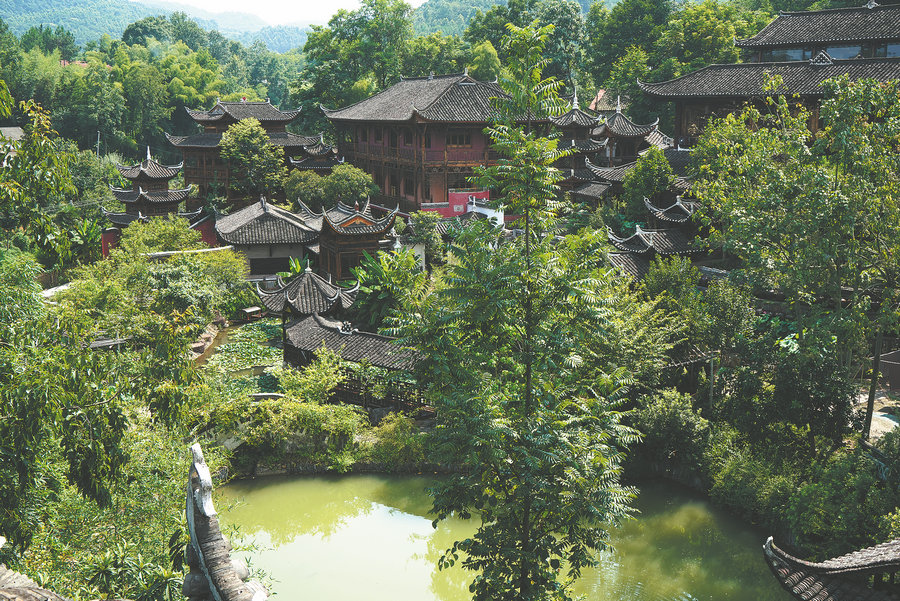
Cultural inheritance
Several years ago, Lei Ming, along with his younger brother, Lei Liang, and sister-in-law, Qin Xiang, came to a major decision to abandon their promising careers in Beijing to construct the courtyard in the hometown of the Lei family. The brothers closed their antique shop in Beijing, and Qin quit her civil service position and sold her apartment and car in the capital to expand the Ganxitan complex. Nine members of the Lei family now live in the mansion, including the brothers' parents, uncle and the three children of Lei Liang.
China's rural vitalization strategy involves developing farming culture and making local culture flourish, aiming to build a new socialist countryside that is beautiful, prosperous and harmonious. The courtyard is undoubtedly a remarkable example of a cultural inheritance.
"Many guests wonder about the architecture of the complex. I tell them that there is no fixed style and that I constructed the buildings, based on my understanding of ancient landscape paintings. It's the outcome of my aesthetic approach and regional culture," says Lei Ming.
"The traditional architectural fittings are old, including the carved wooden festoons. All stone sculptures, ornaments and even the water tanks in the yard are old items, to create the atmosphere of quaint charm."
He says he followed the traditional philosophy of "Tao follows nature" and "human beings are an integral part of nature" to build the high and low-rise buildings in accordance with the terrain.
"I gradually realize that the essence of traditional Chinese culture is to teach people to be charitable and live a peaceful life."
He purchased the old architectural fittings, hired skilled craftspeople to carefully repair them and install them in the buildings.
"It's difficult and expensive for modern craftspeople to make a genuine copy of such delicate handiworks, which are treasures of traditional Chinese handicraft," he says.
A wooden "wind-and-rain bridge" — consisting of the bridge, a tower and a pavilion — is common in southern China. The first construction in the courtyard was that of such a bridge, modeled on the village's pretty bridge built in the Ming Dynasty (1368-1644), which had been destroyed and replaced with a cement one.
"When I was a kid, I often walked on the wooden bridge in the village, so I built a small one in the traditional method due to nostalgia," he says.