


Qing royal architecture unearthed at Old Summer Palace site







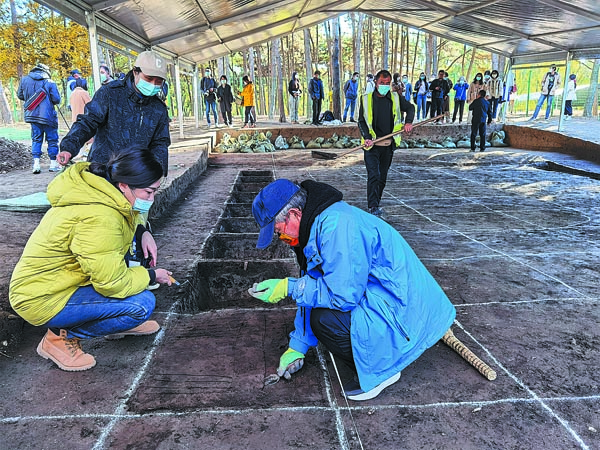
Archaeologists have fully unveiled a key site at the ruins of Yuanmingyuan in Beijing that tells of past imperial glory and demonstrates a painful moment in Chinese history.
New findings at a site known as Danbo Ningjing were announced on Friday by an archaeological team working at Yuanmingyuan, the former resort of the royal family during the Qing Dynasty (1644-1911), also known as the Old Summer Palace.
Danbo Ningjing literally means "to live in serenity and without many desires", a famous line attributed to Zhuge Liang (181-234), a master strategist and household name in Chinese history. Built in 1727, the site covers about 26,000 square meters and was where the Qing Dynasty emperors held farming ceremonies to show respect to nature's cycles.
Six square rooms, whose length was about 4.5 meters, were found during the ongoing excavation at the site. So far, the foundations of all 33 square rooms of identical size that composed the main building of Danbo Ningjing, as recorded in ancient documentations, have been found since archaeological work began on the site in 2020.
The 33 rooms used to compose a hall with a layout that resembled the Chinese character tian, which means farming field.
"This place reveals the moral standards and ideals claimed by Qing emperors and also indicated their pursuit for inner peace," said Zhang Zhonghua, deputy director of the Beijing Archaeological Research Institute and lead archaeologist of the Yuanmingyuan project.
Historical documents show farming lands once surrounded the tian-shaped building to its north, west and east.
"The Qing rulers even participated in cultivating rice there every year," Zhang explained. "It was where they showed their emphasis on agriculture, the foundation of ancient Chinese economy."
Archaeologists also recently discovered a fossilized rock containing rice near the ruins, and more findings of decayed plant remains may emerge in further lab analysis.
Despite the tian-shaped hall having only one floor, its foundation was intricate and designers spared no effort to ensure its stability, archaeologists learned. For example, nails made of cypress wood were driven deep into the ground to support column foundations, and nine layers of rammed earth were densely packed before bricks were laid.