Partnership for a better future
China-proposed GDI and BRI are critical for the development of the continent as it needs effective, relevant and practical international development assistance, investments and experience







China-proposed GDI and BRI are critical for the development of the continent as it needs effective, relevant and practical international development assistance, investments and experience
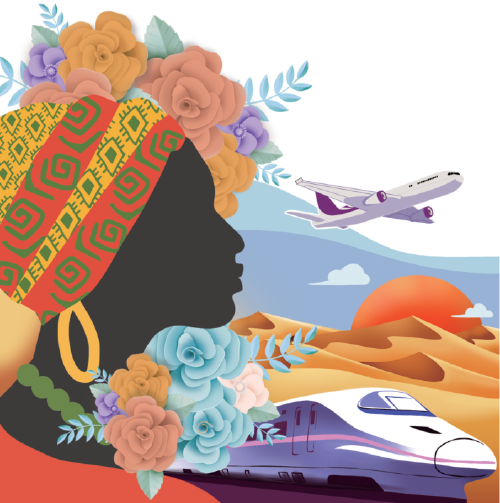
These are challenging times for the global economy, especially the developing economies. Economic and financial institutions have lined up to draw back their global growth forecasts for 2023 and to make dire warnings of the dangers for developing economies, especially those of Africa.
Can Africa defy predictions and buck the global downturn trend and ride out what the World Bank labels an "intensifying development crisis"? Insecurities around jobs, poverty, inequalities, food, health security and climate change are projected to deepen and alleviation goals take longer to achieve.
As the African Union's Agenda 2063 and Action Plan indicate, Africa's future is in its own hands, but one must recognize that African economies also need effective, relevant and practical international development assistance and partnerships, equitable and appropriate ethical investment, corporate partnerships and higher quality governance.
Yet, African economies demonstrate consistently great resilience in the face of the multiple, undeniably severe challenges many of them face, many confounding apocalyptic predictions. If we take sub-Saharan Africa, the region's economies averaged 5.6 percent growth in the 2000-2013 pre-2014 commodity crisis period and recorded continued growth in the second half of the decade until the onset of the COVID-19 pandemic. The COVID-19 pandemic retracted sub-Saharan Africa's GDP annual growth rate by around 2 percent in 2020, but the region demonstrated economic resilience with rebound growth of 4.1 percent in 2021 and 3.7 percent in 2022. However, the World Bank's Global Economic Prospects estimates the region's growth rate at 3.6 percent in 2023 and 3.9 percent in 2024 as the sub-Saharan economies face sluggish global demand, combat new COVID variants and struggle with mounting debt repayments, climate change and rising inflation.
There are several key economic development challenges across Africa, including increasing the diversity of the continent's exports, notably toward manufactured goods, as well as generating a higher share of processing value added in traditional resource and agricultural and food exports. Unemployment and a skills gap in Africa are growing bigger as its population explodes. For this shift to impact poverty alleviation, it needs to generate jobs for low-skilled labor as well as opportunities to develop high skilled jobs. That requires inward investment (bringing know-how and technology) and market development both in Africa and among developed and emerging markets.
At the same time, African economies are grasping opportunities to drive through the "development crisis" through their own efforts such as the African Continental Free Trade Area and a targeted push to quickly maximize the potential benefits of emerging technologies, a strategic action plan to create a strong digital economy, and a strong initiative to drive e-commerce. Infrastructure capacity-building and knowledge sharing are critical to this and this is where international cooperation can help support African initiatives.
China is engaged in supporting African economies, providing effective, practical cooperation. This long-established and close partnership is delivering vital infrastructural investment, corporate knowledge and project experience. For example, China's government, companies and people-to-people communication are working closely with African governments and the African Union to support Africa's digital economy and eliminate the digital divide with Western economies and within African economies. This partnership can be seen not only in the Digital Silk Road, the work of the Forum on China-Africa Cooperation, but more recently in their joint China-Africa Partnership Plan on Digital Innovation. By late 2021, 17 cities in 15 African countries had contracted over 1,500 Chinese companies to help achieve their digital transformation goals and 29 countries had selected Chinese smart government service systems.
High-impact international cooperation projects include the creation of new information highways promoted by China Mobile International in conjunction with several other companies through transcontinental submarine optical cables such as "2 Africa", a 37,000-kilometer cable to connect Africa with the Middle East. Encircling Africa, the cable links 16 countries. Other projects include construction of Multi-Tenant Data Centres, a manifest of China-South Africa cooperation to create Africa's first 5G stand-alone commercial network, and "smart city "projects such as Kenya's Konza Technology City (KonzaTechnopolis) development, Chinese tech and fintech firms are at the forefront of Africa's digital capacity-building, e-commerce and smart, green economic growth.
China's size and strategic importance mean that initiatives such as the Global Development Initiative and the Belt and Road Initiative have become increasingly critical for global development. This is especially true in the context of Africa, where China's actions and investments, alone and in cooperation with other countries, will have a major influence on Africa's capacities to achieve multiple Sustainable Development Goals in a range of low-income African countries.
The author is a senior research fellow and the director of the Centre for Rising Powers and Global Development at the Institute of Development Studies in the United Kingdom. The author contributed this article to China Watch, a think tank powered by China Daily.
Contact the editor at editor@chinawatch.cn.