Seeds of warmer ties planted after disaster







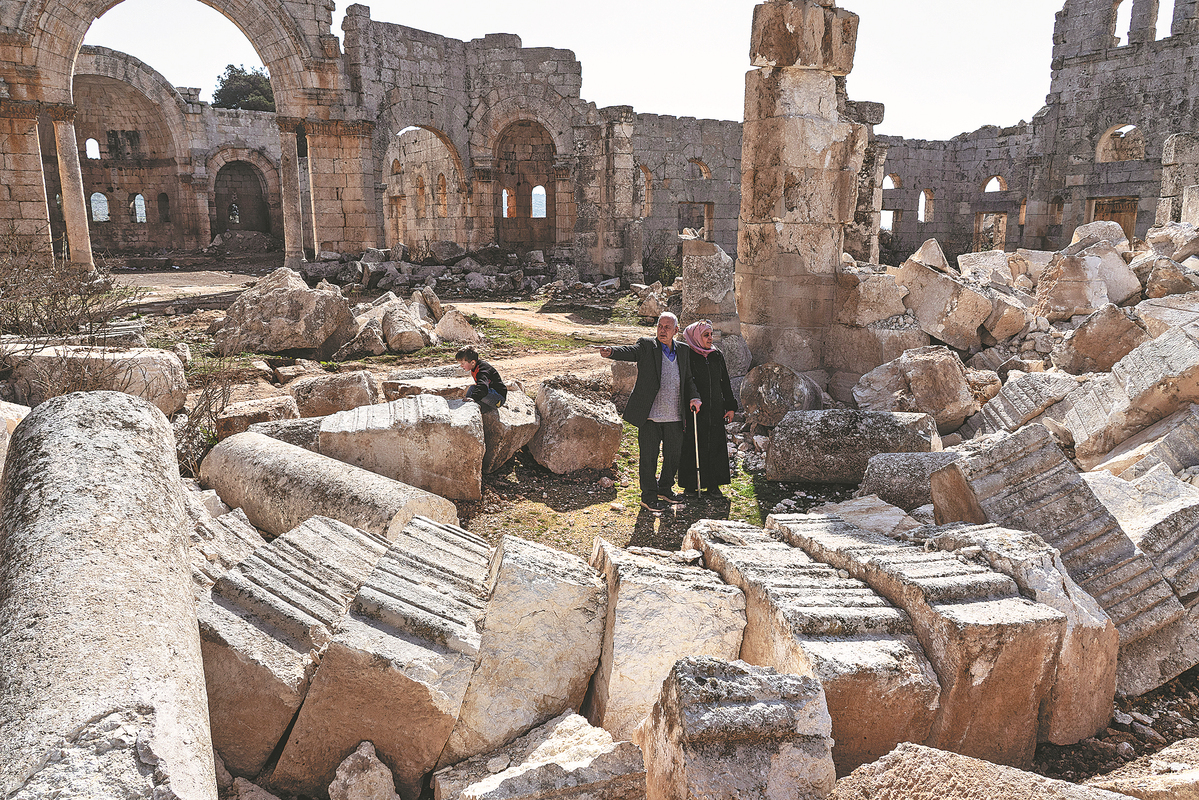
Since earthquakes struck Syria, signs of a thaw in relationships emerge in region
A number of Arab states have extended their support to Syria following the earthquakes that devastated parts of the country early last month, and experts say the moves represent a genuine attempt by these countries to rebuild relations with the war-torn country.
Countries across the Middle East are now focused on rebuilding their economies after years of conflict and the mess left by external powers, they said.
"Day by day the Middle East is going to become a region that is shaped by regional diplomacy rather than international developments," said Gokhan Ereli, Gulf studies coordinator at the Center for Middle Eastern Studies in Turkiye. He added that the Arab states' outreach and President Bashar al-Assad's efforts are part of this.
He described the Arab states' reaching out as a "limited but necessary engagement" because there had been earlier efforts to reach out to the Syrian government even before the earthquakes. But as the "US is still against Assad", this had limited the engagement.
"But we are talking about a regional normalization, and no one should (fall) behind regional normalization periods (and) that is why it is a 'necessary engagement'," Ereli said.
Arhama Siddiqa, an expert on the Middle East and a research fellow at the Institute of Strategic Studies Islamabad, in Pakistan, said: "External powers created a lot of mess in the Middle East. Now, Middle Eastern countries are trying — in their own space by their own means — to build their economies."
After the earthquakes, she said, even Arab states that previously had difficult relations with Syria now see this as an opportunity to improve ties. A case in point was Assad's meeting with the visiting Egyptian Foreign Minister Sameh Shoukry in Damascus on Monday, the first visit by a top Egyptian diplomat to the country since the Syrian civil war broke out 12 years ago.
Relations between Syria and Egypt were briefly cut during the Muslim Brotherhood-led government of then president Mohammed Morsi. Egypt reopened its embassy in Syria in 2013.
Different approach
Syria was a member of the Arab League, a 22-member regional organization formed in Cairo in 1945, until its suspension in 2011 following street protests. However, in recent years a number of Arab states, most prominently the United Arab Emirates, have changed their approach and begun to normalize ties with Syria.
In November 2021, Assad met UAE Foreign Minister Sheikh Abdullah bin Zayed in Damascus, making him the first Emirati official to visit since the 2011 uprising that escalated into a multifaceted war. The two met again in January, and Sheikh Abdullah affirmed the commitment and keenness of the UAE to support efforts to find a political solution to the Syrian civil war.
In the wake of the quakes, too, Assad visited Oman and met with Sultan Haitham bin Tariq al-Said, the state news agency SANA said. The two reportedly discussed fraternal ties and areas of collaboration, agreeing to enhance ties in various areas.
At the Munich Security Conference in Germany last month, Saudi Arabia's Foreign Minister Prince Faisal bin Farhan Al Saud acknowledged that the Arab world needed a new approach toward Syria.
He was widely quoted as saying consensus was building in the Arab world, that isolating Syria "was not working" and that dialogue with Damascus was needed at some point to at least address humanitarian issues and the return of refugees.
Mehran Kamrava, a professor of government at Georgetown University in Qatar, and head of the Iranian Studies Unit at the Arab Center for Research and Policy Studies, said there are three main reasons why the Arab states are changing their policies toward Syria.
First, he said, civil wars have "a natural cycle" where they reach a height "and then they slowly peter out because civil wars are impermanent by nature".
Civil wars are "very intense but eventually they die down", Kamrava said. "People want to go back to their routines."
The second reason is that Assad "has defied all expectations and stayed in power" because "we have not seen mass defections of the Syrian military", and the Syrian state "has pretty much stayed intact".
Third, the Arab governments' realignment of their foreign policies toward Syria after 12 years of civil conflict shows that they "have finally decided that perhaps the Syrian opposition is not worth the expenditure".