East China lab to get world-leading quantum computer







HEFEI — Around a canopy-like freezer hung from the ceiling at a lab in the eastern Chinese city of Hefei, a team of scientists is busy installing a quantum computer.
Li Shaowei has played a major part in this task. The researcher-engineer takes a palm-size cube out of a box. The 3D-encapsulated device, a quantum processor with 176 qubits, is primed to achieve a computational acceleration that is currently not feasible for traditional computers, an ability known as "quantum supremacy". Instead of mazy transistors, this processor contains minutely printed Josephson junctions, a structure less than a micron in size and features a thin layer of aluminum oxide sandwiched between two layers of aluminum.
When the temperature gets close to absolute zero, two aluminum layers will display zero resistance or superconductivity, in a bid to form quantum states that can bolster an exponentially growing calculating capacity. But now, the quantum-based circuit wafer is sealed inside a metal case, with nearly 200 holes allowing connection with the wires dangled down from the freezer above. Standing on a table, Li takes about two hours to complete the connecting work.
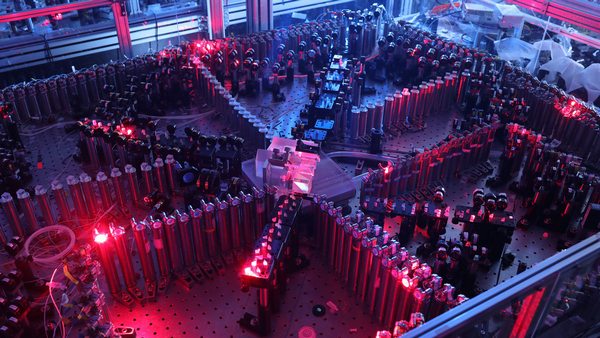
During the past six years, more than 10 superconductivity-driven prototypes were created. Among them is Zuchongzhi 2.1, which is currently running and making a repetitive sound at another lab in the building. Zuchongzhi 2.1 is a 66-qubit programmable quantum computing system, made in 2021, which can perform large-scale random quantum circuits sampling about 10 million times faster than the fastest supercomputer at that time.
"Like Zuchongzhi 2.1, the new system has 66 digital qubits plus 110 coupling ones," says Li, who works at the University of Science and Technology of China. "I have to link each qubit with its corresponding wire, otherwise they may lose control."
The team then manages to package the quantum system into variable-sized, Matryoshka dolllike vacuum jars and used liquid helium to help realize an absolute zero working environment.
The prototype computer, in cylinder shape, reminds Xu Yu, a post-doctoral researcher, of Zordon of Eltar, the protagonist in the US superhero TV series Power Rangers, who has a head soaked in a jar.
Xu says the system under assembly, a replica of Zuchongzhi 2.1, was projected to be linked to a cloud platform for quantum computing, making it accessible to other research institutions and even the public.
In 2019, Google reported the existence of a 53-qubit superconducting processor called Sycamore that performed the quantum random sampling task in 200 seconds, and the designers said then that it would take the world's fastest supercomputer 10,000 years to produce a similar output.
The 66-qubit Zuchongzhi 2.1 is 1 million times faster than the speed Sycamore could produce in 2019.
"Superconducting computing is a technical route believed to be the best strategy for developing quantum computing to a stage where it can be used for tasks similar to those performed by a general-purpose computer," says Xu.
Another team of scientists from USTC has created a quantum computer prototype, named Jiuzhang, with a photon-driven strategy. Jiuzhang 2.0 was shown in 2021 to have implemented Gaussian boson sampling, a classical simulation algorithm, with 113 detected photons, which was septillion times faster than the world's fastest existing supercomputer.
These two technical routes have placed China at the forefront of developing and commercializing quantum computing, driving the country to become one of the global leaders in this sector.
China is also home to a number of startups working on quantum technology such as Origin Quantum, a Hefei-based unicorn company that launched OriginQ Cloud, a full-stack quantum computing cloud service platform.
Currently, quantum computers excel in certain less-practical tasks like quantum random sampling and Gaussian boson sampling. In the near future, more practical quantum computers are expected to push artificial intelligence to new heights, and design entirely new materials, chemicals and medicines.
Having achieved "quantum supremacy", scientists in the global quantum computing race are now placing more emphasis on improving the machine's performance by focusing on error-correcting and the qubit's operating life.
"With ever-known algorithms, the high-quality automatic error correction for a quantum computing prototype may require thousands of qubits," says Xu.