Tibet boarding schools narrow the rural-urban education gap








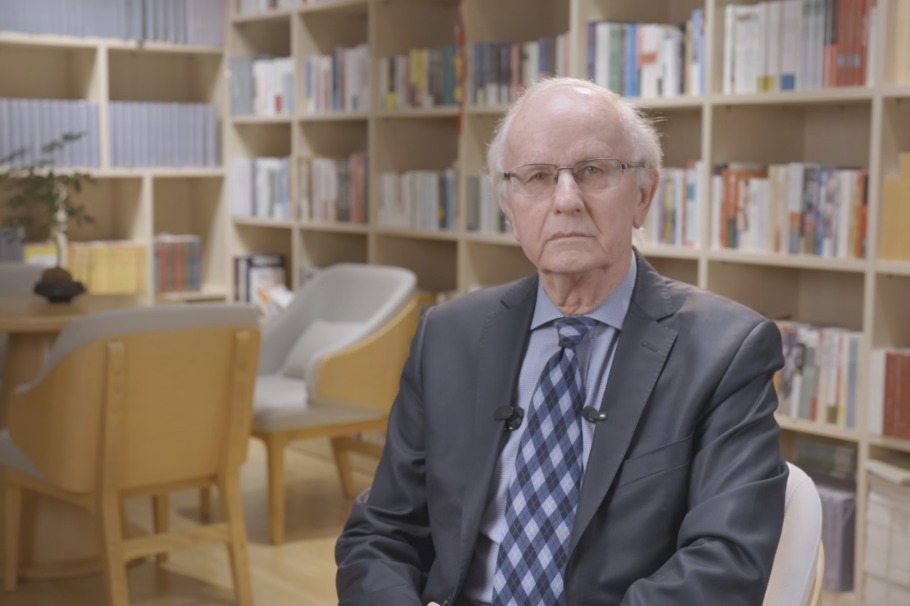
The boarding school system in Tibet has maximized education opportunities for the children of farmers and herdsmen in remote areas of the region, and decades of practice have fully proved that, said Talo, director of the social and economic research institute of China Tibetology Research Center.
"As one of the universal teaching models in the human history of education, boarding schools are commonplace in both Chinese and European history. We should not deny this educational model just because astonishing tragedies once happened in colonial-era residential schools in Canada, Australia, and the United States," he said.
Talo made the remarks on a side session held by the Society for Human Rights Studies on Thursday at the 52nd session of the United Nations Human Rights Council.
Due to the unique mountainous geographical conditions and population distribution in Tibet, it is unrealistic to set up a school in every village, which has been proven unsuccessful and would lead to an educational gap between urban and rural areas, he said.
"The boarding school system allows both rural and urban students to share high-quality educational resources, narrowing the rural-urban educational gap and enabling children from rural and pastoral areas to engage in fair competition with their urban peers," he said at the event themed "The Concept and Practice of Human Rights in China".
He said that boarding schools guarantee that children of farmers and herders in Tibet's remote areas enjoy the right to education, and thanks to the implementation of the boarding school system, both rural and urban students can share high-quality educational resources and receive school education equally, thus narrowing the rural-urban educational gap.
As introduced by Talo, the boarding schools in Tibet, which are mainly for the children of farmers and herdsmen who live more than 2 kilometers away from the school, are mostly semi-boarding. Students stay at school from Monday to Friday and return home to reunite with their families for two days over the weekend. Other students can also choose to board voluntarily.
He also said that the government covers the expenses of boarding school students including food, accommodation, and tuition fees. In 2022, the average subsidy standard for each student reached 4,000-5,000 yuan ($575-$719), which significantly reduces the educational burden on families.
Like other schools in Tibet, boarding schools also implement "bilingual education", which means learning both Tibetan language and Mandarin, and most of the schools also offer foreign language classes, he said.
Some Western media outlets have arbitrarily likened tragedies that occurred in North America's colonial-era schools a century ago to the boarding schools in China's Tibet, and have wrongfully criticized those schools.
"People who made such comment either know little about Tibet or purposely stigmatize China," he said.
Qi Yanping, director of the center for science and technology and human rights studies at Beijing Institute of Technology, said that the development of Chinese rights insists on integrating and considering the civil and political rights with economic, social, and cultural rights as a whole, rather than focusing on one aspect only.
In Tibet, for example, the system of regional ethnic autonomy has been continuously enriched and developed; the chairman of the regional government and the principal leaders of the autonomous prefecture and autonomous county are all ethnic minority compatriots, he said.
"The study and use of the Tibetan language are protected by law, and the country respects and guarantees the rights of all ethnic groups in Tibet to live and carry out social activities in accordance with traditional customs and customs," he said.



- Intl students showcasing global business acumen in Shanghai
- CPC expels former senior official of Guangxi
- Shanghai university unveils sustainable, efficient water treatment system
- Fire at auto business park in Jiangsu claims one life
- Magnitude 6.0 earthquake strikes Akqi county in Xinjiang
- Shenzhou XXI team to carry out first spacewalk