Western model not the only form of democracy







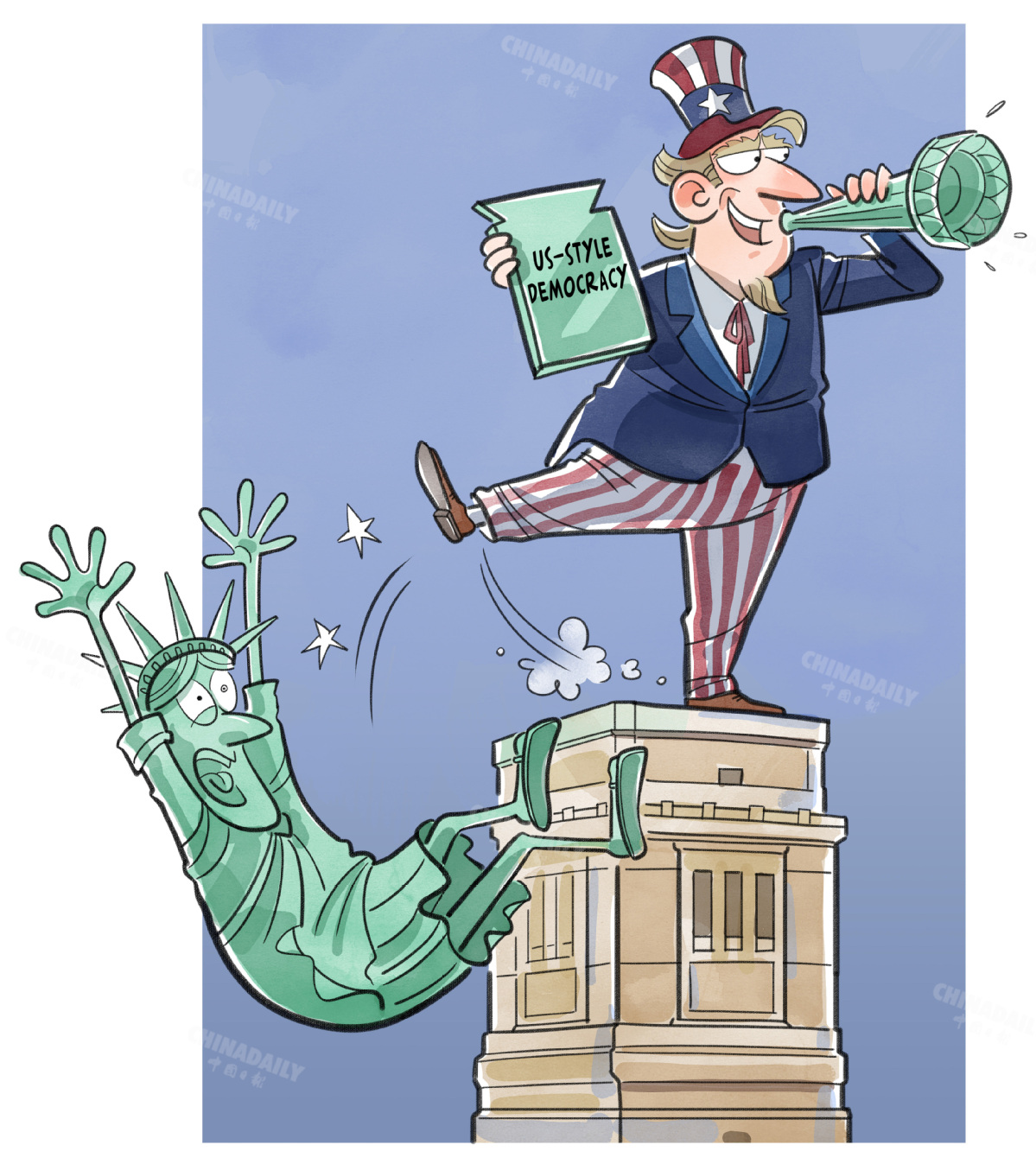
Editor's note: The so-called Summit for Democracy convened by US President Joe Biden reflects his dangerous Cold War mentality and will instigate confrontation and political division within the international community. The move by the United States to divide the world into "democratic" and "undemocratic" camps by using its own standard reveals its attempts to preserve its global hegemony. Two experts share their views on the issue with China Daily.
For decades after World War II, the world had been made to believe that Western democracy is the key to success of nationhood and is the bedrock of global governance. Following the collapse of the Soviet Union, Japanese-American political economist Francis Fukuyama even went to the extent of declaring Western liberal democracy as the ultimate form of government.
Nonetheless, the myth he propagated in his The End of History and the Last Man was short-lived because of China, a rising economic power with a different polity after its accession to the World Trade Organization in 2001. That its political system is different from Western-style democracy has not prevented its economic success despite all odds, including the United States trade wars and the COVID-19 pandemic. In fact, it was the only major economy to achieve positive economic growth in 2020.
While the world is in dire need of coordinated global cooperation in the face of global challenges, the global leadership supposedly provided by the reigning superpower is nowhere in sight; instead, it is putting global governance in disarray.
Over the years, the United Nations-based global governance has been hijacked by the reigning hegemon and its allies to serve their own interests. Yet some Western powers keep harping on the term "rules-based order" in their rhetoric, albeit the rules are interpreted according to their liking.
Even as the polarized world is still in the throes of the pandemic, multilateral global cooperation is being further fragmented with the ideological rift resurrected from the tomb of the Cold War. Ironically, this is done in the name of defending liberal democracy — the very form of democracy that the United States and the West profess and choose to propagate worldwide. US President Joe Biden made no bones about the binary choice he put forth to the world — Democracy or Authoritarianism?
All nation states are categorized unilaterally by the US as democratic or otherwise. The choice of invitee countries to Biden's first virtual Summit for Democracy in 2021 speaks volumes of the US criteria. Under the US geopolitical prism, democracy is nothing but a convenient tool of political expediency in rallying support for Washington to stigmatize Beijing amid the waning Pax Americana.
The old label of "authoritarianism" has been resurrected from the Cold War toolbox to alienate China from the international community. Democracy is being weaponized to isolate and insulate China, the biggest challenger to US primacy, from the rest of the world.
Nobody would ever deny that democracy is a shared value of humanity. It is a parameter for global governance. But there has never been a single model of democracy that suits all nation states. The model of "one size fits all" is simply impossible. Neither can democracy be a panacea for addressing all the woes of governance.
Yet the Western model of liberal democracy has been made the sole benchmark of democracy, and universal suffrage and a multi-party "one-man-one-vote" electoral institution have been touted as the cornerstone of democracy. With the global discourse power in hand, the West has successfully monopolized the right to interpret democracy worldwide. This made the world an easy target of the West's weaponization of democracy. Time and again, the Western powers have instigated "regime change" in countries that do not bow to their diktats. The US-led West ruthlessly overruns the sovereignty of countries, although the UN Charter explicitly states that no country has the carte blanche to impose its desired norms and policies on others with whatever justifications. As democracy is a parameter for global governance in the contemporary world, it is only fair that people of a country enjoy the right to choose their own mode of governance.
Repeated failures of Western-style democratic governments show the essence of democratic governance lies in not the installation of multi-party electoral system per se, but more in its inclusiveness — be it in the process of decision making or in policy formulation and delivery.
Parallel to this, the "one-man-one-vote" is not without flaws, more so when gerrymandering is becoming a collateral norm that has been tacitly deemed a necessary evil in the practice of electoral democracy. The discretional weightage attached to the demarcation of electoral boundaries is, by itself, a form of skewed democracy.
While the West placed due emphasis on the power of ballots in the name of practising "one-man-one-vote", the real participation of the electorate in shaping a nation's governance could hardly go beyond the electioneering process. The post-election policy formulation is almost the monopoly of the legislators, some of whom might be sheer novices bereft of experience and knowledge of public administration.
Having been deprived of the opportunities of participation, the electorate has, more often than not, had their aspirations ignored in favor of a partisan agenda, thus making the governance very much partisan. This explains why in many instances, legislators of some Western democracies choose to lock horns over petty partisan issues at the expense of the people's well-being and taxpayers' money. Filibustering in the American Congress is one of the glaring examples. By so doing, the legislature is reduced to a mere theatre of partisan power play, disconnected totally from the people at large.
On the other hand, the West, through its overwhelming dominance of international media discourse power, has never ceased to portray China as an autocratic state devoid of a Western-style multi-party electoral system with a "check-and-balance" mechanism. Yet the West appears clueless as to how a purportedly authoritarian government could command an overwhelmingly high level of public support for decades.
A survey report, titled "Understanding CCP Resilience — Chinese Opinion Survey Through Time", released in July 2020, perhaps serves to puzzle the West further. Its author, Edward Cunningham of the ASH Center for Democratic Governance and Innovation, Harvard Kennedy School, narrated in his finding that "since the start of the survey in 2003, Chinese citizen satisfaction with government has increased virtually across the board. From the impact of broad national policies to the conduct of local town officials, Chinese citizens rate the government as more capable and effective than ever before. Interestingly, more marginalized groups in poorer, inland regions are actually comparatively more likely to report increases in satisfaction."
Such a narration runs contrary to the predicted destiny of any "authoritarian rule" under the liberal democratic lens. The sheer arrogance and prejudices of the Western political elites against anything alien or non-Western have made them even less likely to accept any alternative form of democracy in the global political spectrum.
A case in point is the Chinese governance model which has never lacked people-centric elements of democracy. The West has been persistently turning a blind eye to the inherent provision of consultation in the Chinese model of governance, which is in stark contrast to the norm of majority rule in Western-style democracy. The latter may appear to have latitude for dissent, but the end result of its decision making is "winner takes all" regardless of the margin of majority. In contrast, the element of consultation dedicated to accommodating the minority views makes the Chinese model of "consultative democracy" even more inclusive in its practice.
The high approval rating of above 90 percent in favor of Chinese governance, as was reported by Cunningham in his survey, should rightfully be viewed as an overwhelming endorsement of the policy formulation and delivery system under the CPC rule. After all, in the practice of democracy, it is the choice of the people that counts. The level of people's confidence in governance is the best barometric measurement of how well their aspirations have been met in their respective countries. This certainly appears more democracy-compliant as compared to a mere form of electoral democracy in practice.
While the world ushers in a new era of multi-polarity, different governance models across the ideological and cultural spectrum are anticipated and should be accepted with generous latitude for tolerance and inclusiveness.
Amid the escalating aspirations and demands worldwide, we should be well poised to embrace a new mode of global governance characterized by the co-existence of different models of democracy. After all, democracy is no longer the monopoly of any nation state, be it the reigning hegemon or otherwise.
This is the edited version of the author's speech at the 2nd International Forum on Democracy in Beijing on March 23, 2023.

The views don't necessarily reflect those of China Daily.
If you have a specific expertise, or would like to share your thought about our stories, then send us your writings at opinion@chinadaily.com.cn, and comment@chinadaily.com.cn.