Molecular laboratory injects momentum in boosting crop production







By the time the Belt and Road Initiative was launched in 2013, Liu Gaoqiong, a professor from China's Nanjing Agricultural University, had spent 16 years in Kenya. Liu moved to the East African country in 1997 through the exchange program, "China-Kenya High Education Cooperation Project".
One of the important aspects of the BRI in the educational cooperation between China and Africa is the people-to-people connection in which educational exchanges are a crucial element. As such, Liu found himself well positioned to contribute to this aspect because since his arrival in Kenya, he had overseen several such collaborative projects to fruition.
In 1994, three years before Liu's arrival in Kenya, Nanjing Agricultural University and Kenya's Egerton University had jointly implemented the Sino-Kenya Higher Education Cooperation Plan and established a biotechnology laboratory and the Sino-Kenya Horticultural Technology Cooperation Center at Egerton University.
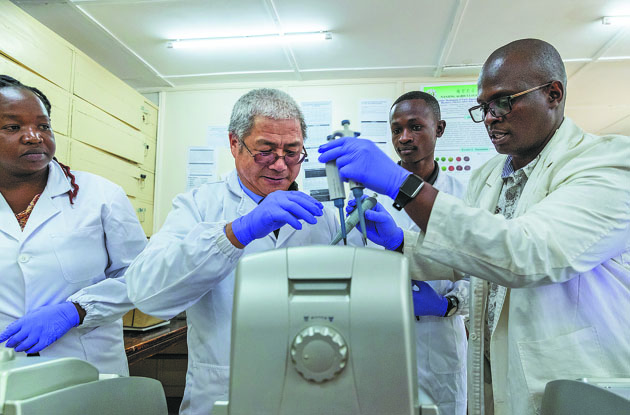
Since he is stationed at Egerton University's Department of Crops, Horticulture and Soils, Liu has helped in overseeing several exchanges of knowledge, students and lecturers between China and Kenya. However, the BRI brought in a wider perspective and more opportunities for collaboration and that is how the Kenya-China Joint Laboratory for Crop Molecular Biology at Egerton University was established in collaboration with China's Nanjing Agricultural University.
"During my early days at Egerton University, we introduced greenhouse technology to the department. Later on, we introduced biotechnology and the collaboration has grown to the point that we have now introduced the molecular biotechnology laboratory," Liu said.
The Kenya-China Joint Laboratory for Crop Molecular Biology at Egerton University began in 2019 with an aim to equip the lab with state-of-the-art facilities, train staff and students, engage in staff and student exchange programs, and engage in joint research and publications.
Liu said that they felt the need to establish the lab because by employing the latest advancements in technology, research becomes more effective and easier. He gave examples of cassava food products research currently being conducted by students at the lab as a testament to its importance in advancing agricultural technology while addressing food security and nutrition security in Kenya.
"We have PhD and master's degree students at the molecular lab who have successfully developed new varieties of cassava, beans, chickpeas, groundnuts and other products which are then distributed to farmers to improve their yields. The suitability and function of our cassava variety are being targeted at dry and semiarid areas to address food security," Liu said.
According to Richard Mulwa, professor of horticulture at Egerton University and director of the molecular lab, the establishment of the laboratory is a significant achievement and its potential to impact crop production in the region is immense.
"Earlier on, our research in terms of crop development was traditional and conventional but with molecular biology, we can select traits directly from DNA signals that we see could be responsible for particular traits. So instead of dealing with a whole plant observation in the field, we have reduced it to the molecular level where we do gene observation and isolation to get the traits we desire in the crops," Mulwa said.
Mulwa, whose partnership with Nanjing Agricultural University dates back to 1995, said he is proud to have witnessed the collaboration grows.
"Our partnership started with Chinese experts being sent to Egerton University as resident professors and moved to the exchange of PhD students from Egerton to study at Nanjing Agricultural University as part of our staff development. Currently, close to 50 percent of staff at Egerton's crops, horticulture and soils department have undergone higher studies in China," Mulwa said.
He added that the establishment of the lab was timely because most of the scientists who advance their knowledge in China have a place to come back to and apply the knowledge they have gained. In addition, the collaboration between Nanjing Agricultural University and Egerton has now expanded beyond the crops, horticulture and soils department to include other disciplines, such as agricultural engineering and agriculture economy.