From 'coal capital' to cultural magnet, historic city gains new life







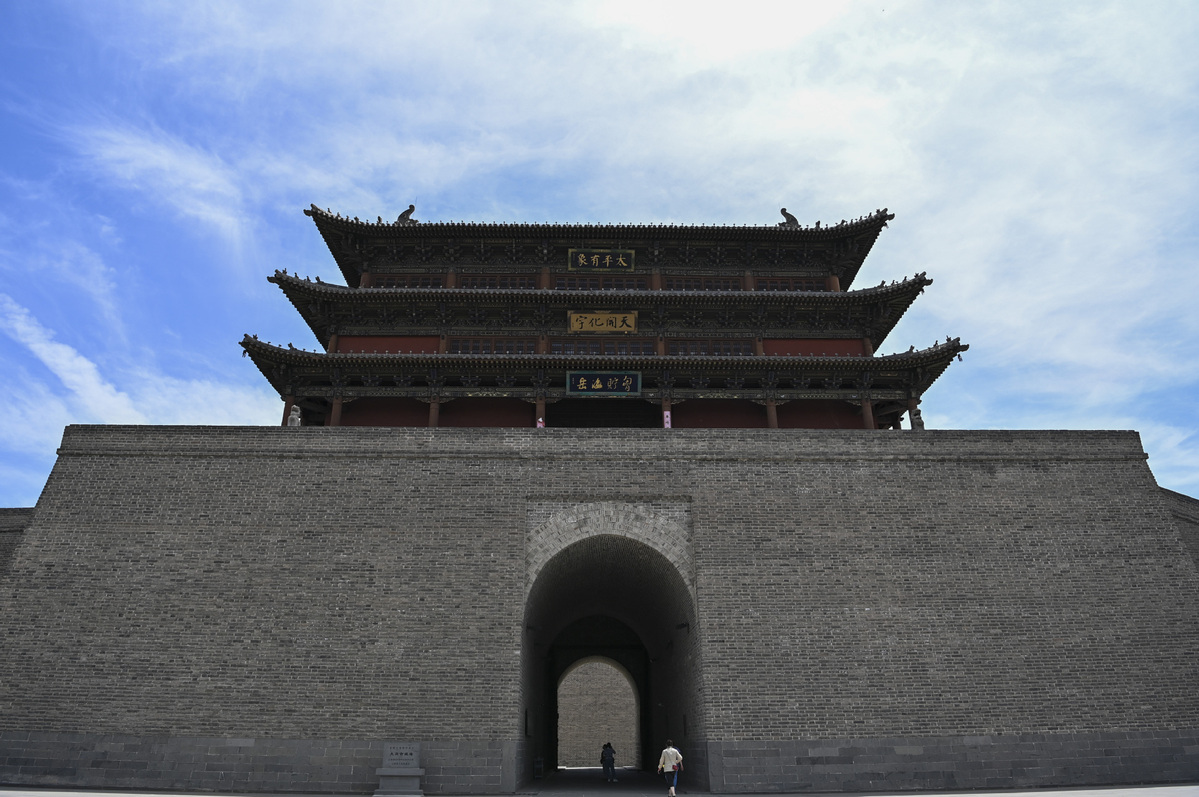
From a frontier land between agricultural communities and nomadic tribes to a major city in north China bearing the name "Great Harmony;" and from a coal-polluted industrial hub to a pristine tourist magnet with countless historical treasures, Datong spins a yarn of openness, resilience, and innovation.
Present-day Datong is a city in North China's Shanxi province that once powered China's economic take-off with a huge output of coal. It is now blazing new trails for growth by tapping into its 2,000-plus-year history and over 3,000 pieces of immovable cultural relics, amid a nationwide renewed interest in traditional culture. The changes have also impacted many locals' lives.
Riding a tourist boom of Datong, Lu Xin (stage name A Lang), a 36-year-old electrician-turned-singer, can afford to make writing and singing songs about the city his full-time job. Day in and day out, he draws inspiration from tidbits of his life in Datong, and more importantly, from the rich cultural heritage of the city.
Heritage
Sandwiched between two winding sections of the Great Wall, and situated at the easternmost tip of the Silk Road during the 5th century, Datong is destined to be a hub where diverse ethnic groups from north China, as well as Chinese and foreigners, can engage in cultural interactions.
Its distinct geography and history have contributed to the unique ethos of the city -- openness and inclusivity. Yao Zijin, a local culture specialist, said Datong stands as an epitome of the history of the multi-ethnic and unified Chinese nation coming into shape.
Two historical events set monumental examples for generations to come.
As early as 2,330 years ago, King Wuling, ruler of Zhao State where the modern-day Datong was located during China's Warring States Period (475 BC-221 BC), feared that the flapping robes Zhao commanders and soldiers wore could be a hindrance to military forces. The ruler initiated a military reform that is now encapsulated in a four-character idiom namely "Wearing the Hu-styled attire and shooting from horseback."
By adopting a much tighter attire that suited the horse-riding needs of nomadic ethnic groups (generally categorized as Hu back then) and training the calvary horseback archery, King Wuling's reforms greatly improved the fighting capabilities of the Zhao military. However, this change came with a fair share of pushback.
The event served as a curtain-raiser for greater interaction and mutual learning between different ethnic groups inhabiting the ancient Datong region. King Wuling's mausoleum is now a cultural heritage site in Datong.
Datong's ancient glory reached its apex when Pingcheng (an ancient name of the city) became the capital of the Xianbei-founded Northern Wei Dynasty (386-534). Rulers of the Xianbei ethnic group settled in the Datong region and decided to learn from Han Chinese by adopting their family names, speaking their language, and wearing Han-style clothing.
Nowhere are the signs of such mutual learning, blending and mixing more visible than in the Yungang Grottoes, a UNESCO World Heritage site featuring over 50,000 pieces of stone Buddhist sculptures in Datong, built largely during the Northern Wei Dynasty.
Architectures encompassing not only Chinese style but also featuring elements of Indian and even Greek design are found in the caves of Yungang. Sculptures that feature musical scenes in 24 caves offer a kaleidoscope of musical instruments ranging from Han Chinese style Zithers and flutes, horns of the Xianbei ethnic group, waist-affixed drums of the Qiuci State, to Persian style harps.
Yuan Xiaozhong, 55, has witnessed the vicissitudes the Grottoes survived in half a century. Born in the Yungang Village adjacent to the Grottoes, Yuan now heads the monitoring department of the research institute of Yungang Grottoes.
"By delving deeper into the Grottoes, I became increasingly convinced that the splendid Chinese civilization was jointly created by people from various ethnic groups. It was the mutual learning between different cultures that sustained and invigorated Chinese culture, and that is also the wellspring of our cultural confidence," he said.