China transforms extreme frontier to renewables belt







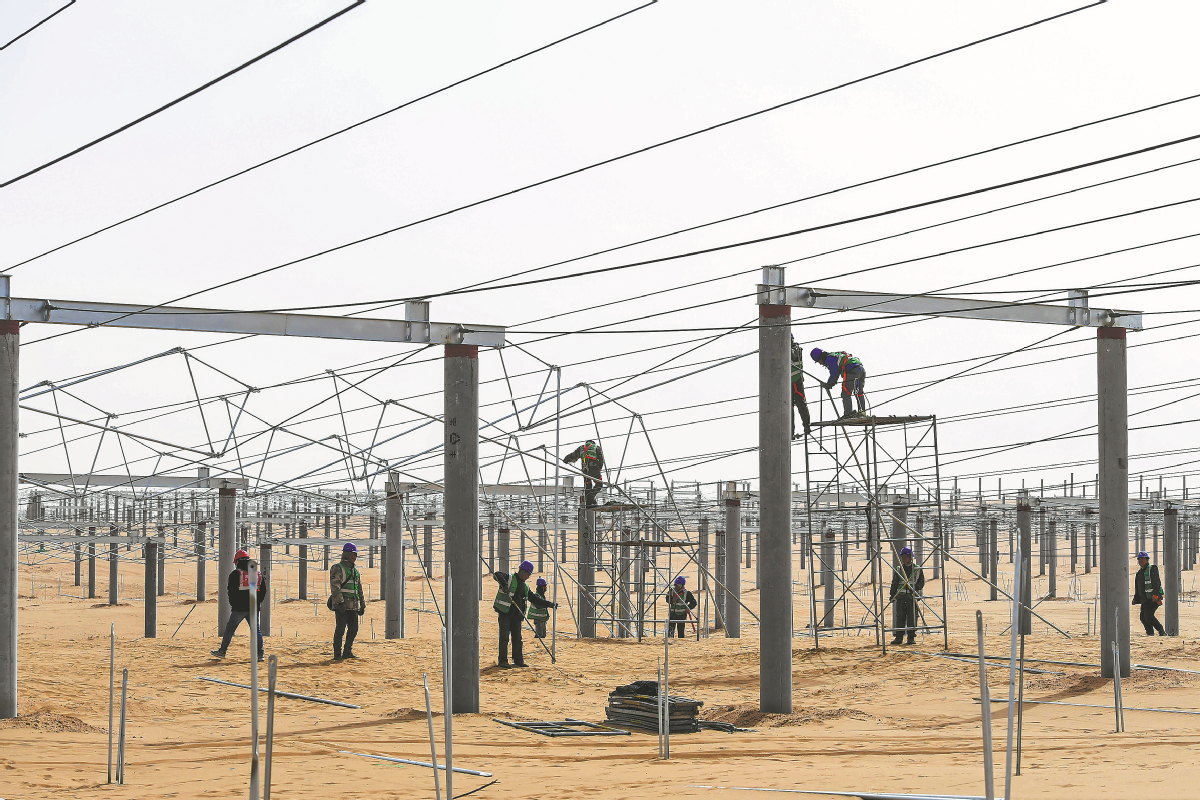
Mega solar, wind projects to supply power needs, reduce CO2 emissions
The Kubuqi desert, located in the Inner Mongolia autonomous region, has always been known for its severe heat and insufficient water sources.
Kubuqi — China's seventh largest desert that was earlier called "the sea of death" — and the Gobi region beyond, consisting of vast expanses of rocky mountains and sand dunes, however, hold out a promise.
Their large expanse of barren land rich in wind and solar resources makes it ideal for developing huge solar and wind power parks that can transform the desolate area into a bustling hub for renewable energy.
And, China is doing exactly that.
A mega solar and wind power base, jointly undertaken by China Three Gorges Corp and Inner Mongolia Energy Group, is currently under construction in the Kubuqi desert and is set to become the world's largest power generation base of its kind.
Designed with an overall installed capacity of 16 million kilowatts, the massive solar-plus-storage project will feature 8 gigawatts of solar power and 4 GW of wind power upon completion, as well as 4 GW of upgraded coal and 300 megawatts of energy storage capacity to support steady grid operation.
The capacity is equivalent to that of Baihetan, China's second-largest hydropower station, said Chen Shicheng from China Three Gorges Corp, who is in charge of the construction site.
Once complete, the project, with a total investment of $11.5 billion, will be able to transfer about 40 billion kWh of electricity to the Beijing-Tianjin-Hebei region every year, half of which will be clean energy, equivalent to saving about 6 million metric tons of standard coal and reducing carbon dioxide emissions by about 16 million tons, Chen said.
This is part of the country's efforts to achieve carbon peak and carbon neutrality goals under a new development philosophy.
By 2030, China's carbon dioxide emissions will peak, stabilize and then decline, and by 2060, China will be carbon neutral and will have a fully established green, low-carbon and circular economy.
China aims to gradually increase the share of consumption of nonfossil energy to around 20 percent by 2025, around 25 percent by 2030, and over 80 percent by 2060, according to a document released jointly by the Communist Party of China Central Committee and the State Council.
The country's carbon dioxide emissions per unit of GDP will be lowered by 18 percent from the 2020 level by 2025 and will have dropped by more than 65 percent compared with the 2005 level by 2030, according to the document.
Green energy push
The scenario is not unique to Kubuqi desert.
The Tengger desert, the fourth-largest in China situated to the west of the Kubuqi desert, stretches toward the Ningxia Hui autonomous region.
Here, the first phase of a photovoltaic power project with an installed capacity of 1 million kilowatts is nearing completion and will soon be operational.
The desert belt winds through several provincial-level regions including Inner Mongolia autonomous region, Xinjiang Uygur autonomous region, Ningxia Hui autonomous region, Qinghai, Gansu and Shaanxi provinces.
China's fight against desertification started decades ago.
In 1988, Elion Resources Group started combating desertification as part of China's greening efforts of the vast Kubuqi desert. The country's first solar project for sand control, with an overall planned capacity of 1,000 MW and operated by Elion, started generating power in 2016 in the Kubuqi desert.
Since then, China has continued to expand its renewable energy projects in the desert and Gobi region, with a particular focus on solar energy.
In 2021, China launched the first phase of wind and solar power projects of a total 100 gigawatts in desert areas that cover 19 provinces, according to a statement jointly released by the National Development and Reform Commission and the National Energy Administration.