Can Yellen's visit reduce the risk of de-risking?








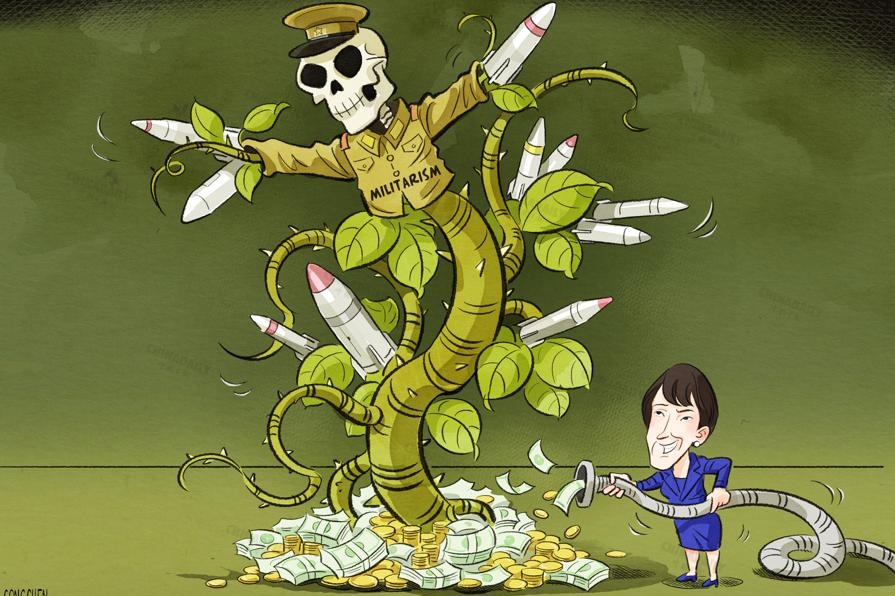
US politicians have begun advocating "de-risking" instead of decoupling with the Chinese economy as the United States has realized it is not possible to decouple the Chinese and US economies even during the three-year pandemic.
Also, the US' decoupling strategy has caused a deep sense of unease among the US business community as well as its allies, and it has become increasingly difficult for the US to convince its companies and foreign partners that it can handle its differences with China.
As US Secretary of Treasury Janet Yellen, who just concluded her visit to China, said, a full separation of the two economies would be disastrous for both countries and have a destabilizing effect on the rest of the global economy. In comparison, de-risking appears to be more moderate and reassuring to the US business community and US allies.
Will Yellen's visit to China and her talks with senior Chinese officials help reduce the risk and put bilateral ties back on track? By engaging in discussions with Chinese officials, Yellen tried to address economic and global issues of mutual concern, even though the US continues to impose high tariffs on Chinese goods and sanctions on Chinese entities, and restrict Chinese investment.
Not much is known about how US politicians intend to implement diplomatic and economic measures for de-risking, especially because de-risking is a term they have borrowed from the world of business. In essence, whether de-risking and decoupling are synonymous depends not only on what Washington says, but also on what it does. While Yellen's visit may help reduce the risk of misunderstandings and misjudgments on both sides, de-risking itself still carries risks.
The US has been complaining about the Chinese government distorting market rules to gain unfair competitive advantage. But in the semiconductor, clean energy and some other strategic manufacturing industries, the US no longer believes in the power and rules of the market and, instead, is trying to keep these industries within the country or attempting at "re-shoring" by offering them special subsidies and financial help.
Moreover, the US administration has adopted a strategy that could destabilize the global supply chains by trying to cut off China's supply chains in these industries through export control and investment restrictions. Such administrative interventions, which deviate from the rules of market economy, make the US' criticism of China sound hollow.
De-risking also involves strengthening the resilience of the US' supply chains. However, the US' goal is to break global supply chains rather than making its own supply chains more resilient, in order to gain a competitive economic advantage against China.
During her visit, while Yellen referred to so-called human rights issues in China, she conveniently ignored to mention human rights issues plaguing the US including racial discrimination and the widening gap between the rich and the poor.
The Joe Biden administration's diplomatic and economic policies toward China have not changed significantly despite US politicians claiming they do not want to decouple the Chinese and US economies and, instead, they are following a policy of de-risking. Although Yellen wants a positive breakthrough in bilateral relations and talked about managing differences, US National Security Advisor Jake Sullivan stressed the importance of national security in Washington's relations with Beijing. Hence, Yellen's claim of the US eschewing decoupling is likely just rhetoric.
In fact, the inconsistency in the language and practice of the de-risking policy reflects the US' confusion vis-à-vis its relations with China, and Washington's positioning and understanding of both itself and Beijing. On the one hand, as the impacts of the pandemic subside, the US' economic performance has prompted some policymakers to become optimistic about the country's long-term economic strength. This may suggest the current US policymakers, unlike those during the Donald Trump administration, do not consider China's perceived economic and ideological challenge to the US as something to be dealt with urgently through decoupling.
On the other hand, some US policymakers continue to voice concerns over the economic prospects of the US, saying the country's industrial base has been hollowed out. To compete with China, they say, the US needs to implement stronger industrial policies and align with its allies. They also plan to apply a "small yard and high fence" strategy against China in the field of cutting-edge technologies.
Therefore, one should be cautiously optimistic about the talks between the two countries at different levels. As former US president Theodore Roosevelt said, "Speak softly and carry a big stick — you will go far." It will take time to assess whether Yellen's visit can help improve Sino-US relations or whether she was just talking softly.
The author is an associate researcher with the Institute of American Studies, Chinese Academy of Social Sciences.
The views don't necessarily reflect those of China Daily.
If you have a specific expertise, or would like to share your thought about our stories, then send us your writings at opinion@chinadaily.com.cn, and comment@chinadaily.com.cn.