New Cambodian PM set to take legacy of Beijing policy







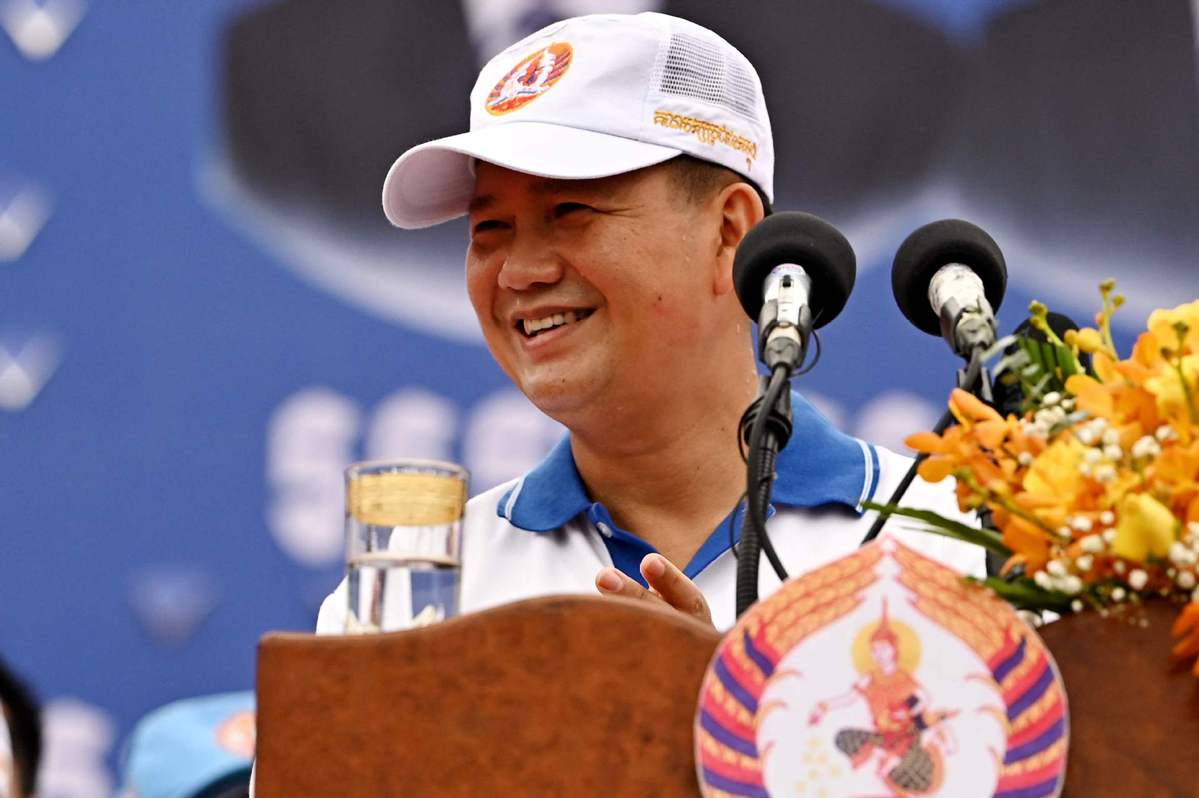
On Monday, Cambodian King Norodom Sihamoni endorsed army chief Hun Manet to succeed his father and long-serving prime minister Hun Sen as the country's leader after their Cambodian People's Party sealed a victory in the national election in July. Foreign media and the diplomatic community will keep an eye on Cambodia's foreign policy to determine which direction the country is taking, especially its China policy, under the leadership of Hun Manet.
Some commentators have said that the fact that Hun Manet studied in the United States Military Academy at West Point, New York, and earned his PhD in economics from the University of Bristol, United Kingdom, suggests Cambodia's foreign policy may tilt toward the West. But the guiding principles of the country's foreign policy are not based on the leader's educational background but on Article 53 of the Constitution, which affirms Cambodia's commitment to permanent neutrality, non-alliance and peaceful coexistence.
The ruling Cambodian People's Party has set seven core principles for the next five years for the country's foreign policy, which include opposing force, disapproval of unlawful occupations, non-interference in the domestic affairs of other countries, prohibition of foreign military presence in Cambodia, and refusal to endorse invasions of other countries.
As a post-conflict nation, Cambodia attaches great importance to peace and stability, both domestically and regionally, and is committed to promoting development and prosperity, and preventing any interference in its relations with other countries.
China is a major country that has always supported the Cambodian people's independent choice of development path, the path best suited to their national conditions, and backed them in defending Cambodia's sovereignty and national security. It also supports the Cambodian people in advancing their major domestic political agenda and socioeconomic development, and opposing external interference in Cambodia's internal affairs.
In this context, Hun Manet is likely to maintain the current policy toward China, which is based on traditional friendship, mutual trust and win-win cooperation. And he is unlikely to change the policy of close cooperation between the ruling parties and governments of the two countries, strengthening the comprehensive strategic partnership of cooperation, and jointly building a high-quality, high-level and high-standard Cambodia-China community with a shared future for mutual benefit, thus contributing to peace, stability and prosperity in the region and beyond.
Hun Manet is also expected to continue socioeconomic reforms, including reforms in the education and healthcare sectors, increase trade and investment within the frameworks of the Association of Southeast Asian Nations, the Regional Comprehensive Economic Partnership and free trade arrangements, especially with China and the Republic of Korea.
Cambodia also has opportunities for opening up its economy through the Belt and Road Initiative, which identifies it as a transport and logistics hub between Vietnam, Cambodia, Malaysia, Thailand and other ASEAN member states.
It also has opportunities for greater international exposure and using networks to boost trade and better safeguard national security through multilateral organizations such as BRICS, the New Development Bank and the Shanghai Cooperation Organization. These organizations and institutions offer access to large networks for trade and investment, cross-border exchanges and security-related issues.
Also, cooperation on military training, equipment supply and combat readiness with China's People's Liberation Army will remain important, as will naval security over the Gulf of Thailand.
While the "old guard" of Cambodia carries a lot of scars from the Cold War, the "young leaders" are faced with diminishing returns from the country's relations with Western economies, especially because, despite trade with the European Union and the United States rising over the past years, China remains Cambodia's largest trading partner and primary source of investment.
Hun Manet and his youthful new administration are well aware of the recessionary troubles afflicting both the EU and the US, and know the economic incentives of maintaining close ties with China. Tourism is slow to recover from the impacts of the three-year COVID-19 pandemic, while Chinese investments are focused on sustainable, greener projects. That's why many officials in Phnom Penh now seek to diversify trade and investment toward sustainable value-added processing and manufacturing to meet the burgeoning needs of ASEAN's expanding middle class.
Despite the post-pandemic effects, the spillover effects of the Ukraine crisis and recessionary trends in the EU and the US that have affected its housing, tourism and garment sectors, the Cambodian economy remains robust. High on Hun Manet's agenda will be issues such as building on Cambodia's RCEP and ASEAN membership and the FTAs with China and the ROK to continue his father's legacy of political stability and relatively high economic growth of 7 percent a year during his term.
The comprehensive strategic partnership of cooperation, ironclad friendship, the building of a Cambodia-China community with a shared future and the hexagonal cooperation framework are the greatest legacy of Hun Sen in Cambodia-China relations, which Hun Manet needs to take forward. The healthy and stable relationship between China and Cambodia is both important and necessary to deepen practical cooperation in various fields.
The Cambodian People's Party victory in the national election highlights the unchanged support of the Cambodia people for the party for three decades, creating a favorable situation for the party to run the government and implement the domestic and foreign policies without any hitch.
The author is the director-general of the International Relations Institute of Cambodia, Royal Academy of Cambodia and chairman of the Technical Committee of Political Science Terminology of the National Council for Khmer Language.
The opinions expressed here are those of the writer and do not necessarily represent the views of China Daily and China Daily website.
If you have a specific expertise, or would like to share your thought about our stories, then send us your writings at opinion@chinadaily.com.cn, and comment@chinadaily.com.cn.