Consumption and innovation drive China's local GDP growth, economic upgrade







NANJING/LHASA -- China's overall economic growth accelerated in the first half (H1) of this year as its service sector rebounded, and traditional industries achieved upgrades through innovation.
In late July, all 31 provincial-level regions of the Chinese mainland published their H1 GDP figures and other key economic indicators. The economic aggregates of 20 regions each exceeded one trillion yuan (about 140 billion U.S. dollars), indicating the robust resurgence and swift recovery of the economy.
Nearly 50 percent of the regions achieved a higher year-on-year GDP growth rate than the country's 5.5 percent increase, with Shanghai, Hainan and Tibet emerging as the frontrunners. Meanwhile, China's economic powerhouses Guangzhou and Jiangsu were the top two GDP generators, each exceeding 6 trillion yuan for the first time.
Industry experts noticed an emerging trend as China's service sector rebounds at a swifter pace than its secondary industry, signaling that its economic structure has bifurcated in reverse.
Customarily, China's secondary industry has grown at a faster pace than the tertiary industry. During the first six months of 2023, the country's tertiary industry increased by 6.4 percent year on year, the most robust among the three industries.
With culture and tourism as its core, the consumption-driven service industry significantly propelled the H1 GDP rise; the traditional manufacturing sector sought technological upgrades through innovation, whereas innovative and emerging industries became new pillars in most provincial-level regions.
Consumption and innovation have therefore become keywords for the encouraging half-yearly local GDP reports and major growth engines in China's local economic development.
CONSUMPTION-FUELED SERVICE SECTOR
Culture and tourism consumption, mainly led by the accommodation and catering sector, contributed considerably to the GDP growth of many regions, including southwest China's Tibet Autonomous Region.
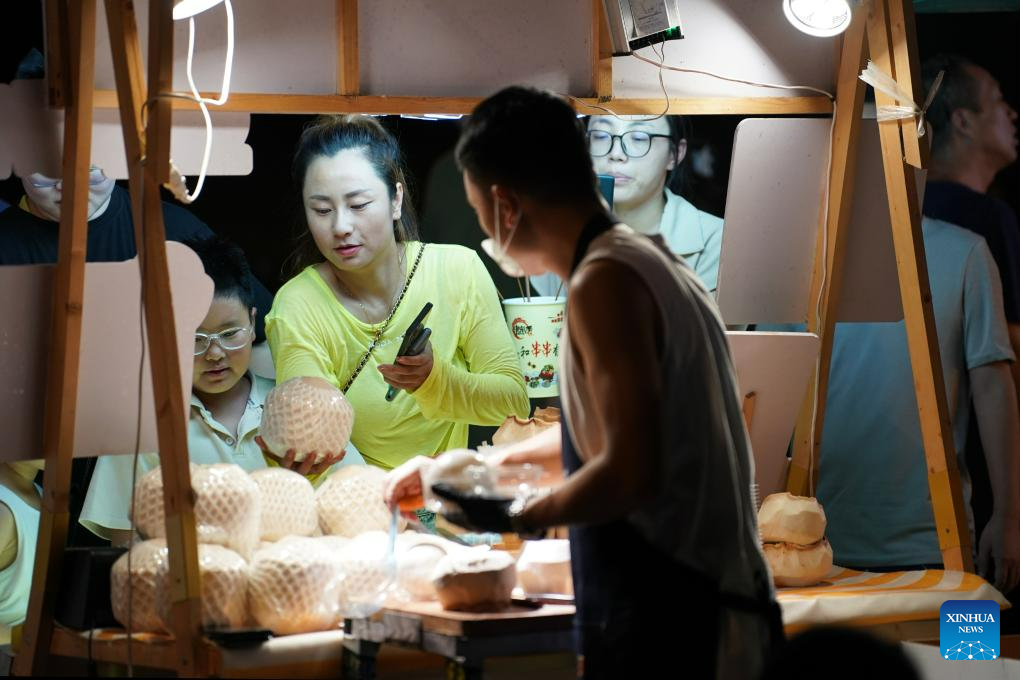
The viral videos on social media consistently depict the extensive queues that often form during holidays at China's picturesque attractions, gourmet restaurants and shopping centers.
Data from the National Bureau of Statistics show that in H1 of this year, China's accommodation and catering industry grew by 15.5 percent year on year; information transmission, software and information technology services by 12.9 percent, and leasing and business services by 10.1 percent, grabbing the top three spots in terms of growth rates among all the sectors of the national economy.
These growth figures are impressive as well as tangible.
The National Highway 318 linking Tibet and neighboring Sichuan, known for steep mountains and rugged terrain, has been bustling with travelers and adventure lovers, while obtaining tickets to visit the iconic Potala Palace and other prominent tourist sites has unexpectedly become more challenging.
Anticipating significant business prospects on the horizon, locals in Poma Village in Tibet's capital city Lhasa have refurbished their houses into Tibetan-style homestays for tourists, resulting in substantial gains for the local community and simultaneously boosting the market for farm produce.
From January to May, the operating revenue of the major service enterprises in Tibet reached nearly 8.5 billion yuan, up 10.6 percent year on year.
The service industry played a prominent role in Tibet's economic growth in the first half of the year. Economic activities centered around retail foot traffic and logistics are showing robust vitality, consequently propelling the growth of related service industries, according to Thubten Khedrup, director of the Tibetan Economic and Cultural Research Center of Tibet University.
"The most important contribution to growth in 2023 will come from consumption and investment, or in other words, the domestic demand," said Zhang Yueyou, a researcher with Yangtze Industrial Economic Think Tank. "Consumer spending is expected to contribute more than 70 percent of economic growth."
INNOVATION-DRIVEN INDUSTRIAL UPGRADE
"China's cultivation of emerging industries has also spurred the country's economic pickup, which has effectively offset the decline of overseas market demand for the traditional manufacturing sector," said Ding Hong, a researcher with the Jiangsu provincial government's advisory office.
Several Chinese manufacturing bases have relied more on emerging technologies to optimize their industrial structure.
Led by new technologies, industries, business models and patterns, many regions, including east China's Shandong Province, saw an upward momentum in investment and added values in relevant industry segments during the first six months.
China's manufacturing hub Jiangsu exemplifies this trend. Nearly one-half of the total value of its major industrial enterprises during the period was contributed by its high-tech industry, while 41.1 percent came from emerging sectors of strategic importance.
Among the total, the added value of new energy vehicles, photovoltaic equipment and components, and lithium-ion battery manufacturing grew by 86.5 percent, 36.9 percent and 28.8 percent, respectively. These three sectors accounted for over one-fifth of the total added value increase of Jiangsu's major industries, said Wang Xuemin, director of the industrial statistics department of Jiangsu provincial statistics bureau.
In the premises of Jiangsu General Science Technology Co., Ltd., a tire manufacturing facility located in Wuxi City, full 5G coverage has been implemented across its workshops, enabling real-time instructions to machinery via intelligent operating systems.
Li Jun, from the company's equipment department, explained how they once grappled with limited automation and excessive energy consumption but the tides have turned, and efficiency now reigns supreme.
With the support of China Mobile, the company's workshops can operate safely around the clock, independent of lighting conditions, all thanks to a seamless intelligent upgrade.
China is currently experiencing a robust wave of digital transformation and smart manufacturing implementation. Data shows that the country's industrial internet has recorded a scale of more than 1.2 trillion yuan, with over 2,100 digital workshops and smart factories put into use. The integration of 5G technologies and the industrial internet is shaping a new era for China's digital economy.