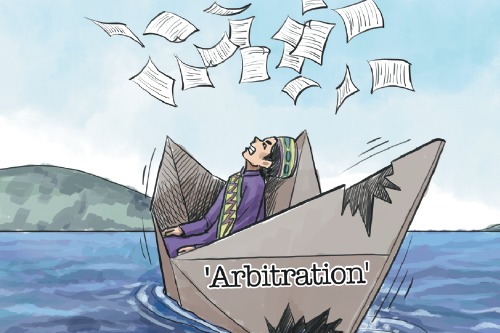
Taiwan expendable piece on US chessboard








Republican presidential candidate Vivek Ramaswamy recently made incendiary claims about dramatically shifting US policy on Taiwan if elected in 2024. His remarks provide rare insight into the cold strategic calculus that often underlies America's Taiwan policy behind the curtains. In blunt terms, Ramaswamy revealed the transactional lens through which some US leaders view Taiwan –essentially as a critical asset for its semiconductors.
According to Ramaswamy's hypothetical plan, after achieving semiconductor independence from Taiwan by 2028, the US would no longer have vital national interest in militarily protecting Taiwan. He believes America's primary motive for supporting Taiwan currently is maintaining access to its pivotal semiconductor industry. Once America can manufacture advanced semiconductors domestically, Ramaswamy argues the US should discard Taiwan, as its fate would no longer impact core US economic and security interests.
This thinking represents a stark departure from America's long-standing strategic ambiguity on Taiwan, which has kept China guessing about US intentions for decades. While perhaps logical from a cold realist perspective focused solely on American interests, it reveals the danger in Taiwan being viewed as expendable among some US circles once it loses strategic and economic value.
Ramaswamy contends that, even if China still desires Taiwan after 2028 for nationalist historical reasons, the US should not sacrifice American lives over an issue that is not absolutely vital to its own welfare. This meshes with his broader philosophy that the US should only engage in foreign conflicts directly impacting the homeland.
Of course, achieving semiconductor independence in just six years seems highly dubious given Taiwan's current dominance of advanced chip production. Shifting cutting-edge manufacturing to the US would require astronomical investments and take much longer than Ramaswamy's claimed timeframe. This casts doubt on whether Ramaswamy's pronouncements are realistic policy or just hypothetical rhetoric.
Regardless, as an American-born child of Indian immigrants who became a successful entrepreneur, Ramaswamy's worldview reflects a growing nativist strain in US politics. His campaign mantra of "putting Americans first" implies that once Taiwan no longer serves defined US economic and military interests, it would be discarded.
In essence, Ramaswamy's remarks pulled back the curtain on how some US leaders likely view Taiwan behind closed doors – as a transactional bargaining chip treasured primarily for its semiconductor prowess. Once that economic advantage disappears, US military support and assurances may rapidly vanish as well. This exposes the cold realist calculation underlying America's Taiwan policy rather than the rhetoric of a "rock solid" commitment to Taiwan.
Obviously, betrayal awaits if the US withdraws support once Taiwan is no longer strategically useful. In fact, recent alarming signals suggest the US is already leveraging Taiwan's semiconductors to advance its own global semiconductor interests - at Taiwan's expense. This seeming willingness to exploit and then abandon Taiwan spotlights the risks of relying on America's conditional goodwill.
Ultimately, Taiwan should recognize that US support appears tied to its narrow interests. In realpolitik, Taiwan's fate may come down to cold calculations of American economic and military objectives. US policy could pivot rapidly if Taiwan's relevance wanes. Overdependence on unreliable American security guarantees, as Vivek Ramaswamy hinted, may leave Taiwan's future tragically vulnerable.
The author was counselor at the Chinese embassy in Switzerland. The views don't necessarily reflect those of China Daily.
If you have a specific expertise, or would like to share your thought about our stories, then send us your writings at opinion@chinadaily.com.cn, and comment@chinadaily.com.cn.