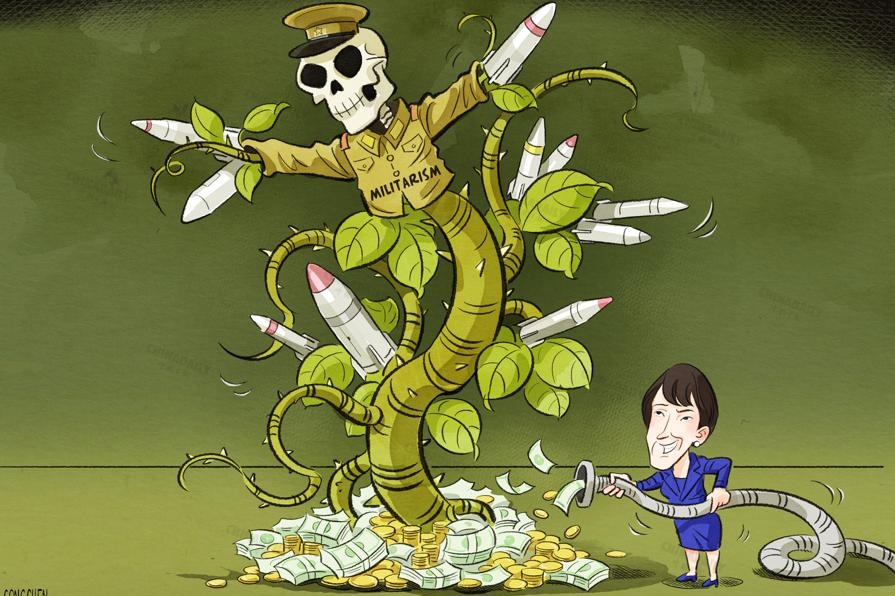
Japan should abide by treaty of peace and friendship








This year marks the 45th anniversary of the signing of the Treaty of Peace and Friendship between China and Japan, which says that "the Contracting Parties shall develop durable relations of peace and friendship … on the basis of the Five Principles of Peaceful Co-Existence; The Contracting Parties affirm that in their mutual relations, all disputes shall be settled by peaceful means without resorting to the use or threat of force; The Contracting Parties shall endeavor to further develop their economic and cultural cooperation and to promote exchanges between the people of the two countries".
The treaty also says that neither of the parties should seek hegemony in the Asia-Pacific region or in any other regions, and that both will oppose efforts by any other country or group of countries to establish such hegemony.
The treaty is the legal foundation for the peaceful coexistence of, and mutually beneficial cooperation between, China and Japan.
But by deciding to dump the nuclear-contaminated water from the damaged Fukushima Daiichi Nuclear Power Plant into the sea, Japan is violating the spirit of the treaty, for its action will contaminate the oceans, dealing a blow to China's fishing and other industries and threaten the livelihoods of millions of people.
The signing of the treaty coincided with the launch of reform and opening-up by China. At the beginning, the Japanese government and people supported China's development due to the two countries' high economic complementarity.
During that time, although the two sides faced problems emanating from historical issues, such as the dispute over the sovereignty of the Diaoyu Islands, Tokyo's relations with the Taiwan authorities and the trade imbalance, Tokyo and Beijing tended to solve the problems through talks and consultations, without letting them seriously affect their overall bilateral relations.
But from the end of the Cold War to 2010, Sino-Japanese relations underwent changes due to headwinds created by the "redefinition" of the Japan-US alliance, former Japanese prime ministers visiting the Yasukuni Shrine, which honors war criminals including 14 class-A war criminals, the boat collisions in the waters off the Diaoyu Islands, and the Japanese government signing a "purchase contract" on the Diaoyu Islands with their so-called owners and officially "nationalizing" them, and other factors.
Since 2010, bilateral relations have become even more complicated. The two sides had differences and disputes, especially over strategic and political policies, even earlier, but they agreed to maintain normal and beneficial trade relations. But despite benefiting from their technological and economic complementarities, the two sides couldn't bring the two peoples closer through their frequent cultural exchanges.
Today, an increasing number of Chinese and Japanese people view each other's country negatively. Worse, Japanese right-wing forces, by hyping up the "China threat" theory, have forced many Japanese people to believe China indeed poses a "security threat" to Japan, with Japan's increased defense budget further widening the emotional gap between the two peoples.
As such, the treaty today faces perhaps the biggest challenge in its 45-year history. Japan should therefore adhere to the treaty without allowing its shifting diplomatic strategies to undermine it, in order to promote common development.
Japan has intensified its diplomatic activities since passing the Economic Security Promotion Act last year, apparently to safeguard its economic security but in reality to "decouple" from China economically. It also is strengthening its alliance with the United States and rebuilding regional and global supply chains under the "Indo-Pacific Economic Framework for Prosperity".
As part of the US' "Indo-Pacific" strategy, Japanese Prime Minister Fumio Kishida and Republic of Korea President Yoon Suk-yeol held a meeting hosted by US President Joe Biden at Camp David in Maryland, on Aug 18. The three leaders discussed how to turn the US-Japan alliance and the US-ROK alliance into one comprehensive US-Japan-ROK alliance, ostensibly to strengthen deterrence against the Democratic People's Republic of Korea, but in reality to check China's peaceful rise, which does not augur well for the Asia-Pacific region.
By promoting the "Indo-Pacific" strategy, Japan is actually helping the US to maintain its hegemony in the region, which violates the treaty it signed with China 45 years ago.
However, despite its best efforts, Japan may not succeed in its attempts to decouple from China, or to check China's rise, because the two countries' industry, supply and value chains are intertwined and play an important role in the global economy.
The supply chains of every country, especially Japan's, are intertwined with those of China. No wonder trade cooperation serves as the ballast of Sino-Japanese relations. Bilateral trade and investment have yielded huge mutual benefits for the two sides. While Japan's foreign direct investment in China exceeds $120 billion, China is Japan's top trading partner and Japan China's second-largest trading partner. And according to Oxford Economics, the average return on Japanese FDI in China from 2015 to 2020 was 15 percent a year on average.
China is promoting high-quality development and opening-up, and building a market-oriented business environment based on law while urging Japanese companies to increase their investments in China. But instead of capitalizing on the opportunities, Japan is busy trying to counter the Belt and Road Initiative.
There is hardly a country today that doesn't face challenges, but many of those are common challenges such as climate change. This means China and Japan can use the complementarity of their industry chains, and cooperate in the fields of environmental protection, green development, healthcare and eldercare to achieve common development.
Japan should abide by the principles of the treaty and make rational decisions for the common interest of the two peoples and the people in the rest of the Asia-Pacific.
The author is a professor at the Beijing Center for Japanese Studies of Beijing Foreign Studies University.
The views don't necessarily reflect those of China Daily.