

China's 1st 'zero-altitude' astronomical observatory put into use
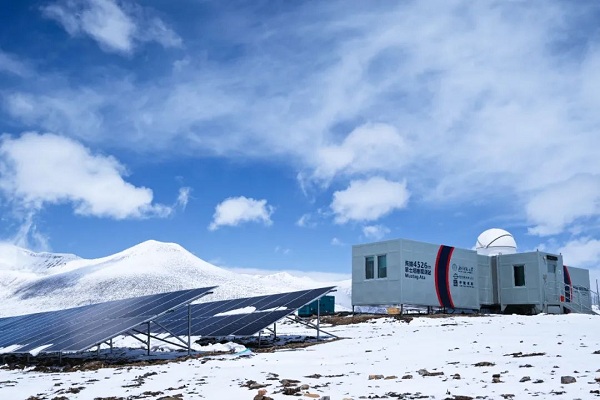
China's first "zero-altitude" astronomical observatory begins operating. [Photo/WeChat account of Optics Valley of China]
China's first "zero-altitude" astronomical observatory, the Muztagata Astronomical Observatory, was recently used in the Xinjiang Uygur autonomous region. The observatory building was independently developed and constructed by China Construction Third Engineering Bureau Group Co and will continue to support high-altitude scientific research.
The company is based in the East Lake High-tech Development Zone (also known as Optics Valley of China, or OVC).
The observatory, with a total construction area of around 150 square meters, is located near the Kunlun Mountains' third highest peak, the Muztagata Range, making astronomical observation, lodging, and administrative tasks feasible.
Using this observatory, astronomers will conduct observations and research in fields such as cosmology, star formation and evolution, galaxies, and active galactic nuclei. Furthermore, they are expected to carry out high-resolution optical imaging observations, taking advantage of the excellent atmospheric visibility conditions around the observatory.
"The atmospheric pressure and oxygen concentration at the mountaintop is only about 55 percent of that on the plain," said Ye Zhiwu, deputy director of the High-Altitude Human Settlement Engineering Research Center at the China Construction Institute of Advanced Technology.
"This means that astronomers working in such high-altitude areas will be exposed to a harsh environment with low pressure, low oxygen concentrations, low temperatures, and strong ultraviolet radiation," he added.

High-altitude areas feature low pressure, low oxygen concentrations, low temperatures, and intense ultraviolet radiation. [Photo/WeChat account of Optics Valley of China]
To help address the problem, China Construction Third Engineering Bureau Group Co worked with Beijing Normal University and Xinjiang Astronomical Observatory of the Chinese Academy of Sciences, and developed the observatory building using the pressurized-enclosure technology. Researchers in the buildings will feel like being in the zero-altitude areas, hence the observatory's name.
The architectural blueprint of the building was meticulously crafted to optimize the productivity and well-being of scientific professionals, particularly those who spend prolonged periods at the observatory.