Japan's toxic water release violates international law







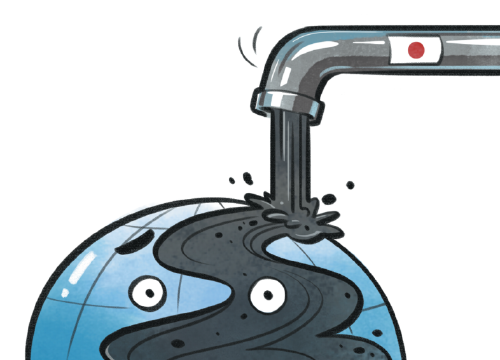
Tokyo Electric Power Company, the operator of the damaged Fukushima Daiichi nuclear power plant announced that the first-round of the release of "treated and diluted water" has been completed shortly after noon on Monday.
Japan began discharging the nuclear-contaminated water from the damaged Fukushima nuclear power plant on Aug 24, drawing widespread criticism from across the world because the water contains non-degradable radioactive elements which could harm the marine environment and ecology, and human health.
To deal with the radioactive water accumulated in the Fukushima plant, Japan formed the subcommittee on the handling of ALPS-treated water. The subcommittee suggested in 2020 report that the sea-discharge and vapor-release methods were the most practical ways of disposing of the radioactive water. However, the subcommittee suggested ocean discharge only as a viable method, not as a definite choice.
The United Nations Convention on the Law of the Sea includes provisions for the protection and conservation of the marine environment. Article 192 of the UNCLOS stipulates the general obligations of states to protect and preserve the marine environment, while Article 194 specifically addresses issues related to nuclear pollution. The first paragraph of Article 194 says it is the obligation of the states to exercise "due regard" when disposing of radioactive materials, while the second paragraph says the states are obligated to prevent trans-boundary environmental damage.
The obligation to exercise "due regard" does not guarantee an absence of pollution (resultant obligation); instead, it requires minimizing pollution through the most practicable means (behavioral obligation). And the "Trail Smelter Arbitration Case" (1941) says the standard of the exercise of "due regard" should be proportionate to the risks of transboundary harm based on a case-by-case assessment.
The subcommittee suggested the ocean discharge option for several reasons: most nuclear facilities in the world discharge wastewater from nuclear power facilities into the ocean after treating it to remove nuclides such as tritium; the dispersion of tritium in ocean discharge is easier to predict and monitor compared with other methods; and the International Atomic Energy Agency deems ocean discharge feasible and in line with international norms.
As a result, Japan assumes that by dumping the radioactive water from the Fukushima facility into the sea, it will not violate its obligations under international law.
But the radioactive water Japan is discharging into the ocean after "treating" it using the Advanced Liquid Processing System still contains various non-degradable radioactive elements (such as carbon-14 and tritium), and about 70 percent of the water does not meet ocean discharge criteria. This is different from the almost radioactive isotope-free wastewater nuclear power plants normally discharge into the ocean.
In fact, Japan's action goes against one of the fundamental principles of international nuclear safety, the principle of justification, which requires the overall "benefits" of the discharged wastewater to outweigh the risks. Therefore, by dumping the radioactive water into the sea, Japan has violated the erga omnes (toward all) obligation.
Also, the assessment report of the IAEA lacks persuasiveness and authority. Japan asked the IAEA to conduct a safety assessment after deciding to discharge the water to ensure its safety. But the assessment was based on data and information provided solely by Japan, and only a small number of water samples were analyzed by the IAEA. The authenticity and accuracy of the data and information, as well as the independence of the sampling process, are questionable. And anyway, the IAEA assessment lacks sufficient persuasive power.
Additionally, the IAEA assessment report was published in the name of the agency's director-general and thus it is not an endorsement by the IAEA's Board of Governors or General Conference. Therefore, its conclusions only serve as reference, not as recommendation.
The environmental impact assessment (EIA) plays an important role in concretizing "due diligence" in procedural terms. The EIA is not only regulated by Article 206 of the UNCLOS but also has become customary international law in practice, thus constituting an obligation that must be fulfilled.
As for the dumping of the nuclear-contaminated water into the sea, it falls under the category of pollution originating from land, as defined by Article 207(1) of the UNCLOS, which stipulates that the states should follow internationally agreed rules, standards, recommended practices, and procedures to establish laws and regulations to prevent, reduce and control pollution from land-based activities. The obligation to conduct an EIA is customary in international law.
Since there is no legally binding emissions regulation and standard with regard to pollution originating from land at the international or regional level, the rules of international law on land pollution depend largely on the discretion of the states that have jurisdiction over the activities.
Article 197 of the UNCLOS stipulates the obligation of cooperation. The International Tribunal for the Law of the Sea has interpreted the content of this obligation in its interim measures. From a preventive perspective, this obligation includes three aspects of consultation — consultation on the exchange of information regarding the results generated by activities; consultation on monitoring of hazards and impacts; and consultation on measures to prevent marine pollution. Therefore, Japan should have consulted other countries, especially neighboring countries, as well as the IAEA before deciding to dump the radioactive water into the sea.
Moreover, since Japan's dumping of the radioactive water into the sea water involves many aspects, Japan should have consulted with international organizations before going ahead with its 30-year water discharge plan.
Japan has failed to fulfill its obligations under international law, both before and after it began discharging the radioactive water into the sea. For example, it didn't study all the feasible methods the experts had suggested to dispose of the radioactive water, or issue timely notices on its discharge plans.
Japan has also failed to fulfill its obligations under international treaties. In essence, Japan has exploited the gaps and loopholes in the international legal system to discharge the radioactive water into the sea, posing a risk to the entire marine ecosystem. This should be stopped, and states and international organizations should use legal means to resolve the issue and hold Japan accountable.
The author is a professor at the Institute for China's Ocean Security, Ocean University of China, and a senior researcher at the Institute of Ocean Development, Ocean University of China. The views don't necessarily reflect those of China Daily.
If you have a specific expertise, or would like to share your thought about our stories, then send us your writings at opinion@chinadaily.com.cn or comment@chinadaily.com.cn.