Farmers reap fruits of BRI collaboration







Editor's note: Uniting continents, transforming lives and imagining a sustainable future on a collective front, the Belt and Road Initiative has demonstrated it is a broad way for China and the world to seek common prosperity. This page highlights the initiative's power of collective efforts in making strides toward sustainable development and tackling global challenges.
Joint research and latest technology transform Kenya's agriculture
"Knowledge shared is knowledge squared," according to an African proverb, implying that once knowledge multiplies it becomes useful to future generations.
By January last year Anna Wanjiku had given up on a tomato greenhouse on her 2-hectare farm in Nakuru County, in southwest Kenya.
The tomatoes, plagued by a disease caused by soil-borne bacteria, ended up delivering her minuscule harvests, and it was impossible for the project to turn a profit.
Things turned around a year ago when lecturers in the faculty of agriculture at nearby Egerton University approached her offering help in dealing with plant diseases through technology developed at Nanjing Agricultural University in China.
Wanjiku has been a beneficiary of the collaboration between the two universities after receiving improved bean seeds developed at a joint research laboratory at Egerton and established through collaboration with the Nanjing university.
The seeds, named Chelalang beans, can be planted during both long and short rain seasons and are tolerant to root rot disease and high soil acidity.
Having improved her beans yield from working with the joint laboratory, Wanjiku did not hesitate to offer her farm to be used as a demonstration center for teaching other farmers how to use technology to manage bacterial wilt disease.
With the help of Nanjing Agricultural University and Egerton University her dilapidated green house was refurbished and later used as a field classroom to educate students, local farmers and county agricultural officers on how to graft tomato scions onto disease-resistant rootstocks. This has enabled local farmers to improve their yields, reduce crop damage and minimize the need for imported pesticides.
"The university approached me about the collaboration on the demonstration village, and I felt what they were planning was going to benefit me and farmers around here," Wanjiku said. "Our area is fertile and receives good rain, and what most farmers lacked was the right technology.
"With the cooperation we have with the university our harvest will be better, and I'm sure many farmers will be able to earn a reasonable living from their farms. We will benefit economically because the crops take a short time but there is more produce."
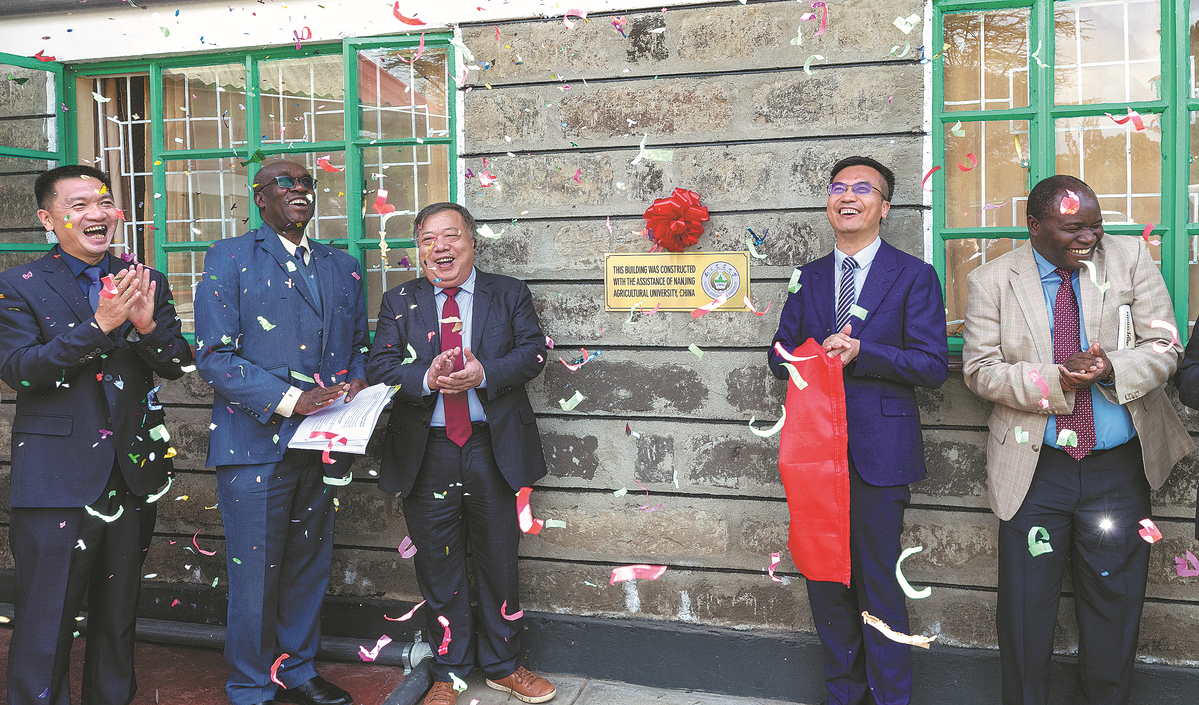
The demonstration village is part of a proposal that Chinese President Xi Jinping put to the Forum on China-Africa Cooperation in Dakar, Senegal, in 2021 to set up China-Africa joint centers for modern agrotechnology exchange, demonstration and training.
The demonstration village in Nakuru County is one of 10 poverty-reduction and agricultural demonstration projects set up across Africa and is the latest of a number of collaboration projects between Nanjing Agricultural University and Egerton University.
The collaboration between the two universities, which began 28 years ago, has centered on research on hybrid crops and on training farmers and government agricultural employees to improve agronomic practices.
One project is the Kenya-China Joint Laboratory for Crop Molecular Biology at Egerton set up in 2019. It aims to provide state-of-the-art facilities, to train staff and students, to organize staff and student exchange programs, and to engage in joint research and publication.
Richard Mulwa, a professor of horticulture at Egerton University and director of the molecular laboratory, said its establishment was significant and that its potential to help with crop production in the region is immense.
"Earlier on our research in terms of crop development was traditional and conventional, but with molecular biology we can select traits directly from DNA signals that we see could be responsible for particular traits. So instead of dealing with a whole plant observation in the field, we have reduced it to the molecular level where we do gene observation and isolation to get the traits we desire in the crops."