


Strokes of genius
Few others can boast the centuries of cultural influence of Wang Xizhi, whose work, thanks to the medium of rubbing, has obsessed emperors and laymen alike for nearly two millenniums, Zhao Xu reports.








The writer's character
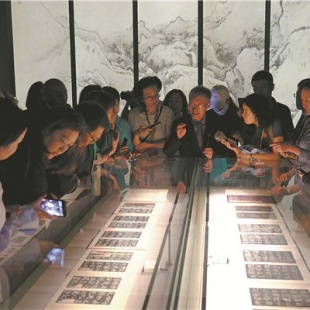
The 14 copies of Preface rubbings on view at the Palace Museum represent the impassioned endeavor of one man named You Si, a top minister of the Southern Song court who reputedly amassed more than 100 different versions of the same piece, for which he is probably remembered today more than anything else.
Neither a love of art nor a desire to stay in trend could fully explain the craze, according to Ho Pik-ki, a rubbing specialist from the Art Museum of the Chinese University of Hong Kong, home to 10 of the 14 Preface rubbings on display.
"The devotion Wang Xizhi's Preface was able to inspire from the Song literati was also due to the historical context in which it was made," she says.
Born in 303 into an elite household that shared close ties with the ruling family of the Western Jin Dynasty (265-316), Wang Xizhi grew up amid intense internal strife which, followed by attacks from the empire's nomadic enemies, eventually led to its demise in 316. At the same time, the founding of the Eastern Jin Dynasty (317-420) was proclaimed by a member of the royal family who, upon the advice of Wang Xizhi's father, had previously relocated from Luoyang (modern-day Luoyang city, Henan province) to Jiankang (modern-day Nanjing city, Jiangsu province), taking with him many powerful supporters who later formed the core of his government.
"To make that move required the crossing of the Yangtze River, which signaled the Jin court's relinquishment of rights to its vast northern territory, something that's likely to bring up painful memories for those who lived between the Northern and Southern Song dynasties," says Ho.
Whether Wang Xizhi, who willfully gave up a career in office to fully entertain the loves of his life — calligraphy certainly counted as one — had the political convulsion of his life in mind while writing it, no one will ever know. But there's irony in the fact that the Preface rubbings found their most fervent collector in Jia Sidao (1213-1275), one-time chief councilor to a fast-crumbling Southern Song court before his fall from grace, four years before the Mongols established their rule over China.
Hoarding a reputed 800 copies or more, the man known for his ruthless manipulation of power had effectively turned a fascination into a fetish.
Yet few would have any doubt as to whether he had ever found the same inner peace Wang Xizhi had discovered for himself surrounded by "towering mountains and majestic peaks, dense foliage and slender bamboos, clear streams and gurgling rapids", to quote the calligrapher's own description of his group's gathering spot of 353.
"Although we select our pleasures according to our own inclinations — some noisy and rowdy, and others quiet and sedate — when we have found that which pleases us, we are all cheerful and contented, to the extent of forgetting that we are growing old," Wang Xizhi wrote later in his article.
Or maybe "smugly contented", says Feng Xiaoxia.
"Few are aware of the long-standing debate concerning this particular Chinese character in the writing. Some believe it is快, meaning happy or cheerful, while others believe it to be 怏, which contains one more stroke and means complacent or smug," she says. "Those who stand by the second choice argue that it was a complacency bordering self-conceitedness that had allowed the calligrapher to forget, for a brief moment, the evanescence of life.
"They believe that the one vertical stroke that has made the difference was there at the very beginning, before repeated rubbing-making robbed it from the inscribed stone which couldn't stand all the wear. And they believe that latecomers who failed to read the mind of the master were misled by rubbings that didn't show that particular stroke. As they made their own stone inscriptions based on the wrong impression, what was a mistake became a prototype."
According to Feng Xiaoxia, one man who holds this view was Aisin Gioro Qigong (commonly known as Qigong, 1912-2005), a descendant of the ruling Manchu family of Qing (1644-1911), China's last feudal dynasty. Back in 1127, his ancestors drove the Song court southward without allowing themselves much chance to sample its cultural achievements.
"Of the handmade copies of the Preface from Tang Dynasty calligraphers, Qigong most revered the one by Feng Chengsu," says Feng Xiaoxia. "He traced the outlines of each character before filling them with ink, paying great attention to the subtle change of ink tones within the space of one stroke. He also dutifully reproduced the corrections Wang Xizhi made of his own piece, thus showing the master's thought process."
Rendered permanent in stone, such efforts allowed the workings of a great, creative mind to be revealed, at least in part, to those whose empathy, if not admiration, the calligrapher had anticipated.
"Alas! As we of the present look upon those of the past, so will posterity look upon our present selves," wrote Wang Xizhi toward the end of his immortal piece. "Therefore, I have put down here a sketch of my contemporaries and their sayings at this feast, and although time and circumstances may change, the way happiness and regrets are evoked will always remain the same.
"Future readers are bound to have their feelings aroused as they cast eyes upon my writing."