AI for good: China's proposal for global AI governance







Artificial intelligence is seen by many as leapfrogging progress for humanity, an engine of productivity and economic growth like no other. It is hailed by Dr. Henry Kissinger as “a grand undertaking with profound potential benefits.” In 1950, the concept that machines could use available information to solve problems and make decisions was put forward in an academic paper Computing Machinery and Intelligence by Alan Turing, the renowned British computer scientist that widely considered to be the father of AI. 73 years later, social media, web search, navigation, ride-sharing, and countless other AI applications are coexisting and conversing with us at home and in workplaces.
Amid the leaps and bounds, the worrying voice on the potential dangers is also growing louder. “I fear the consequences of creating something that can match or surpass humans,” said by Stephen Hawking in an interview during the 2017 Global Mobile Internet Conference, “Humans who are limited by slow biological evolution couldn’t compete and would be superseded.” “The digital divide is inflaming inequalities. Hate speech, disinformation and conspiracy theories on social media platforms are spread and amplified by AI”, “fueling violence and conflict in real life”, warned UN Secretary-General António Guterres in his address to the General Assembly in September 2023.
On October 18, the Global AI Governance Initiative was announced at the opening ceremony of the third Belt and Road Forum for International Cooperation. This most pertinent proposal puts forward an open, fair and efficient approach to the development, security and governance of AI, intending to harness the transformative technologies for the benefit of humanity.
AI for the People
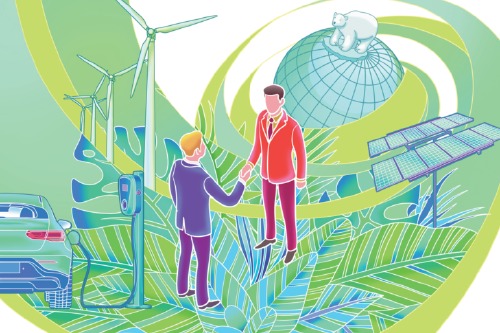
The Initiative proposes up front a people-centered vision. On the premise of ensuring social security and respecting the rights and interests of the people, the fundamental purpose of developing and deploying AI technologies is to enhance the common well-being of humanity.
AI has been applied to address global challenges including climate change, biodiversity conservation and sustainable development, and to provide services on public health, education and more. As UNICEF data shows, by June 2023, nearly 240 million children in the world have some form of disability. AI-powered assistants can offer tailored learning paths to ensure they get an equal opportunity to learn. AI is capable of making life better for people, and for future generations in particular.
Mutual respect, equality, and mutual benefit in AI development are also highlighted. Every country is entitled to develop and use AI. Yet no one should take action to obstruct the advances of others or build exclusive small clubs for technological hegemony. According to Goldman Sachs Research, generative AI like chatbots could raise global GDP by seven percent and lift productivity growth by 1.5 percentage points over a 10-year period. To realize such a promising prospect, a viable pathway is global collaboration and cooperation, sharing AI knowledge and making AI technologies available to the public under open-source terms, as the Initiative rightly puts it. As Stephen Hawking noted in one of his last talks, “We should do all we can to ensure that its (AI’s) future development benefits us in our environment.”
AI with a Reliable Security Framework
The development of AI has heightened the already serious concerns about misinformation and disinformation; entrenched bias and discrimination; invasion of privacy; AI arms and intelligence systems; fraud and other violations of human rights.
To avoid grey rhino events, a reliable security framework is needed to steer AI onto a path that benefits the economy and people while keeping the negative effects in check.
China is one of the earliest countries that have launched detailed regulations governing AI. Since 2017, a series of laws and regulations including the Data Security Law and Administration of Algorithm-generated Recommendations for Internet Information Services have been promulgated. Two position papers on strengthening AI ethical governance and military application were also successively submitted to the UN, offering systematic proposals in the fields of strategic security, law and ethics, technological security, rules-making and international cooperation.
On October 24, 24 artificial intelligence experts, including Turing Award recipients Geoffrey Hinton and Yoshua Bengio, jointly published an article, calling for breakthroughs in AI safety and ethics and promptly establishing effective government oversight.
Such ideas are echoed in the Initiative: to establish and improve laws, ethical norms, and regulatory systems for AI. It bears on humanity’s ability to press the stop button at critical moments, to forestall disruptive disasters beyond control, and diminish the potential risks.
AI by Inclusive Global Governance
At present, cutting-edge AI technologies are concentrated in a small number of super companies and countries. It could deepen global inequality and turn the digital divide into a chasm. Equal access and utilization of AI by all countries are crucial to bridging the technological, digital, and development gaps. More importantly, each and every country has a role to play in AI governance. The developing world, in particular, needs to continuously enhance representation, voice, and rights of decision-making in this field.
On 26 October, UN Secretary-General António Guterres announced the creation of the UN High-Level Advisory Body on Artificial Intelligence. The Initiative calls for discussions within the UN framework to establish an international institution to govern AI. Joint efforts are needed to build an inclusive network to address major issues concerning international AI development, security, and governance at the global level.
In the nascent stage of an AI era, AI is like a double-edged sword that “may better or—if wrongly deployed—worsen humanity.” The way we utilize and regulate AI and how we balance development and security could bring good outcomes or otherwise. Developing guiding ethics for AI will require commitment and insight, “and this commitment must be made within nations and among them,” written by Dr. Henry Kissinger in The Age of AI.
In 2022, China ranked second in the Global AI Innovation Index, for the 3 consecutive years. During the sixth World Artificial Intelligence Conference held in Shanghai in July 2023, the value of China’s core AI industry was estimated at over $68 billion. With great power comes great responsibility. The Initiative is a most timely step by China for global AI governance with a great sense of responsibility.
When countries embrace cooperation and act in concert, a deep chasm can be turned into a thoroughfare. China stands ready to engage in exchanges and practical cooperation with all countries on global AI governance and deliver benefit for all humanity through AI technology. Now is the time to harness the benefits of AI for the good of all.
The author is a current affairs commentator based in Beijing.
The views don't necessarily reflect those of China Daily.
If you have a specific expertise, or would like to share your thought about our stories, then send us your writings at opinion@chinadaily.com.cn or comment@chinadaily.com.cn.