



Exhibition casts light on link between past and present







About 130 million to 110 million years ago, a vast region — covering today's western Liaoning province, southern Inner Mongolia autonomous region and northern Hebei province — had a warm climate and a landscape of lakes and forests, which nurtured the many and diverse plants and animals, nowadays known as the Jehol Biota.
Scientists have proposed that repeated volcanic eruptions might have killed the creatures and created the fossil trove that even preserves soft tissue, like skin, organs, feathers and fur, in the ancient lake rock layers. Dubbed the "Mesozoic Pompeii" for its similarity to the ancient Roman city destroyed by the violent eruption of Mount Vesuvius in 79 AD, the Jehol Biota has provided tantalizing clues to evolutionary studies.
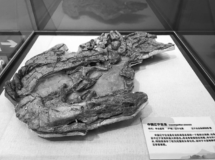
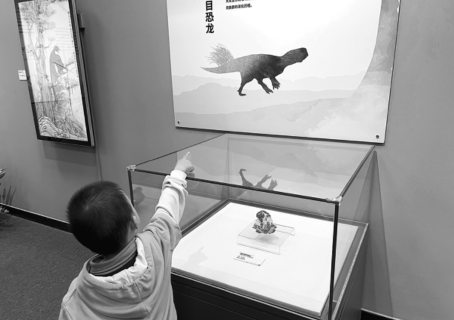
Ancient Jehol: Special Exhibition on Major Mesozoic Fossil Discoveries at the National Natural History Museum of China in Beijing tries to take visitors back to the period to better understand the link between the past and today, through 131 exceptional fossils unearthed over the past three decades. Opened on Nov 2 and running through Dec 3, the exhibition is organized by the museum and the Lingyuan city government in Liaoning.
"Over the past 30 years, Chinese researchers have studied the biota, with some world-influential discoveries published in scholarly journals," Zhang Yuguang, deputy director of the museum, says.
"The exhibition showcases these findings through vivid language and multimedia presentation."
He adds that more than half of the fossils are on display for the first time, and 130 are type specimens designated as a permanent reference for a new species.
Deng Tao, head of the Institute of Vertebrate Paleontology and Paleoanthropology of the Chinese Academy of Sciences, agrees that the exhibition is a platform to showcase these important discoveries by Chinese scientists, some of which might even change published texts.
This year marks the 100th anniversary since American geologist and paleontologist Amadeus William Grabau first discovered a type of fauna in Lingyuan in 1923, and named it the Jehol Series. In 1962, Chinese paleontologist Gu Zhiwei first proposed the name Jehol Biota. With increasing numbers of new fossil discoveries, in particular since the early 1990s, the Jehol Biota has caught the attention of domestic scholars. Traditionally, the biota is defined by three typical elements: the conchostracan (clam shrimp) Eosetheria, the insect Ephemeropsis, and the fish Lycoptera.
At the exhibition, the star fossil is the world's earliest placental mammal Juramaia sinensis, which has pushed back mammal evolution 35 million years. Before its discovery, scientists thought Eomaia, which was also discovered in Liaoning, was the mother of all placental mammals. Jura means the Jurassic period; maia is mother; and sinensis refers to its provenance in China.
"Although it is less than 20 centimeters long from head to tail, looking like a shrew (a small mammal related to mole and hedgehog), it can be called 'a great-grandmother' of all placental mammals, including us, human beings," Zhang says.
Besides mammal ancestors, there are also fossil birds, including the Ornithuromorpha, the clade within which all living birds are nested, and the Enantiornithes, an extinct lineage of stem bird. The exhibition includes almost all the biological categories in the transition from the Mesozoic to the Cenozoic.
"These well-preserved fossils unearthed in the Jehol Biota do not only indicate the process of biological evolution from primitive to relatively progressive, but also show the rich diversity of biological species, greatly enriching our understanding of the assemblage of biological groups and ecosystems in the middle Mesozoic age," Zhang says.
As the conclusion of the exhibition states, "there are still puzzles that remain unsolved, and we hope that the Jehol area will afford us more discoveries and scientific findings in the next 100 years, while promoting global academic exchange and cooperation, as well as fossil protection and utilization."


Today's Top News
- China, France issue joint statements during Macron's visit
- Xi, Macron have friendly exchanges in China's Chengdu
- Unity urged to advance Global South development
- Rule of law guards sound business environment
- Resilience of Sino-French economic ties hailed
- Xi, Macron vow to deepen relations








