More cheap new energy key to old climate problem







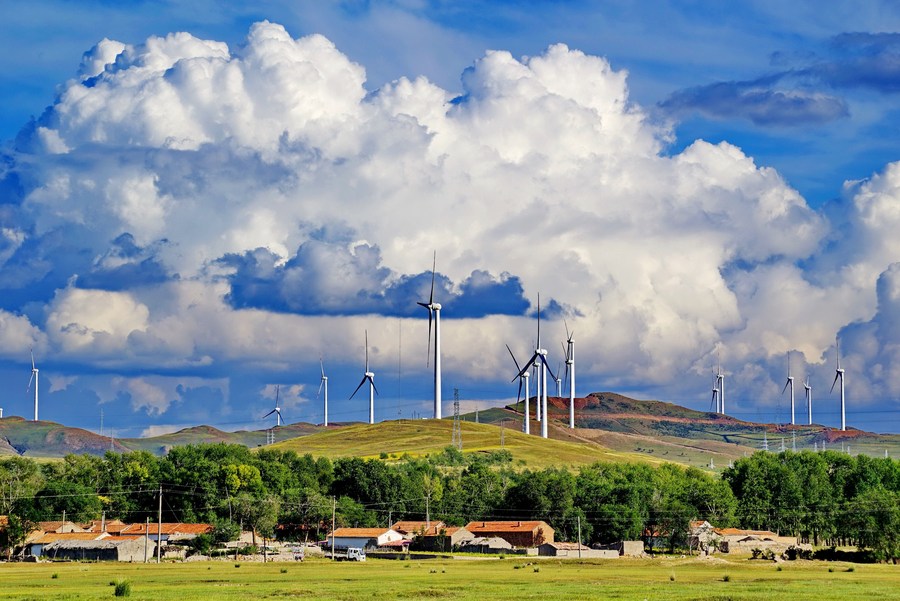
The spectacle of another annual climate conference is getting underway in the United Arab Emirates from Nov 30 to Dec 12. Like Kabuki theater, performative set pieces lead from one to the other: politicians and celebrities arrive by private jets; speakers predict imminent doom; hectoring NGOs cast blame; political negotiations become fraught and inevitably go overtime; and finally: the signing of a new agreement that participants hope and pretend will make a difference.
This circus has been repeated since the 1990s. Despite 27 previous conferences with iterations of ominous speeches and bold promises, global emissions have inexorably increased, punctuated just once, by the economic shutdown enforced by the COVID-19 pandemic. This year is likely to see higher emissions than ever before.
Almost every rich country preaches far more than it delivers. This is exemplified by the European Union, which has promised more than anyone else, yet — when forced by Russia-Ukraine conflict to cut off gas imports — went looking in Africa for more oil, gas and coal. Meanwhile, almost every poor country understandably prioritizes prosperity, which means abundant, cheap and reliable energy, which still means fossil fuels.
Underpinning the climate summit farce is one big lie repeated over and over: that green energy is on the precipice of replacing fossil fuels in every aspect of our lives. This exaggeration is today championed by the International Energy Agency, which has turned from an impartial arbiter of energy data to the proponent of the far-fetched prediction that fossil fuels will peak within just seven years.
The claim ignores the fact that any transition away from fossil fuels is occurring only with enormous taxpayer-funded subsidies. And while major energy players like Exxon and Chevron are moving back to investment in fossil fuel, big bets on green energy have failed spectacularly. Over the past 15 years, alternative energy stocks have plummeted in value, thus sending the pensions of ordinary workers tumbling due to virtue signaling pension companies while general stocks have increased more than 4-fold.
What won't be acknowledged in the United Arab Emirates — because it has never been acknowledged at a global climate summit — is the awkward reality that while climate change has real costs, climate policy does, too.
In most public conversations, climate change costs are vastly exaggerated. Just consider how every heat wave is depicted as an end-of-the world, cataclysmic killer, while the far greater reductions in deaths from warmer winters pass without being remarked on. Yet the costs of climate policy are bizarrely ignored.
Analyzing the balance between climate and policy costs has been at the heart of the study of climate change economics for more than three decades. Renowned economist William Nordhaus is the only climate change economist recognized with a Nobel Prize. His research shows that we should absolutely do something about climate change: early cuts in fossil fuel emissions are cheap and will reduce the most dangerous temperature rises. But his work also shows that highly ambitious carbon reductions will be a bad deal, with phenomenally high costs and low additional benefits.
Climate activists, who insist we should listen to the science, have consistently ignored this research and encouraged rich world leaders to make ever-greater climate promises. Many leaders have even gone so far as to promise net-zero carbon emissions by 2050.
Despite this likely being the single costliest policy ever promised by world leaders, it was made without a single peer-reviewed estimate of the full costs. Earlier this year, a special issue of Climate Change Economics made the first such analyses.
This astonishing work has gone almost entirely unreported by any major news outlet. It shows that even with very generous assumptions, the benefits of pursuing net zero will just slowly inch upwards over the century. By mid-century, the benefits — meaning the avoided costs from climate change — could reach about $1 trillion each year.
But the costs would be much, much higher. Three different modelled approaches all show far higher costs than benefits for every single year throughout the 21st century and far into the next. By 2050, the annual costs of the policy range between $10 trillion and $43 trillion. That's 4-18 percent of global GDP. Consider that the total tax intake of all governments across the world today is about 15 percent of global GDP — and politicians would potentially have us spend more than that.
Across the century, the benefit is 1.4 percent of global GDP while the cost averages out at 8.6 percent of global GDP. Every dollar in cost delivers perhaps 16 cents of climate benefits. Clearly, this is an atrocious use of money.
The only thing that could avoid this summit being a retread of 27 other failures is if politicians acknowledge the real cost of net zero policy — and instead of making more carbon cut promises, vow to dramatically increase green energy R&D.
This would help innovate the price of low-carbon energy below that of fossil fuels so every country in the world will want to make the switch. Instead of subsidizing today's still-inefficient technology and trying to force a transition by pushing up the price of fossil fuels, we need to make green technologies genuinely cheaper.
Sadly, that seems a far-fetched hope. Instead, this climate summit looks set to be another wasted opportunity producing yet more hot air.
The author is president of the Copenhagen Consensus. His new book is "Best Things First".
The views don't necessarily represent those of China Daily.
If you have a specific expertise, or would like to share your thought about our stories, then send us your writings at opinion@chinadaily.com.cn or comment@chinadaily.com.cn.