OFF THE BEATEN TRACK
Avoiding better-known Guizhou karst sites in favor of those hidden from plain sight serves to enhance an intrepid adventurer's sense of accomplishment, Chen Liang reports.







While traveling in Guizhou province, a region renowned for its expansive and stunning karst landscapes, tourists often find themselves exploring, or en route to, a magnificent cave, a unique sinkhole, or a mystical underground river.
During a visit to the province in mid-September, two friends and I made a decision to steer clear of the well-trodden paths and popular attractions and instead focus on exploring sites that are lesser-known to tourists, accessible, and offer cheap or even free admission. We visited five karst attractions during our five-day trip. Of them, two were truly impressive!
Depth of attraction
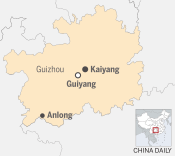
The Hou'er Sinkhole in Kaiyang county is located 76 kilometers from the provincial capital of Guiyang. As it's only one-hour drive from the airport in Guiyang, we left it as the last stop of our trip in Guizhou.
We stayed in the county seat of Kaiyang on a Saturday evening and went to the sinkhole the next morning. The site is only 8 km from the town. When we arrived there at 8 am, after having rice noodle in beef soup as our breakfast, we found that we had to wait an hour for it to open.
A park manager refused to let us in ahead of opening time, despite our pleas.
She explained that it was still too dark in the sinkhole at that moment, and the stone trail descending to the bottom of the karst funnel was slippery.
She wasn't kidding. After we walked along a stone-paved path into the sinkhole, the road passed a patch of dense wood as it gradually disappeared into a cave.
After walking in the cave, illuminated by dim lights, for about 10 minutes, we descended onto a steep path built into the sheer cliff, which leads to the bottom of the sinkhole.
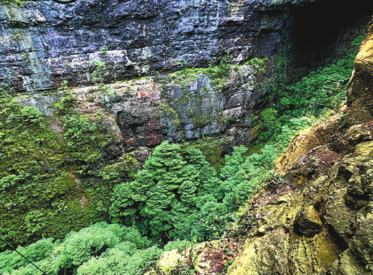
Water, trickling down from the upper part of the cliff, dampened the path and nurtured different kinds of shade plants, such as ferns, which grew rampant. So we had to be very careful while descending.
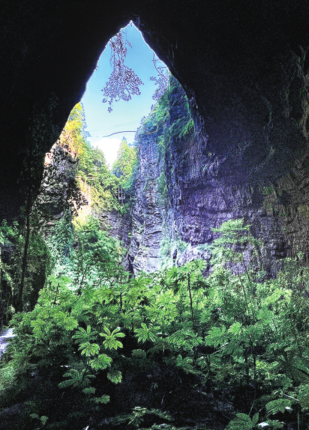
Right on the cliff, halfway to the bottom, I could see the elliptical sky framed by edges of the 300-meter diameter sinkhole, which has a depth of 280 meters, and, at the bottom, a diameter of 280 meters. Due to the shape of the sinkhole's opening, it is named hou'er, meaning "monkey's ear" in Chinese.
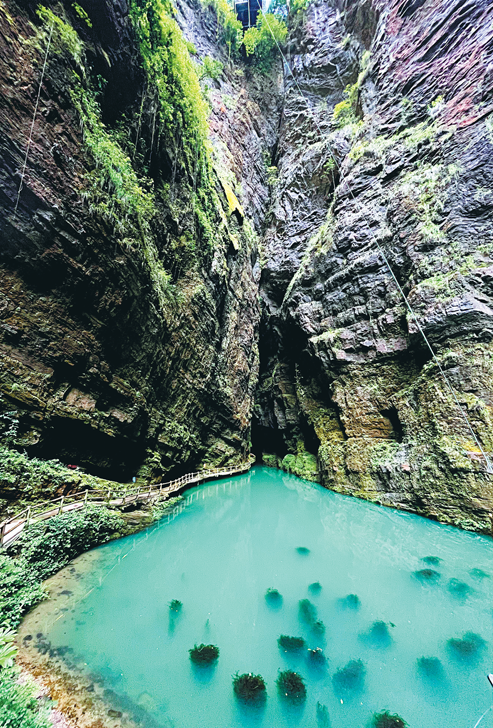
I could see a dense canopy of trees covering the sinkhole bottom like a green carpet, bordering a small pond of emerald water. I couldn't help wondering how they managed to grow so well in such a secluded space.
The water in the pond is actually from an underground river.
A boat lies at anchor along a plank walkway and is probably used to take visitors to explore part of the downstream cave. While we were there, however, no park employees were around.
The waterfront plank path connects two caves. We walked into the upstream cave and scaled a steep stone passage for several hundred meters.
Outside the cave, we found ourselves back at the upper part of the sinkhole. Along a path built on the cliff, we continued our walk until we completed a full circuit of the sinkhole. Later, I discovered that the funnel is actually a karst system with four caves and two underground rivers, including one stretching underground for several kilometers.
We met just several tourists during our three-hour stay at the site. Quiet and beautiful, with cheap admission, the Hou'er Sinkhole is definitely worth a closer look.
Cave of wonders
After finding out that we were traveling in Xingyi city in the southern part of Guizhou, a friend sent me a message and suggested we visit Hejia Cave in Anlong county.
"It is amazing," the message said.
After visiting a scenic site in Xingyi, I checked a navigation app, found that Anlong neighbors Xingyi and that Hejia Cave was only a 30-minute drive away, so we decided to take a look.
It was around 4 pm. The app led us onto a narrow country road. About 1 km away from the site, I saw a primary school pupil returning home.
I pulled over and asked him whether we were on the right track and close to the cave. He said he had never heard of it.
I kept driving for another five minutes and passed a village. The app told me to turn back as I had missed a turn.
I didn't see any obvious turn on the way, so I was confused and had to pull over again. I asked villagers by the road. Finally, one seemed to know what I was asking about. He explained that there was a cave behind a fishpond in a lower valley that we had passed. "You have to find the fishpond first and go behind the house near the pond," he said.
We did exactly that and drove along a dirt lane hidden behind some dense bushes. Near the pond was a two-story house and a patch of land on which a farmer was harvesting vegetables. He told us to follow the path into the wood where "you can see the cave after a five-minute walk".
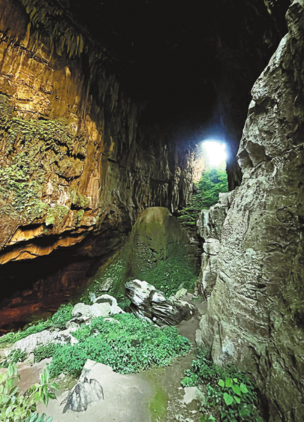
Through the wood and descending along the lane, we soon saw the huge cavern with not only a towering entrance, but also a wide exit on the opposite side.
The afternoon sunshine tinged part of the cave's inside wall. A huge stalagmite at the bottom of the cavern was partly covered with ferns. Swifts and bats circled around the sky framed by the cave and the forest, and their chirping made the hidden valley in front of the cave a little noisy.
It was truly a pleasant surprise to find such a massive natural wonder near a country road and behind a farm house.
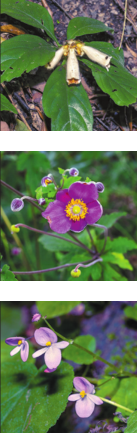
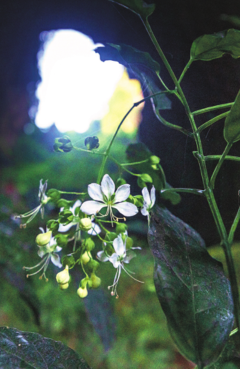
We descended along the path into the cave, discovering that, because of the sunshine, a kind of beautiful white flower was in full bloom inside the cave.
When darkness began to fall, though, we had to leave.
Even though we still had two days left to explore the province, I knew that the cave would certainly be the highlight of our trip.




Today's Top News
- Takaichi must stop rubbing salt in wounds, retract Taiwan remarks
- Millions vie for civil?service jobs
- Chinese landmark trade corridor handles over 5m TEUs
- China holds first national civil service exam since raising eligibility age cap
- Xi's article on CPC self-reform to be published
- Xi stresses improving long-term mechanisms for cyberspace governance