Private firms have to adapt to the times







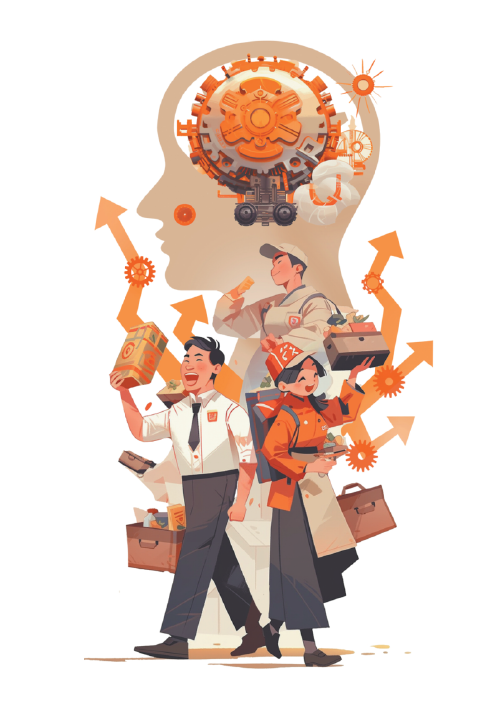
Editor's note: Since the beginning of reform and opening-up, China has been committed to injecting new impetus into the economy. What are the key focuses for the year ahead? Three experts offer their insights to China Daily.
Given the changes in the economic landscape, private enterprises need to change their mindset, too, and understand the characteristics of the new landscape while aligning their thought processes with it in order to achieve their goals.
To discern these characteristics, they need to compare the new landscape (or the "new paradigm") with the previous one or the "old pattern". The old pattern was characterized by a small base but a high growth rate, a vast industrial space where almost any production activity was profitable because natural resources were inexpensive and labor costs were low. It leveraged traditional and comparative advantages, gained from entering low-end and cheap segments of the supply chains or from being a latecomer to a sector. This gave rise to imitation but ensured rapid progress following in the footsteps of established players.
During the "old pattern" period, global conditions were favorable for China's industries, not least because developed countries were adjusting their industrial structures, and transferring their excess capacity which dovetailed with China's economic structural and labor force needs. The era of rapid reform and opening-up witnessed the flourishing of private enterprises, making China the world's second-largest economy with a double-digit growth rate, with labor-intensive sectors' exports being one of key engines.
However, as China transitions to the new normal, characterized by moderate and stable growth, the landscape has significantly changed: while the absolute GDP size increases, the growth rate has slowed, and overcapacity plagues low-end industries and the industrial space has diminished. And with resources and labor costs drastically rising and the cost of environmental damage becoming costlier, the notion that comparative advantages can drive growth indefinitely has come in for severe challenge.
In the new landscape, global conditions have become less favorable for China, with Western countries, led by the United States, resorting to unilateralism and protectionism, and restricting China's access to high-end technologies. Making the situation more complex is the rapid development of some neighboring countries, which are now offering cheap labor and attracting international capital away from China. Amid all this, the global economic downturn has further restricted the once booming foreign trade that propelled China's rapid ascent.
To address these challenges, private enterprises need to recognize that economic development in the new landscape hinges on two key factors: penetrating the domestic market while exploring new international markets; and achieving self-reliance in all sectors of the economy and clearing the technological bottlenecks restraining China's economic progress. The control over high-end technologies is not only an economic imperative but also a matter of national security.
The traditional model of rapid development has not only lent credence to but also consolidated this approach. Some private enterprises remain fixated on gaining the benefits of latecomer advantages, and thus stick to the old development model that is focused on fast growth and high returns, even at the cost of the environment. This fixation has ossified their mindset, causing them to use old methods to address new challenges, stifling their innovation capacity due to their overdependence on comparative and latecomer advantages.
History provides intriguing cases that warrant reflection. For example, after the first Industrial Revolution, Great Britain's development slowed down as the country remained enamored by outdated methods. Regardless of how advanced and effective the beneficial methods once were, they could not lead the way against the backdrop of new developments, and the production and market they created could not foster continuous growth. Yet the British clung on to the old patterns, allowing the ruthless development of the United States and Germany to surpass them.
For the sustainable and healthy development of private enterprises, it is important that the government and society work together to create a conducive environment, while private entrepreneurs ponder whether to continue fueling the economy with outdated products or whether high-tech innovations can help them manufacture products that meet the demands of the changing times and markets.
Analyzing why enterprises led by individuals such as Ren Zhengfei and Li Shufu never lack funds is illuminating: they offer products that the markets demand, ensuring a continuous influx of funds. Without technological innovation and viable projects, money cannot achieve much.
Observing how entrepreneurs in Western market economies thrive amid the ebbs and flows, we have realized that the entrepreneurial spirit is forged through myriad challenges, and success is achieved by adapting to the changes and addressing the challenges. To thrive, enterprises require not just money but also a forward-thinking mindset along with concrete implementation.
For private enterprises to continue to thrive, they cannot rely on equipment, technologies, workforce quality and management capabilities that bore fruit 30 years ago. And rather than considering economic downturns as disasters, it would be more productive to see them as opportunities for transformation and renewal.
The author is a senior economist at Renmin University of China.
The views don't necessarily represent those of China Daily.