Ancestral maneuvers
Ancient DNA confirms connection between Yangtze River basin and other ancient Southeast Asian cultures, Wang Qian reports.







The Ma'an site in Wuxi, Jiangsu province, has recently emerged as a pivotal archaeological site providing genomic insights into the ancient history of the Yangtze River Basin and the origin of its residents during the Neolithic period. The extracted ancient mitochondrial genomes also indicate a genetic link with the ancient populations of Southeast Asia.
The site's latest archaeological breakthrough has enabled the successful extraction of ancient human genome data from the Majiabang Culture period, dating back to approximately 6,000 years ago.
The Majiabang Culture represents the earliest Neolithic discovery in the Wuxi region and can be considered the cradle of civilization in this area.
"It is the first time that we have successfully obtained genetic data from an ancient man dating back 6,000 years to the Majiabang Culture period," says Du Panxin, a researcher at Fudan University's Institute of Science and Technology Archaeology.
Du says the maternal genetic type belonged to haplogroup F1a1'4, which is associated with ancestral groups in northern Vietnam (4,000-2,000 years ago), northern Laos (3,000 years ago), Indonesia (2,000 years ago), the Philippines (1,800 years ago), the Guangxi Zhuang autonomous region (1,500 years ago), and northern Thailand's Hanging Coffins (2,500-800 years ago). It suggests extensive ancient interactions and potential migrations across Southeast Asia, according to Du.
"By comparing this genetic type of the ancient people of the Majiabang Culture with the genetic lineage of modern language groups, we believe that the ancient people in Wuxi may be related to the ancestors of the Dong-Tai language family," Du adds.
This groundbreaking discovery fills a critical gap in DNA research of the region's early residents, offering new clues to the close interconnectivity among prehistoric cultural groups in the lower reaches of the Yangtze River region and their potential connection to the ancestors who are all from the Dong-Tai language family. This intriguing connection prompts further research into the linguistic and cultural exchanges that may have occurred between these ancient communities.
The Dong-Tai language family was proposed and named by the Chinese linguist Li Fanggui, and is also known as the Zhuang-Dong or Kam-Tai. According to the World Ethnic Language Network, there are 91 languages and dialects in the Dong-Tai language family, which are mainly spoken in Southeast Asia, extending from southernmost China's Hainan province, to India in the east, and the Malay Peninsula in the west and south.
The Dong-Tai language family is a very complex cultural community from South China to Southeast Asia. The frequent contact and movement of prehistoric people in this area resulted in a complex landscape of intertwined languages and cultural blends.
Scholars from home and abroad have conducted many studies on the origin, migration and differentiation of the Dong-Tai language family from different disciplinary perspectives, and have reached some consensus. Although different views still exist, the latest findings can provide a new perspective.
The ancient DNA, extracted from sources like fossilized bones, teeth and other sediments, provides clues to help decode human origins and evolutionary history in the Yangtze River Basin, which makes the tracing of migration routes in the region possible.
"Based on the preliminary findings, it is likely that the initial ancestors who arrived in Wuxi did so by migrating from the south to the Taihu Lake," says Liu Baoshan, director of the Wuxi Institute of Cultural Relics and Archaeology.
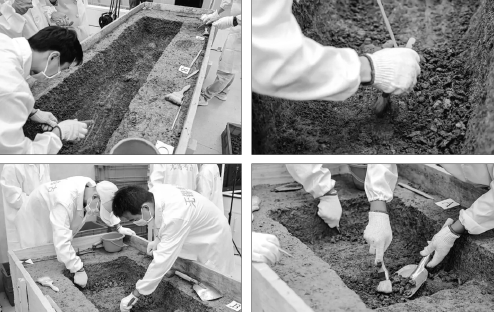
In June, the institute conducted a live archaeological excavation at the Ma'an site, uncovering two tombs from the Majiabang Culture. Within these tombs, researchers discovered two ancient human skeletons, and they successfully extracted ancient DNA from one of them.
The Ma'an site is significant not only for its ability to yield ancient genetic data, but also for its broader archaeological implications.
Excavations conducted between April last year and February this year unearthed a total of 26 tombs from the Majiabang Culture period. This extensive fieldwork, with a meticulous focus on preserving the archaeological context, has provided a wealth of material for multidisciplinary laboratory archaeological investigation.
Multidisciplinary teams of experts conducted extensive analysis of tomb artifacts, including human remains, which were sent to Fudan University's Ancient DNA Lab to unlock genetic secrets from the past.
The researchers emphasized the need for further exploration and data collection, particularly in the core areas of the Majiabang, Songze, and Liangzhu cultures, believing it will not only provide a more comprehensive understanding of the evolutionary context of the Yangtze River region's inhabitants, but also contribute to a broader understanding of human migration and cultural development.
Results of the latest research of the Ma'an site were released during a national-level seminar on preventive protection and restoration of unearthed cultural relics in September. At the seminar, the East China Base of the Chinese Academy of Social Sciences' Institute of Archaeology was inaugurated to strengthen cooperation with the Shaanxi Academy of Archaeology and conduct archaeological fieldwork in eastern China. Located in the Helv City Relics Park in Wuxi, its tasks also include strengthening the establishment of talent teams, promoting the transformation and application of scientific research findings, and deepening scientific and technological cooperation and academic exchanges at home and abroad.
Cang Wei in Nanjing contributed to this story.