Living Buddha keeps in tune with modern era of life







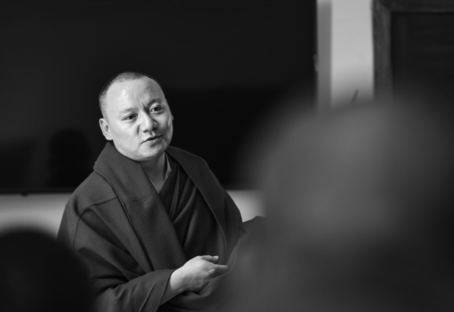
LHASA — On a cool autumn night along Barkhor Street in the heart of Lhasa, the tranquility was complemented by a Buddhist chant accompanied by ethereal melodies. Not too many in the audience were aware that the lead singer of the band was no ordinary vocalist but, in fact, a "Living Buddha".
As Balog Tenzin Dorje, who is also known as Balog Rinpoche, commenced chanting, accompanied by flute, guitar, ritual drum and bell, devout Tibetan Buddhists at the scene knelt on the ground, hands clasped together, bowing in prayer.
The scene unfolded at a folk art festival, held in the capital city of Southwest China's Xizang autonomous region in September. The festival aimed to promote various forms of intangible cultural heritage, including Naru Great Dancing, an ancient Lhasa dance dating back to the seventh century, and the well-known dramyen, a traditional Tibetan plucked string instrument.
Balog Rinpoche and his band named Dharma presented the ancient Songs of Milarepa, also listed as an intangible cultural heritage item, of which the Living Buddha himself is an inheritor.
Born in Lhasa in 1982, Balog Rinpoche was identified as the reincarnated Living Buddha of Yangrigar Monastery in Maldrogungkar county at the age of 8.
Growing up in Norbulingka, dubbed Lhasa's "Summer Palace", he not only studied Buddhist doctrines, but also learned Mandarin, English, painting, music, and other subjects from a young age.
As the 42nd-generation inheritor of the Songs of Milarepa, which was listed as a national-level intangible cultural heritage in 2021, Balog Rinpoche began learning and preserving the item in 2004.
There are currently over 600 bearers of intangible cultural heritage items at various levels across the region.
Milarepa was one of the most influential figures of the Kagyu School of Tibetan Buddhism. His oral teachings of Buddhist doctrines were passed down and collected by his followers as the Songs of Milarepa, serving as a valuable resource for understanding Buddhist philosophy. The Songs of Milarepa were traditionally passed down among practitioners, but Balog Rinpoche aims to better preserve and introduce them to more people. As a result, he established Dharma in 2013, with the band attempting to incorporate a moderate amount of instrumental accompaniment.
The band comprises guitarists, a drummer, and a keyboard player hailing from the Mongolian, Manchu, Tibetan and Han ethnic groups.
Though their performances are not frequent, they have graced stages in Beijing, Shanghai, Hangzhou, Zhejiang province, Chengdu, Sichuan province, and Lhasa.
"The Songs of Milarepa are meant to be diverse. They can offer spiritual guidance to the public. Through our interpretation, we aim to contribute to the inheritance of this intangible cultural heritage today," says Balog Rinpoche.
Apart from preserving the Songs of Milarepa, Balog Rinpoche teaches The Thirty-Seven Practices of Bodhisattva and Mandarin at the Tibet Buddhism Academy.
Nestled in Chushul county and inaugurated in 2011, the academy is the region's only high-level comprehensive Tibetan Buddhist institute. It has nurtured thousands of outstanding monks and nuns to serve the Tibetan Buddhist community.
Inside the academy, there are sacred religious buildings such as Tshogs Chen Hall, scripture-debating grounds and white pagodas, which coexist harmoniously with modern teaching facilities including a 400-meter standard running track, an artificial turf soccer field, and indoor and outdoor basketball courts.
Balog Rinpoche usually meticulously arranges his robe before class and carries a laptop that connects with the classroom's screen projector to show students his course material.
His students, also clad in monks' robes, attend the class with their laptops, tablets and translation pens. He guides the students to use Mandarin to compose sentences, while giving explanations in Tibetan.
Different from typical teaching buildings, red carpets are laid in the corridors of the academy, while the classrooms are equipped with shoe cabinets, requiring students to take off their shoes before entry. Some classrooms feature Tibetan carpets and tea tables, where students sit on the floor.
"It's not that common to see someone teaching at the academy who is simultaneously a Rinpoche. But, as far as I'm concerned, an excellent knowledgeable professor, abbot or Geshe should also be respected as a Rinpoche," Balog Rinpoche says.
Influenced by the artistic milieu of his family life, Balog Rinpoche embarked on learning thangka painting from a young age and graduated from Tibet University with thangka painting as major.
Through diligent study, he also became proficient in English.
Today, Balog Rinpoche teaches others the things he excels at.
Every week, he teaches thangka painting at a manual arts school and hosts online Tibetan and English classes during weekends for students from Tibetan and Han ethnic backgrounds.
To promote thangka art, he established a painting class in 2014, receiving apprentices from diverse ethnic backgrounds, in order to encourage more exchanges and interactions among different ethnic groups.
Managing temple affairs, lecturing at a Buddhism academy, preserving the Songs of Milarepa, and teaching thangka painting, Balog Rinpoche described his daily life as busy yet fulfilling.
"The title of 'Rinpoche' means greater responsibilities," he says, emphasizing that a Rinpoche needs to lead, and positively impact, Buddhist practices among the monks, continue historical missions and fulfill the wishes and needs of believers of the religion.
Nowadays, many Living Buddhas contribute to the promotion of Buddhism and benefit the public in diverse ways. Some establish Tibetan medical clinic teams that offer free healthcare services to the public; some advance studies in Buddhism or pursue higher education at universities; while others pass on Buddhism teachings and traditions within monasteries.
"I would like to establish a professional Buddhism translation center based on my father's work, to collect, compile and translate ancient Buddhist scriptures," says Balog Rinpoche regarding his future career goals. "At the same time, I plan to establish a Milarepa Museum to enhance protection and promotion of the precious cultural heritage."
Xinhua





Today's Top News
- Turning export resilience into prosperity
- Policy paper on Latin America and Caribbean unveiled
- IMF: China's resilience will be sustained
- Optimization of educational assets stressed
- China-Russia joint air patrol shows resolve to maintain peace, stability
- Group of Friends initiated to boost global governance