Dishing up different discoveries
A celebrated documentary maker's new series uses a novel approach to explore the cultures and traditions behind delectable delicacies, Xing Wen reports.







Chen Xiaoqing has inadvertently become a celebrated figure among foodies.
The chief director of the immensely popular documentary series, A Bite of China and Once Upon a Bite, skillfully captures the essences of diverse ingredients and dishes, and interweaves their legacies with heartwarming human stories.
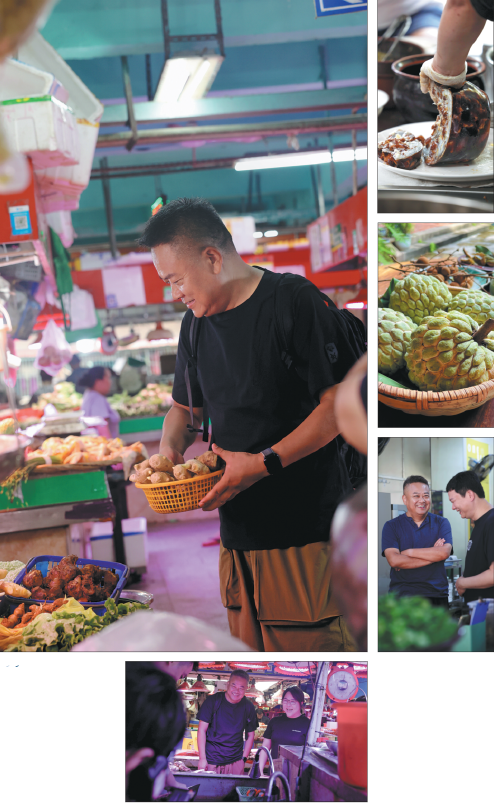
Although he's a celebrity, Chen is shy, and only recently appeared on the other side of the camera for the first time — that is, as the host of the recently aired documentary, China Beyond Tastes.
In this series, he takes viewers to locations throughout the country, including Changsha and Zhuzhou in Hunan province; the Chaoshan area in Guangdong province; Kashgar in Northwest China's Xinjiang Uygur autonomous region; and cities in Zhejiang, Yunnan, Shanxi and Shandong provinces.
"Food not only satisfies our palates but also represents the rich cultural history behind it and the unique customs of a particular region," says Chen, who also serves as the program's chief director.
The series is alternatively known as My Gastronomic Guide in Chinese. Chen says he uses the term "guide" here, because it can refer both to food and travel.
During each leg of the journey, Chen invites specialists, including chefs, philosophers, archaeologists, anthropologists, musicians, economists, documentary directors and writers, to explore not only local restaurants and streets but also farm fields and even archaeological sites.
These serve as the backdrops for engaging discussions on such topics as lifestyles, societal shifts, civilizational transformations, and the emergence and disappearance of customs.
Producer Li Jie adds that "guides "could also be other individuals who offer anthropological perspectives and could include cultural players, taxi drivers or even children at a market.
"Their diverse perspectives provide us with valuable insights into the fascinating worlds that lie beyond culinary experiences," Li says.
For instance, anthropologist Cao Yu serves as one of Chen's culinary guides in Changsha, which is known for its spicy fare.
Cao has written a book that explores the 400-year history of Chinese consumption of chili peppers. He posits that the original intent behind Chinese people's fondness for spicy food was to use it like a stimulant to give them energy.
"The sweat-inducing spicy sensation can trigger the release of dopamine, and seemingly foster Hunan people's relatively vigorous character," says Cao.
"Eating spicy food together, sweating profusely and losing inhibition causes people to experience a sense of camaraderie through thick and thin. This kind of empathy forges a fundamental bond among people. So, eating spicy food together can serve as a social activity that ties people to one another," he adds.
Likewise, history professor Xu Jilin guides Chen through Chaoshan to sample the area's cuisine. Xu points out: "Patriotism and love for one's hometown are not merely conceptual. They are a physiological yearning. Our stomachs will never betray us, revealing where our roots lie."
Chen says: "This new program actually provides an insight into our previous endeavors in researching and discovering food, as well as the analytical processes involved. Throughout the series, we encounter, meet, taste and delve into the food's production processes, exploring the interconnectedness between the individuals behind the food and the respective regions from which they come. Our aim is to present these aspects to the audience as fully as possible."
The documentarian previously worked as a columnist who deployed sophisticated descriptions to chronicle his culinary journeys through places like Beijing and Chengdu, capital of Southwest China's Sichuan province.
He points out that the younger generation often lacks the time and energy to learn traditional cooking techniques from their parents and grandparents.
This, he explains, is precisely the motivation behind his documentaries.
"We aim to create a visual record of these foods and cooking techniques so that future generations can be aware of the ways of life their ancestors once enjoyed."




Today's Top News
- China expected to prioritize boosting consumption and domestic demand in 2026, expert says
- Xi, Macron jointly meet press
- Xi, Macron attend signing ceremony of cooperation documents
- Xi calls on China, France to expand cooperation in multiple areas
- Xi holds welcome ceremony for Macron
- New, smart holistic approach needed for aging society