Legacies longer than lifetimes
Excavations of an ancient cemetery in Shaanxi are uncovering stories about its elite occupants, Wang Ru reports.







People perish but can still tell so many stories long after.
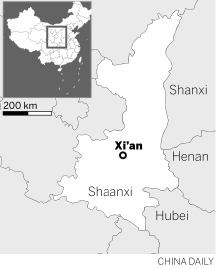
Since the Han Dynasty (206 BC-AD 220), the Hongdu Plateau in the north of what is now Xianyang, Shaanxi province, was a popular final resting place for those of high social status.
As a result, archaeologists have discovered a large number of prominent figures' tombs there, including nine emperors' and their family members' mausoleums dating to the Western Han Dynasty (206 BC-AD 24).
Now, in the central area of the plateau, a new discovery has unveiled the largest independent cemetery consisting of tombs ranging from the Sixteen Kingdoms period (304-439) to the Tang Dynasty (618-907).
The latest discoveries at the Beichengcun (Beicheng village) cemetery site in Shaanxi's Xixian New Area, near the provincial capital Xi'an, were recently announced by the National Cultural Heritage Administration in Beijing.
The archaeological excavations from 2021 to 2023 were carried out by the Xi'an Municipal Institute of Cultural Relics Conservation and Archaeology.
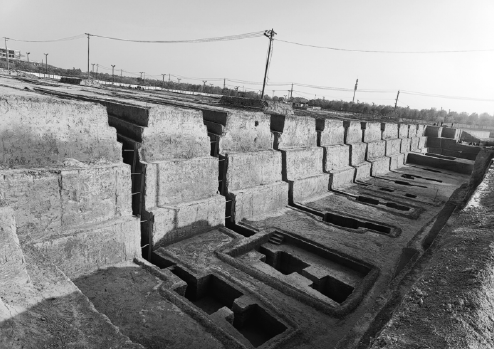
Archaeologists have uncovered a moat surrounding the cemetery, identified 301 tombs and excavated 285.
According to Chai Yi, a researcher at the institute, they have basically determined the more than 80,000-square-meter graveyard's scope and layout.
The moat is 350 meters long and 260 meters wide, and dates back to the Northern Wei Dynasty (386-534).
The tombs are well-organized in rows from west to east, with their passages facing eastward, says Chai.
Time and place
The tombs can be divided into three periods.
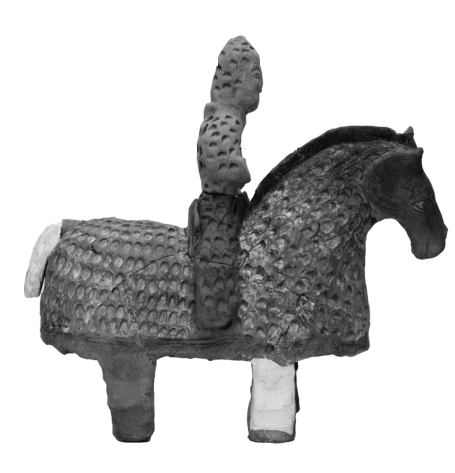
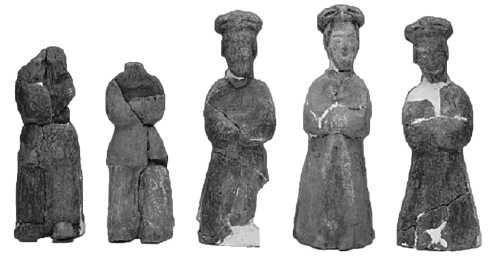
The first one, the Sixteen Kingdoms period, has 38 tombs in four rows in the northeast. These are all catacombs with long sloping passages, a common design in central Shaanxi since the Western Han, says Chai. Artifacts unearthed from these tombs include clay figurines, lamps and cooking stoves.
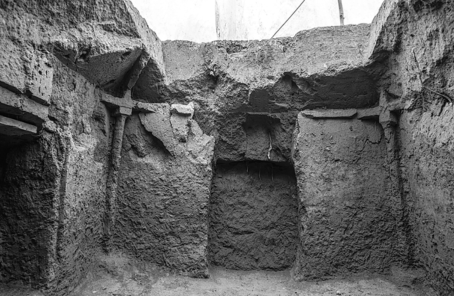
In this year's excavation, archaeologists have found a tomb containing carved earthen replicas of wooden structures and engravings on the soil walls of the burial rooms that resemble wooden beams' frames that were commonly used by the Han ethnic group. This practice is rare and is believed to have emerged during the Sixteen Kingdoms period in central Shaanxi, according to Wei Zheng, an archaeology professor at Peking University.
According to Chai, this is often viewed as a reflection of ancient Chinese people's ideas about life and death — that is, to serve the dead as if they were living — and shows other ethnic groups' absorption of Han culture in the Sixteen Kingdoms period.
The five rows of 101 tombs of the second period — from the Northern Wei to the Western Wei Dynasty (535-556) — are to the south and west of those of the earlier period. The majority of them are also catacombs with long, sloping passages. But only a few artifacts have been unearthed from these tombs, including coins, clay jars and a model couch.
No 325 tomb yielded a tomb brick with the inscription "Year 13 (AD 489) of the Taihe era" from the Northern Wei Dynasty. No 135 yielded another with "Year 15 (AD 549) of the Datong era" from the Western Wei Dynasty.
The other 146 tombs are from the Northern Zhou (557-581), Sui (581-618) and Tang dynasties, in the west, northeast and other empty areas of the cemetery. They are either catacombs with long slopes or vertical passages. The latter were also common in central Shaanxi at that time, according to Chai.
Not many artifacts have been unearthed from these tombs, except for a few clay pots, cups, coins and inscribed bricks.
Archaeologists have also analyzed the human bones discovered there.
"Through analysis, we have found the bones belonged to about 400 individuals, and the sex ratio is generally balanced — 100 females per 130 males. Most were between 25 and 50 years old," says Chai.
Since the scale of the cemetery is much larger than that of a single clan and the tombs' orientations remain consistent across different periods, unlike the neighboring tombs outside the moat from the same time period, archaeologists believe that they belong to a tribe, and those buried there must have a blood or geographical relationship.
Extended connections
"This cemetery demonstrates that these people have maintained the traditional funeral customs of their own group for a long time. … Moreover, archaeometric analysis reveals they probably had close links with some groups like the Qiang ethnic group, and Di and Rong tribes," says Chai.
Although owners of the cemetery probably belonged to a non-Han group, the features of the cemetery, including the layout of the tombs and the unearthed artifacts like clay figurines, coins and bronze mirrors, are not very different from those of the contemporaneous culture from Central China. This reveals cultural communication and integration at that time, says Jiao Nanfeng, a researcher at the Shaanxi Academy of Archaeology.
The Sixteen Kingdoms period marked a time of wars and short-lived regimes established by many different people. But it was also crucial to the cultural exchanges that formed the shared community of the Chinese nation.
Chai also mentions most of these people mostly ate plant-based food, complemented by some meat.
Moreover, the grades of the tombs seem to gradually decline across the three periods.
During the Sixteen Kingdoms, the tombs were large and for middle-class officials or aristocracy, as demonstrated by their scale and unearthed artifacts. But from the Northern Wei to Western Wei, the tombs were middle-sized, with far fewer burial objects. In the latest period, the tombs were small and probably for ordinary people, according to Chai.
"Through these discoveries, we can infer that these people had a high social status during the Sixteen Kingdoms period," she says.
"Although they still had some status from the Northern Wei to the Western Wei periods, they obviously saw it decline as compared with before. In the last period, they were not different from ordinary people. It shows the dynamic changes in the cemetery across time," says Chai.
According to Jiao, the cemetery can be regarded as an important discovery in the history of China's archaeological studies of tombs.
"The Beichengcun site is a large-scale graveyard from the Sixteen Kingdoms period, Northern Dynasty (386-581), Sui and Tang periods. It has a long history and is well-preserved," says Jiao.
"It was used for more than 300 years. In ancient China, about 20 years was a generation. By this measurement, about 15 generations of people were buried in this cemetery.
"Its legacy spans such a long time, and its tombs, which are around the same sizes, are distributed in an orderly fashion. … We haven't seen another contemporaneous cemetery like this in China," he adds.
According to Jiao, archaeologists didn't know much about tombs from the Sixteen Kingdoms period until recently. This graveyard hosts the largest number of graves dating to that period discovered at a single site, he adds.
Chai says DNA analyses will be conducted on all of the human bones to get more information about these people.





Today's Top News
- Tokyo urged to specify its past commitments
- Cooperation conducive to steadying progress in China-France partnership: China Daily editorial
- Shenzhou XXI crew set for first extravehicular activities
- Xi, Macron attend China-France Business Council meeting
- China expected to prioritize boosting consumption and domestic demand in 2026, expert says
- Xi, Macron jointly meet press