Animating the ancients
A new cartoon flick imagines a fantastical account of the mysterious Sanxingdui civilization, Xu Fan reports.







Archaeologists are still working on unraveling the mystery of who the people were behind the marvelous artifacts found in Sanxingdui, one of the largest archaeological discoveries in the 20th century in China.
While nobody really knows the answer, a new animated film produced by China and Canada is boldly imagining and ultimately visualizing the identity of this civilization that flourished more than 3,000 years ago.
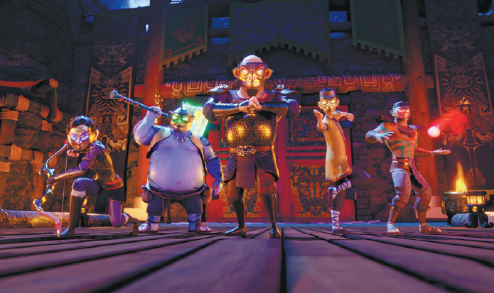
Heroes of the Golden Mask, directed by Canadian animation veteran Sean Patrick O'Reilly, was released in domestic theaters on Dec 29.
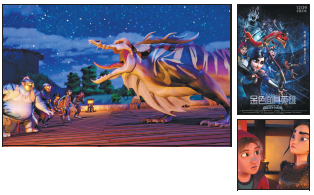
Combining elements of fantasy and adventure, the film fictionalizes an ancient realm ruled by a king named Yufu, and protected by a team of five warriors from various civilizations from China, East Asia, the Mayans and Atlantis. These fighters possess superpowers when they wear their golden masks.
Li Xian, the only female among the five, is entrusted by her father — a golden-mask warrior who dies in the battle against an evil invader — to find his successor. Fate leads the young woman to embark on a journey, traveling through time to the modern world, where she unexpectedly discovers that a troubled teenager named Charlie is the chosen heir. Despite their initial conflicts and differences, the two protagonists join forces with three other warriors, defeating their enemies and restoring peace to the kingdom.
Producer Zhang Zhihong recalls that the project, which was launched in 2015, featured plans to create a Sanxingdui culture-themed franchise, including a novel series, an animated movie, a computer game and a theme park.
After the Chinese creative team finalized the story outline, Canadian author John Wilson, who is known for historical tales, wrote The Ruined City, the first volume in the Golden Mask series. Following the novel's publication in 2018, the outline was developed into the film's script with a Chinese version for China, and an English version for North America.
In order to seek more inspiration about the ancient civilization that once prevailed in Southwest China's Sichuan province, the film crew — consisting of animators and writers from home and abroad — went to several famous archaeological sites and historical attractions in the province, including the Sanxingdui site in Guanghan, the Jinsha site in Chengdu and the ancient ethnic Qiang city in Maoxian county in Aba Tibetan and Qiang autonomous prefecture.
Some of the most-celebrated artifacts on show at the Sanxingdui Museum, which has authorized their use in the movie, include a bronze mask with protruding eyes, a nearly 4-meter-high bronze tree, a jade tiger and a golden scepter.
"The many cultural relics and artifacts collected at the museum showcase exquisite craftsmanship, making them a treasure trove of great academic and archaeological significance. We hope that the movie will promote Sanxingdui culture to a broad international audience," says Zhang, who's also chairman of Sichuan Golden Image Cultural Communication Co.
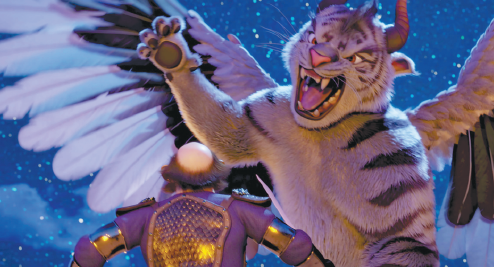
In addition, some of the monsters in the movie, including a formidable tiger with white fur and a pair of wings, have been inspired by descriptions found in Shan Hai Jing (The Classic of Mountains and Seas), a collection of Chinese mythology believed to have been written more than 2,000 years ago.
Zhang recalls there were sometimes cultural differences with their Canadian colleagues when discussing the designs of the characters.
For instance, one of the five golden-mask warriors is a young man named Zhu Long, who can transform into any of the 12 animals of the Chinese zodiac. However, due to his fear of heights, the creature he is most reluctant to transform into is the dragon.
In Chinese culture, the dragon symbolizes power and auspiciousness. Throughout history, dragons have been used by many Chinese emperors to adorn their palaces, representing the pinnacle of authority. However, Western legends and myths mostly portray dragons as fire-breathing and malevolent beasts.
"We want the movie to introduce Chinese culture to a wider foreign audience. Therefore, our Chinese team tried hard to persuade their foreign counterparts that Zhu's dragon avatar should emanate a noble temperament. Comfortingly, they accepted our suggestion," says Zhang.
Speaking of the design of Yufu, the ruler of the kingdom depicted as the creator of Sanxingdui culture in the movie, Zhang recalls that the creative team conducted extensive research. They delved into legends and literary works such as the famous poem Shu Dao Nan (The Difficulty of Shu Roads) by Tang Dynasty (618-907) poet Li Bai, which mention the King Yufu on which the film is based.
"Yufu was originally depicted as a fisherman in certain legends and myths," Zhang says.
"We can only imagine what he looked like. The Western team once envisioned him as a slightly hunched, skinny old man. However, we still wanted his appearance to be more majestic and noble. The final design combines elements from both teams."
He adds that he hopes the film will encourage more international interest in China's ancient civilization and culture, as more related products are in the pipeline.


Today's Top News
- Property mkt bracing for big overhaul
- Volunteers key to advancing modernization
- China, Russia vow to defend WWII legacy
- Japan will pay a heavy economic price if it pursues Takaichi's militant agenda
- French President Emmanuel Macron arrives in Beijing
- Cold wave, strong winds grip many parts of country