Pillow talk that speaks volumes
An exhibition examines what nighttime head rests say about social development in ancient times, Qin Feng and Chen Meiling report.







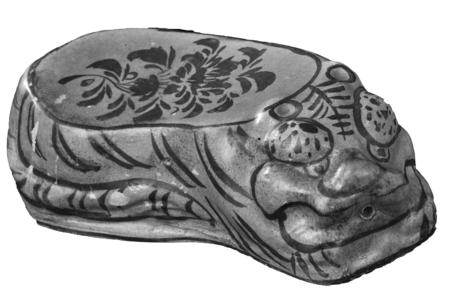
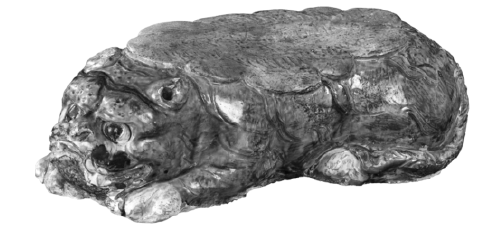
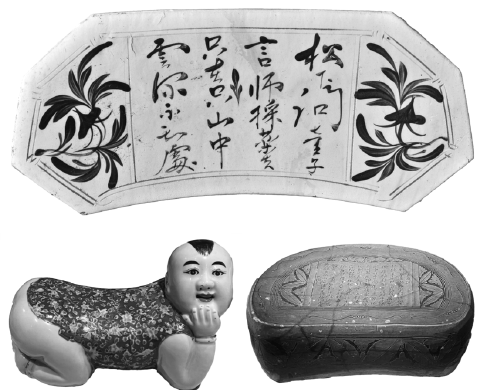
A tiger on its stomach. A reclining woman. A lion with her cub. A bare-bottomed boy resting his chin on his hand. Some are cubes. Some are round. And some are polygons. Most are porcelain. An ongoing exhibition in Baoji, Shaanxi province, shows how pillows can be much more than just places to put our heads while we sleep.
The exhibition, which runs until April 10, displays 121 ancient pillows from the Western Han Dynasty (206 BC-AD 24) until early 20th century. It's co-organized by the Baoji Bronze Ware Museum in Shaanxi and the Nanyue King Museum in Guangzhou, Guangdong province.
In ancient China, pillows demonstrated aesthetic sensibilities and conveyed good wishes. Cat-shaped pillows, for instance, symbolized hopes that a couple would enjoy good health while growing old together. Ceramic pillows shaped like babies signified fertility. And so on.
"These pillows, made using various materials and designs, are not just daily items but also artistic creations with cultural and historical value," says Guo Jing, director of the exhibition department of the Baoji Bronze Ware Museum.
"They show vivid social scenes from different periods and interesting folk cultures, and contain memories of the past. We hope that these relics help visitors enter the world of the ancients," she says.
A particularly special exhibit is the pearl pillow unearthed from the tomb of the King of Nanyue, a kingdom that existed from 204 BC to 111 BC. It was established after the collapse of the Qin Dynasty (221-206 BC), and encompassed what is now Guangdong, the Guangxi Zhuang autonomous region and surrounding areas.
The pillow is made of 470 unprocessed pearls, with diameters ranging from 0.1 to 0.4 centimeters, indicating its owner's elite status.
Another special exhibit is a tiger-head pillow, which symbolizes courage and strength, according to Guo.
"Tiger-head pillows are made in various ways," she explains.
"Some craftspeople embroider images of the head. Others carve or sculpt them from jade, wood or porcelain. In ancient times, these pillows were often for children, and represented good fortune and healthy growth."
Ancient craftspeople would often incorporate motifs like mountains, rivers, flowers and animals, or inscriptions of poems, literary passages or proverbs, when making everyday items.
As such, some pillows carry verses like, "your descendants have their own good fortune; do not work as horses and cattle for them", or portray scenes of lotus ponds with green birds, eagles catching rabbits, or children at play.
"Ancient people's harmonious relationships with nature is displayed within this small realm — a pillow," she says.
There are a few theories as to why ancient pillows are hard, rather than soft. One idea is that a gentleman's virtue was likened to jade and, as such, should be of a similar feel. Another is that hard pillows better support the neck, stabilize the head and improve blood circulation in the eyes and consequently improve vision.
Also, ceramic pillows are cooler and can help lower body temperatures, which is refreshing in the summer heat.
Li Ming, who visited the exhibition earlier this month, says he knows that ancient and modern pillows are different. He has watched some TV dramas in which emperors sleep on luxurious bejeweled pillows.
"I thought hard pillows might lead to problems like a stiff neck. But the guide mentioned that there are medical accounts suggesting that hard pillows can improve vision. That surprised me. I want to try it myself," he says.
Li says he'll recommend the exhibition to family and friends.
"It's interesting that we can learn about ancient social conditions and customs through pillows. It's like seeing a big world through a small object."
The earliest known pillows can be traced back to the Neolithic period, and the earliest physical evidence of pillows in China comes from the Warring States Period (475-221 BC).
In the Han Dynasty (206 BC-AD 220), nobles were buried with jade pillows. During the Sui (581-618) and Tang (618-907) dynasties, the ceramics industry flourished, and porcelain pillows emerged. The development of porcelain pillows peaked during the Song, Liao, Jin and Yuan dynasties (960-1368), gradually declining after the Ming and Qing dynasties (1368-1911).




Today's Top News
- Xi congratulates 50th founding anniversary of Lao People's Democratic Republic
- Enhancing old-age finance prioritized
- French president to pay three-day state visit
- Tobacco control measures shouldn't go up in smoke
- Strategy defines growth trajectory
- Opportunity to reconnect Europe with China