A Neolithic site in Jiangsu tells new stories







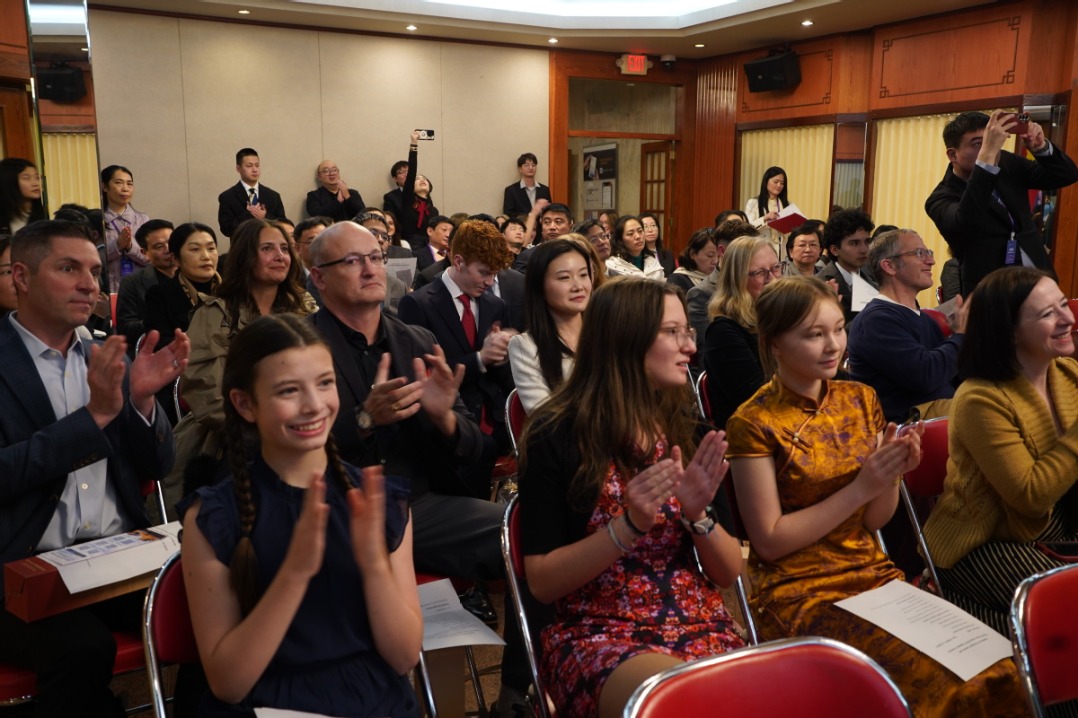
The latest discoveries at the Neolithic settlement of Sanxingcun in the Yangtze River's lower reaches were recently highlighted at the fifth Shanghai Archaeology Forum.
The site, dating from 6,500 to 5,500 years ago, in what is today Jintan district in Changzhou, Jiangsu province, was found during the second national census of cultural relics in 1985. The six-year excavation carried out there in the 1990s, involved the unearthing of more than 1,000 Neolithic tombs, 4,000 artifacts and 1,200 well-preserved human bones. It was officially listed as one of China's Top 10 Archaeological Discoveries in 1998.
The latest excavations there started in 2022, and are continuing what was started 30 years ago. It is being carried out by the Chinese Academy of Social Sciences' Institute of Archaeology, the Nanjing Museum, the Changzhou Institute of Archaeology and the Jintan Museum.
The new excavations have uncovered more than 570 finds from the Neolithic period to the Qing Dynasty (1644-1911). The highlight is a settlement dating back to the middle and late periods of the Majiabang Culture and the early period of the Songze Culture. These Neolithic cultures in the lower reaches of the Yangtze River date back roughly 6,000 and 5,500 years, respectively.
The site covers about 350,000 square meters. A roughly 10,000-square-meter loess platform stands in the middle.
Altogether 345 tombs, 210 ash pits, 12 houses and other structures, as well as about 1,000 artifacts have been unearthed during the latest excavations, Institute of Archaeology researcher Li Moran says.
Based on the distribution patterns of Neolithic remains and artifacts, the entire site can seemingly be divided into functional zones, including residential, burial, and bone-tool and pottery production areas.
"This time, we're planning to excavate the central loess platform, the tombs in the south, and the residential and handicraft workshop areas in the north, and expect to develop a panoramic view of how people lived there about 6,000 years ago," says Li.
A highlight of the artifacts is a ritual object made of three parts — a stone yue axe, a bone ornament on its top and an ivory decoration at its base. It's believed there was likely a handle connecting the three that hasn't been found.
Similar artifacts have been found in the Archaeological Ruins of Liangzhu City, a UNESCO World Heritage Site in Hangzhou, Zhejiang province, but the one from Sanxingcun is even older, says Institute of Archaeology researcher Li Xinwei.
"It seems the regard for the yue axe as a symbol of power and the custom of decorating it persisted, and the oldest specimen to date comes from this site," says Li Xinwei.
Consequently, this excavation may enhance understanding of the lineage of ancient cultures in the Yangtze River's lower reaches, says Li Moran.
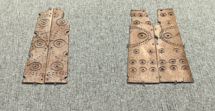
Four carved bone boards, which had never been found in China before, were discovered in a tomb on the site. The grave belonged to a young female, who's thought to have been the leader, since her tomb seemed to convey the most status among those on the site from that time. Another 15 funerary objects, including bone hair clasps and spoons, and jade artifacts, were discovered inside. The find suggests a matriarchal society with a female leader.
The boards adorned with concentric circles and dotted lines were found on the left side of her chest. These two patterns are typical of the Neolithic, Hebei Normal University archaeology professor Tang Huisheng says.
There are different theories as to their functions. Some scholars believe they were used to make records, while others believe they may have served religious or magical purposes.
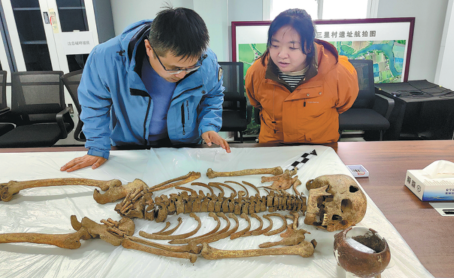
Most of the human bones found at Sanxingcun were well-preserved.
"They're hard and solid, whereas most human bones found in the Yangtze's lower reaches from this time aren't," Li Moran says.
"This fills in some gaps in the samples between China's north and south during the Neolithic."





Today's Top News
- China, Russia vow to defend WWII legacy
- Japan will pay a heavy economic price if it pursues Takaichi's militant agenda
- French President Emmanuel Macron arrives in Beijing
- Cold wave, strong winds grip many parts of country
- Russia's visa-free policy to promote tourism
- Yuan poised for stronger global role