Brush up on the past
New exhibition pays tribute to Huang Binhong's dedication to tradition and innovation, which helped initiate a new era for Chinese ink painting, Lin Qi reports.







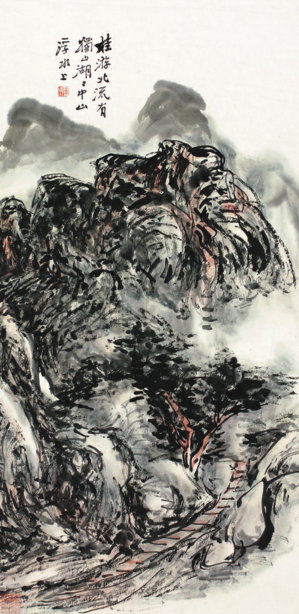
Nearly seven decades after his death, Huang Binhong's art remains visually unappealing and just as difficult to comprehend as ever for many members of the public. Now hailed as one of the greatest ink artists of 20th-century China, Huang created a distinctive vocabulary of painting.
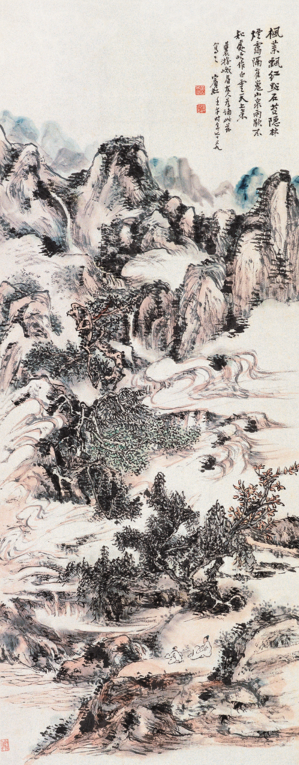
His landscapes use few colors and rely mostly on varying shades of ink, and his work has sometimes come to be referred to as the "Binhong-style dark". He liked to depict mountains and trees as big circles, or uneven triangles, in messy strokes, and often shaded his subjects in inclined angles, making them look as if they were about to fall down or fall apart.
Huang himself was fully aware that his very individual style was not favored by many people, or even by the market, and foresaw that this would continue for years. Despite this, he never doubted his exploration of the realm of ink, and for people who are fascinated by his art — whether in his time or today — the avant-garde spirit that motivated him to change the Chinese ink tradition has ensured him prominence in Chinese art history.
For years, exhibitions have been mounted to help the general audience better understand Huang, his art and his belief in Chinese cultural tradition.
Immortal Legacy, the latest such effort, is currently being held at the Art Museum of Beijing Fine Art Academy. The exhibition, which runs until April 21, is a collaboration with the China Academy of Art Library and the Zhejiang Provincial Museum, both in Hangzhou, Zhejiang province, where Huang lived and taught in the later years of his life, and which both house extensive collections of his work, manuscripts and documents.
Wu Hongliang, director of the Beijing Fine Art Academy, says that Huang is recognized as a "pinnacle" of modern Chinese art who "devoted his whole life to carrying on the cultural lineage, and who meanwhile possessed a modern spirit and a universal outlook".
"Huang was an industrious creator, and thinker. He looked back to the past which empowered him to have insight into the present and future, to enrich the tradition, and to usher his contemporaries into a realm to take Chinese ink art to a new height," Wu says.
The exhibition brings together paintings from the collections of several institutions, Huang's photos and manuscripts, as well as magazines he edited, to show the full extent of his accomplishments.
Inheritance and reform
Huang was noted for his full understanding of the core of Chinese painting. He once said that "one would not be accomplished (in painting) if one didn't learn from the prominent artists of history".
He is particularly known for his expertise in the art of the Song Dynasty (960-1279), a time when Chinese painting reached a peak in terms of technique and artistry. He said that Song painters found a balance between figurative depictions and the delivery of temperament, mood and emptiness, and that he looked to present the same harmonious feeling in his landscape paintings, layering ink in a heavy, dense way to convey a sense of weight and dignity.
But Huang was not one to stick to the rigid conventions of Chinese painting. He had no intention of staying in his studio and simply repeating what his predecessors painted.
He spared no effort in making breakthroughs and traveled extensively around the country to draw inspiration from its varied landscapes. He was a loyal follower of Shitao, a revolutionary painter of the 17th century, who once said that a painter should "view all the awe-inspiring landscapes, and let their feelings and imaginations draw (from them)".
Huang himself once said that "a painter should learn from his contemporaries and also those who lived in ancient times; and what is more important than learning from our predecessors is learning from nature".
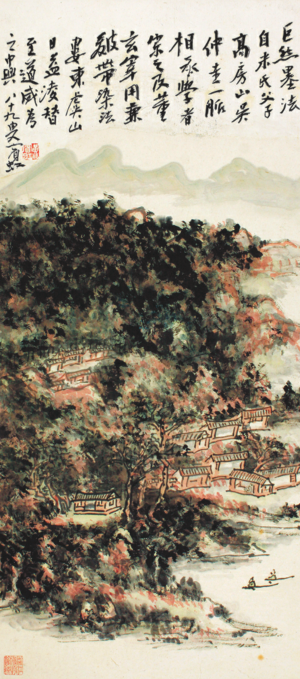
His landscape paintings show his predilection for the scenery of southern China, where he grew up and spent the largest part of his life.
Born in Jinhua in Zhejiang province, in later years, he returned to his ancestral village in Shexian county, Anhui province, several times. The distinctive natural landscape of Shexian has drawn artists and intellectuals for centuries, and it is also famous for producing fine quality ink and ink slabs.
Huang was also inspired by the landscapes of Hangzhou, especially by the areas around the West Lake. He spent seven years teaching at the China Academy of Art, which is located by the picturesque lake, before his death in 1955, and the view inspired him to paint several of his signature paintings.
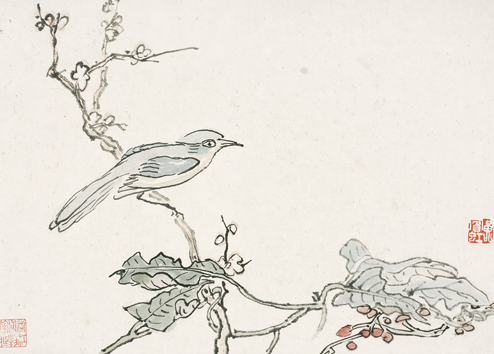
He made a reputation with his landscapes, and so visitors to the exhibition may be surprised by his flower-and-bird paintings, which show a majestic grace.
No one has summarized this strand of his work better than Zhang Zongxiang, an eminent late calligrapher and seal artist. "The brushwork, color arrangements and composition of Huang's paintings show us a brand-new world he created; they are serene and classic, and they soothe one's heart," he once commented.
Broad vision
Despite his mastery of painting, Huang wanted to be independent in creation and didn't live from selling his work. Instead, he wrote a lot, worked as an editor at publishing houses and magazines, took on teaching jobs at different schools, and even owned an antique store. He was an active scholar, keen on socializing, and often organized salons for members of cultural circles, sometimes at his store.
He was a consummate painter, calligrapher, and seal engraver, versed in the studies of archaic Chinese characters on objects such as oracle bones, ceremonial bronzes and stone tablets. He was also knowledgeable about gastronomy, tai chi, weiqi (Go) and traditional Chinese medicine.
Zhang Jian, co-curator of the exhibition and a professor of modern Chinese art at the China Academy of Art, says that Huang was an erudite master scholar, with wide-ranging interests. "Because of his extraordinary vision of art and the world, Huang was able to breathe new life into Chinese painting, and thereafter revive Chinese culture."
Huang died in 1955, but his thorough research continues to benefit others. At the memorial service held the day after his death, his family made a large donation to the country including his works and his vast collection of antiques, which include paintings, calligraphy and vintage seals, ceramics, jade objects, stone rubbings, manuscripts and letters. These are all held in the collection of the Zhejiang Provincial Museum, and some of them are now on show in the current exhibition.


Today's Top News
- Fudging position on Taiwan question unmasks Takaichi's ulterior motives: China Daily editorial
- Blowing 'hot and cold' won't benefit the UK
- Xi congratulates 50th founding anniversary of Lao People's Democratic Republic
- Enhancing old-age finance prioritized
- French president to pay three-day state visit
- Tobacco control measures shouldn't go up in smoke