SAR a 'showroom' for mainland brands







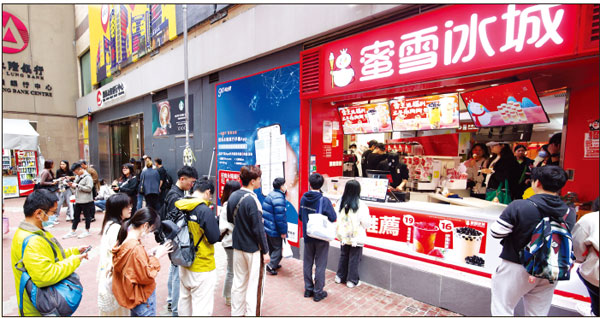
Dining brands from the Chinese mainland are making a beeline for Hong Kong's bustling commercial districts.
The high-profile arrivals over the past year have been mostly household names like spicy fish dish maker Tai Er and bubble tea chain Mixue Bingcheng.
In the lively neighborhood of Mong Kok, crowds throng Mixue Bingcheng's store at weekends, offering a snapshot of the newcomers' rise to fame. According to a local consumer, many mainland restaurants have become top alternative places for gatherings and working lunches.
Mainland chains venturing into the special administrative region are attracted for a host of reasons, including business opportunities, as the growing northbound spending trend has sparked their brands' profile among Hong Kong residents, says Kenneth Kwong Ka-kei, assistant professor at the marketing department of the Hang Seng University of Hong Kong.
Last year, 53.3 million Hong Kong travelers visited the mainland, accounting for 74 percent of the total number of outbound visitors from the city, according to the Immigration Department.
The SAR's superior international standing, with cultural diversity and great tourist appeal, is also favorable to mainland companies' prospective global expansion, says Kwong. "Hong Kong is a good showroom. Mainland enterprises can explore not only Chinese consumers, but also access people with a different culture from across the globe that might help them further expand to the outside world."
Mainland companies' presence in Hong Kong is often seen as a prelude to wooing international capital - a good example being Haidilao International Holding, a Beijing-based hotpot chain that opened its first eatery in the SAR in 2017. In less than a year, the chain, known for its free services and entertainment, such as manicures offered to waiting customers, raised HK$7.27 billion ($932 million) in one of the city's largest initial public offerings in 2018.
The timing of their arrival was ideal as it came when businesses could find a bargain place in Hong Kong's competitive commercial property market.
Tony Lo Chin-ho, chief executive of Midland's industrial, commercial and investment property wing, says prime retail spaces in Hong Kong's major business districts still have a good supply of shops.
In the case of Hefu Noodles - another mainland brand set to tap the local market - Lo says the chain's reported monthly rent of HK$300,000 in Causeway Bay's Russell Street is a drop of almost 70 percent from the peak.
Differentiation is key
However, fierce competition in the local market may pose challenges to mainland food and beverage operators' expansion plans, Tai Hing-shing, convener of Hong Kong-based think tank Academia, stated in an article published in Singapore's Chinese-language newspaper Lianhe Zaobao.
Dubbed Asia's gastronomical capital, Hong Kong is home to a tantalizing array of culinary delights catering to the discerning taste buds of locals and visitors.
It's reminiscent of a southward trend in the 2000s when brands like Sichuan-style hotpot chain Tanyoto entered Hong Kong. The mainland firm, which initially enjoyed considerable popularity, soon found it difficult to retain a consistent customer base and closed down in 2014.
For new dining brands, it's essential to "differentiate themselves" to make a mark in Hong Kong's culinary industry, but it's a tough task, given the competitive landscape, Tai wrote. "Only time will tell how long this latest wave of mainland food and beverage brands entering Hong Kong will last."
On a more positive note, the arrival of mainland brands offers strong benefits to the local consumption market amid weaker-than-expected spending as newcomers are expected to spur benign competition, says Kwong.
Chief Executive John Lee Ka-chiu has made rebooting local consumption a key part of his administration's efforts to drive the city's post-pandemic growth following years of economic contraction. A series of measures has been launched, including night markets held in various districts as part of the Night Vibes Hong Kong campaign.
According to the provisional data of the Census and Statistics Department, retail sales had risen by 7.8 percent year-on-year in December to HK$36.3 billion, but still fell short of pre-pandemic levels.
"Newcomers will actually encourage an improvement. When local retailers face their counterparts from the mainland, they might think about how to improve their services and products," Kwong adds.
evanliu@chinadailyhk.com


- IBLAC members eye AI potential on Shanghai's West Bund
- China sends new navy fleet on escort mission in Gulf of Aden, waters near Somalia
- Marxist classics compilation yields fruitful results in China
- China's water governance achievements
- Chinese vice-premier stresses efforts to consolidate poverty alleviation achievements
- Number of registered Nanjing Massacre survivors falls to 24