The race to record disappearing cultures
Following on from Yunnan pilot, the national library launches project to document traditions of small-population ethnic groups, Wang Qian reports.







When Pumi ethnic group singer Rongbaxinna visited Cao Changshou, a famous Pumi storyteller in his 90s in Yunnan province in 2018 and 2021, she knew that the clock was ticking on preserving the traditions, cultures and languages of the 28 small ethnic groups in China, each of which has a population of just under 300,000.
As the last generation fluent in the language and culture of the Pumi ethnic group, which has about 45,000 members, Cao passed away after Rongbaixinna's last visit, with only 20 ancestral tales recorded in his mother tongue.
"The loss of the elders of these ethnic groups is heartbreaking to see; they are like living museums, who store cultural treasures in their minds. We must rescue and record these treasures before they are gone," Rongbaxinna says.
The 43-year-old was taught to sing by her grandfather, whose melodies always transported her to a dreamland in her childhood imaginings. His death rang the alarm for her to rescue disappearing traditional art forms, and she set up a national database to record the cultural heritage of these small ethnic groups.
As the initiator of the archival project for the oral traditions of ethnic groups with small populations, Rongbaxinna describes the project as a race against time as many unique, centuries-old traditions, traditions of song, dance, crafts and festivals, are already under threat, and in some cases may soon disappear.
Thanks to a pilot program launched by the National Library of China, the Yunnan Provincial Publicity Department and the Yunnan Intangible Cultural Heritage Protection Center in 2018, the cultures of eight ethnic groups in Yunnan — the Jingpo, Blang, Achang, Pumi, Nu, De'ang, Derung and Jino — have been listed, and four have already been documented.
These include 97 folk songs and 58 folk tales of the Derung, which is China's smallest ethnic group, with a population of just 7,310, among whom 20 people interviewed; 104 folk songs and 58 folk tales of the Jino, with 71 people interviewed; and the 116 folk songs and 113 folk tales of the Nu, with 51 people interviewed.
Following up this pilot program, the National Library of China signed a cooperation agreement in Beijing on Jan 25 for the traditional oral archive project with provincial-level libraries in the 13 provinces and regions that are home to the 28 small ethnic groups.
"Most of these ethnic groups do not have a writing system, which has hindered the spread of their culture. They can only survive if people continue to pass their traditions on by mouth. By launching this project, we can collect and document vivid narratives, such as ancestral tales told in their native tongue with the aid of song and dance, through multimedia channels," says Huo Ruijuan, deputy director of the National Library of China.
The archives will be available for the use of scholars and the public to promote cultural diffusion and protect the nation's cultural diversity for future generations, she adds.
As oral traditions play a crucial part in keeping cultures alive, UNESCO suggests that mass media and communication technologies can be used to preserve and even strengthen oral traditions and expressions by broadcasting recorded performances both to their communities of origin and to a wider audience.
For Pai Dang, a tuliang player from the Jingpo ethnic group, the passing on of the group's folk music means the survival of their way of life and the preservation of their history. Tuliang is a transverse wind instrument made of bamboo, with a single embouchure hole and no finger holes.
"Only a dozen people are learning to play it. I welcome anyone who wants to learn," he says, adding that, after the tradition has been passed down through the generations, he is afraid that it may disappear one day for lack of inheritors.
He knows the survival of Jingpo folk music depends on initiatives such as the oral tradition archival project.
For Rongbaxinna, it is not only a group's language or music, but also its culture, worldview, values and principles that inform future generations, and teach them about their past.
Rising to national fame in 2006 as a participant in a youth singing contest on China Central Television, Rongbaxinna knows that Pumi folk songs earned her recognition at home and abroad.
"It is the ethnic songs of Yunnan that have taken me to the national and international stage, and which have the power to transcend language barriers and connect people from different cultures and backgrounds," the singer says.
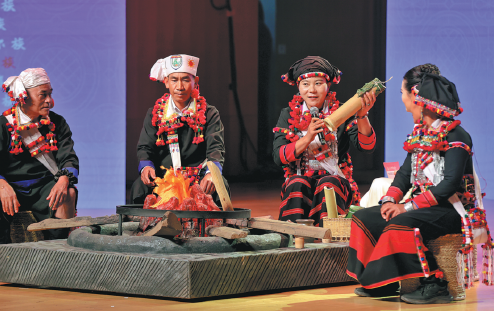
During the cooperation agreement ceremony at the National Library Arts Center late last month, folk artists from the eight ethnic groups in Yunnan performed dances and songs, including the Jino big drum dance, which was listed as a national-level intangible cultural heritage in 2008, and the Munao Zhaiwa (a Jingpo epic told in a mix of poetry, singing and dancing), as part of the Yunnan Province Pilot Project Exhibition and Performance Showcase. The theme was "Holding Tight in Memory".
On the stage, Dong Cunlian, a 70-year-old Derung woman, introduced the traditional art of facial tattooing. To prevent them from being carried off as slaves, the Derung traditionally tattooed the faces of their women, usually when a girl reached the age of 12 or 13. Only about 20 Derung women have facial tattoos today.
Lei Jia, who is a professor at the China Conservatory of Music, artistic director of the performance showcase and also one of the participants in the 2018 oral tradition project, says the oral traditions of ethnic groups take many forms, from folk singing and poetry to lecturing, and embody the experience and knowledge of countless generations. These traditions not only reflect ethnic groups' history, but also contain their particular understanding of the universe and nature, and form part of the country's collective memory.
"The unique cultures of ethnic groups with small populations is the common wealth of the nation, and we have the responsibility to preserve them and carry on them, and for their stories and songs be heard by more people," Lei says.






Today's Top News
- Fudging position on Taiwan question unmasks Takaichi's ulterior motives: China Daily editorial
- Blowing 'hot and cold' won't benefit the UK
- Xi congratulates 50th founding anniversary of Lao People's Democratic Republic
- Enhancing old-age finance prioritized
- French president to pay three-day state visit
- Tobacco control measures shouldn't go up in smoke