Ancient Shu shines in Shanghai
New museum's first exhibition is part of an ongoing series that is dedicated to tracing origins of Chinese civilization, Zhang Kun reports in Shanghai.







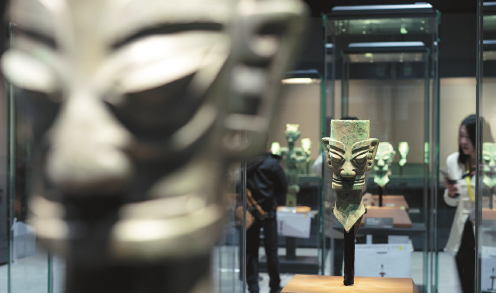
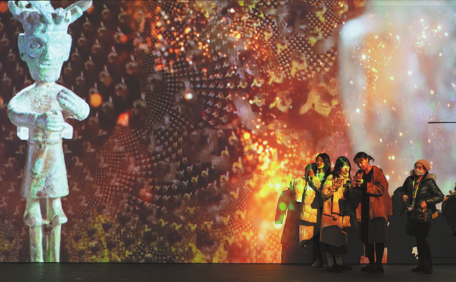
Shanghai Museum East had its soft opening on Friday with the exhibition, Stars Over China: The Ancient Shu Civilization of Sanxingdui and Jinsha.
Construction of the new museum opposite the Shanghai Science and Technology Museum in the Pudong New Area started in 2017, and it is expected to open to the public this year in three phases.
Shanghai Museum East has six stories, with a gross floor area of 113,200 square meters.
Its exhibition space will be divided into 20 halls covering a total area of 33,600 sq m. It is expected to receive more than 5 million visitors every year.
The first to open alongside the Sanxingdui exhibition will be the hall of Chinese bronze art, which houses around 500 objects that present the development of bronze art in China from the 18th century BC to the mid-1800s in seven sections.
The Shu region was an ancient state in southwestern China that lasted for more than a millennium before its fall in the fourth century BC. Excavations of the Shu civilization, most notably at the Sanxingdui and Jinsha sites, started in 1929 and since the 1980s important discoveries have been regularly made.
Stars Over China: The Ancient Shu Civilization of Sanxingdui and Jinsha is hosted by the Shanghai Museum, the Sichuan Provincial Institute of Cultural Relics and Archaeology, the Sanxingdui Museum in Guanghan and the Jinsha Site Museum of Sichuan province.
Featuring 363 objects, including the latest archaeological finds fresh from preliminary cleaning, the exhibition is the largest display of ancient Shu civilization outside its home province of Sichuan.
Over 200 of the objects have come from Sichuan, but the Shanghai Museum has also managed to borrow objects from 25 other museums and institutions all over the country that reflect the connections between the Shu civilization and other parts of China.
"We believe the exhibition will be phenomenal," says Chu Xiaobo, director of the Shanghai Museum.
The institution began accepting online bookings on its WeChat social platform a few days ahead of the opening.
"We have reserved space for 8,000 visitors every day, and in five minutes we were fully booked," he says.
"We are confident we'll be able to turn the new Shanghai Museum East into a cultural landmark recognized by the whole world."
On Jan 29, the Shanghai Museum invited members of the media to witness the unpacking of two signature exhibits for the upcoming exhibition.
The first was Bronze Figure With Towering Strands of Hair, which dates to between the 13th century and 11th century BC. Standing 104 centimeters tall, the statue's knees are bent and its buttocks are prominent in a posture resembling that of a person doing a dead lift.
The figure has changed people's impressions of traditional Chinese art, says Hu Jialin, a bronze researcher at the Shanghai Museum, because it is commonly believed that traditional Chinese art tended to emphasize the abstract and avoided realistic depictions of the human form.
"This figure shows that realistic representations of human figures were found in China as early as 3,000 years ago."
Hu points out that contrary to the public perception that Sanxingdui and Jinsha art was "exotic" and different, it was an integral part of ancient Chinese art, and was closely connected to cultural relics found in many other parts of the country.
"We noticed the similarly realistic depictions of animal forms on bronze art in the Yangtze River watershed," Hu says.
"And we believe the terracotta soldiers were somewhat influenced by the bronze figures of Sanxingdui."
The second artifact unveiled to the media was a gold mask excavated at the Sanxingdui site in 2021.
"We have found similar masks at the Jinsha site, and this shows that Sanxingdui and Jinsha share a similar cultural root," Hu says.
Archaeologists have speculated that the mask was originally placed on a bronze head sculpture and was important to the worship of gods during Shu sacrificial ceremonies, he says.
The latest exhibition is the third in the Shanghai Museum's ongoing series, The Essence of China, which aims to present the origins of Chinese civilization through a series of exhibitions over the course of a decade, according to Chu.