Sichuan's dragons burn bright
The southwestern province is decoratively illuminated to celebrate the mythical zodiac creature and Lunar New Year, Huang Zhiling reports in Chengdu.







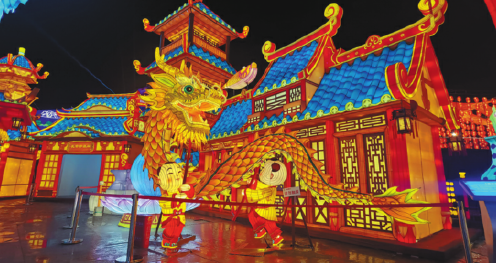
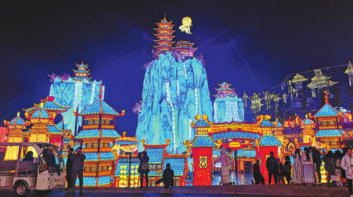
These days, the Jinsha Site Museum transforms into a dreamy otherworld of light at night. The destination in the western part of Sichuan province's capital, Chengdu, is hosting an 18-day lantern festival through Sunday to celebrate Spring Festival and the recent arrival of the Year of the Dragon. As such, the mythical creature appears in festive displays throughout the museum.
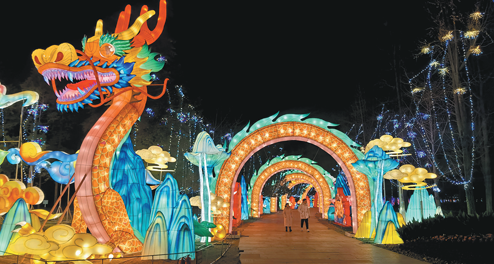
On the right side of the archaeological site's iconic sunbird statue is an imposing dragon lantern with its body coiled into five arches that draws visitors who take photos of it.
"Seeing the gigantic dragon (lantern) is an auspicious sign for many," says local youth Niu Yong. "So, I also posed for a picture with it."
The 300,000-square-meter museum, which is a national archaeological park, displays over 140 groups of lanterns with themes related to dragons, sun worship and ancient Shu culture. Shu is Sichuan's ancient name.
The Jinsha Ruins site on which the museum is located is home to a 3,000-year-old gold-leaf sunbird artifact excavated in 2001. The State Administration of Cultural Heritage adopted this golden disc as an official symbol of Chinese cultural heritage in 2005.
The administration says it made the decision based on the bird's exquisite craftsmanship, and its representation of ancient Chinese sun worship and the nation's enterprising spirit, according to museum curator Zhu Zhangyi.
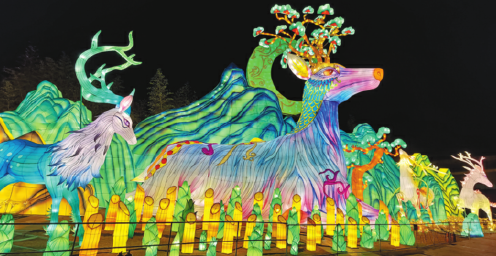
About 3,000 years ago, the ancestors of Shu regarded the deer as a totem and used antlers to express animistic beliefs. Today, outside the museum's relics hall where important artifacts were excavated in 2001, a 15-meter-tall deer-shaped lantern looks over the brightly lit ancient Shu people's homeland.
Sichuan is one of the important birthplaces of Chinese culture, where human activity can be traced back to 2 million years ago. The province boasts rich cultural relics, such as those at the Piluo Paleolithic site in Daocheng county and the Sanxingdui Ruins in Guanghan, a city under the administration of Deyang.
In Deyang, which is about 88 kilometers from Chengdu, a 37-day lantern festival that runs until March 9 is being staged in Xuanzhuhu Park.
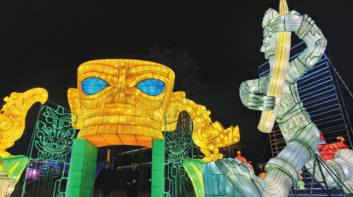
Covering 53 hectares and featuring 1,060 groups of lanterns, the festival features relics from the Sanxingdui Ruins, traditional customs pertaining to Spring Festival and contemporary light sculptures.
Golden masks and ivory lanterns from the Sanxingdui Ruins are the most popular icons among visitors, says Deyang Party committee information officer Zeng Jielin.
The Sanxingdui Ruins, which were discovered in 1929 by a farmer digging a ditch in his fields, and the Jinsha Ruins are closely related. Archaeologists have made comprehensive analyses of relics from both ruins, including gold, bronze, jade, stone, ivory and pottery, and have found similarities in their types, shapes and production techniques.
Some researchers believe Sanxingdui's people moved to Chengdu after the civilization suddenly fell in the aftermath of a disaster, such as a flood, and then founded the Jinsha civilization.
Sichuan is promoting both ruins' joint application for inclusion on the UNESCO World Heritage List, Zhu says.
A 62-minute bullet train ride north of Deyang leads to Sichuan's northernmost city, Guangyuan, which is hosting the 24-day Empress' Hometown Lantern Festival through Sunday.
Guangyuan is best known for the Shu Path and as the birthplace of Wu Zetian (624-705), China's only ruling empress.
Construction of the Shu Path, linking Sichuan and neighboring Shaanxi province, started around 316 BC. It was built on mountains so precipitous that luminary Chinese poet Li Bai (701-762) wrote, "Traveling on the Shu Path is as difficult as ascending to heaven".
Wu was the fourth ruler of the Tang Dynasty (618-907). During her reign, she excelled at appointing capable people, and China enjoyed peace and prosperity.
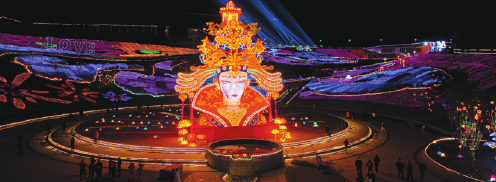
The lantern festival is being held near the exit of the Guangyuan East Expressway with 42 groups of lanterns conveying stories related to Wu, local culture and customs.
Many people especially wish to visit Zigong, a city in the south of Sichuan, whose lanterns are considered to be among China's best.
Viewing lanterns became a Spring Festival custom in Zigong during the Tang Dynasty. The city's lantern show has toured more than 70 countries and regions, becoming a calling card of both Zigong and China.
And Zigong's International Dinosaur Lantern Festival has long been a highlight of Sichuan's winter and its Lunar New Year tourism, attracting a large number of tourists not just to the city but also, more generally, to Sichuan, says provincial culture and tourism official Yan Sashuang. The event's 30th installment runs until Sunday.
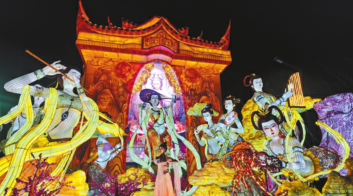
It hosts over 1,000 lantern displays depicting China's 5,000 years of culture, including dragons, bronze ding cauldrons and feitian, a mythical flying creature depicted in Dunhuang's Mogao Grottoes, a UNESCO World Heritage Site in Northwest China's Gansu province.
On the square of the main entrance to the site of the festival, a 48-meter-long dragon lantern rotates 360 degrees to spiral around a sundial. It's the largest mechanical lantern in the festival's history.
Peng Chao contributed to this story.




Today's Top News
- Fudging position on Taiwan question unmasks Takaichi's ulterior motives: China Daily editorial
- Blowing 'hot and cold' won't benefit the UK
- Xi congratulates 50th founding anniversary of Lao People's Democratic Republic
- Enhancing old-age finance prioritized
- French president to pay three-day state visit
- Tobacco control measures shouldn't go up in smoke