Exhibition highlights unique origins







A special exhibition in Guangzhou, capital of Guangdong province, showcases unique Bronze Age civilizations and long-standing Chinese culture.
The exhibition, Nurtured by the Same Water, Bronze Age Civilizations in the Yangtze River Basin, demonstrates the unique temperament and styles of the three ancient Chinese cultural circles of Ba and Shu, Jing and Chu and Wu and Yue, as well as the cultural atmosphere of mutual integration and promotion.
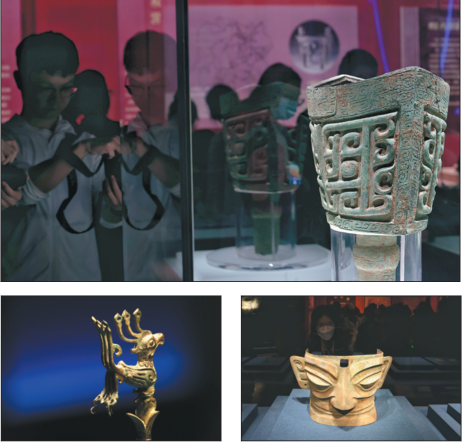
The exhibition in Guangdong Museum in this southern metropolis displays a collection of 137 sets of precious exhibits from the Yangtze River Basin, including 54 first-class cultural relics, depicting the politics, military, culture, society and life in the ancient Chinese dynasties in the region, one of the cradles of Chinese civilization.
Major exhibits include bronze masks, swords and ancient chime bells, which were unearthed in the area.
The exhibition, which opened on Feb 6, will run until June 2. It is co-organized by 18 museums and cultural units from the Yangtze River Basin.
Ye Wei, curator of the exhibition, says it allows visitors to experience, and get a sense of, the unique charm and cultures of Bronze Age civilizations along the winding Yangtze River.
"Meanwhile, throughout the exhibition period, visitors can also participate in various related activities, including interactive digital exhibitions, and making rubbings of bronze ware patterns, to gain a deeper understanding of the Bronze Age civilizations," says Ye, who is also deputy research librarian of the collection management department of Guangdong Museum.
The exhibition consists of four parts, including "Ba and Shu Shine Together", "Heroes Rose Together", "Unity in Diversity" and "Unification of the Country".
Of them, the first part "Ba and Shu Shine Together" interprets the ancient Shu civilization, represented by the Sanxingdui Site, Jinsha Site, and Xindu Majia Wooden Coffin Tomb, from the perspective of the Yangtze River Basin, showcasing the mystery and uniqueness of the Ba and Shu civilizations from multiple perspectives.
Ba and Shu were regions associated with modern-day Chongqing municipality and Sichuan province, named after ancient Chinese states during the Shang (c. 16th century-11th century BC) and Zhou (c. 11th century-256 BC) dynasties.
Ba and Shu were the two most important ancient states coexisting in the area during the pre-Qin period (before 221 BC).
The section "Heroes Rose Together" reveals the grandeur of the feudal kingdoms, the unique and romantic customs of the Jing and Chu, and the advocating of boating and martial arts practice by the ancestors of the Wu and Yue, highlighting the distinctive characteristics of the Bronze Age civilizations in the middle and lower reaches of the Yangtze River.
"Unity in Diversity" analyzes and compares the Bronze Age civilizations in the Yangtze River Basin with the diverse integration pattern of Chinese civilizations in the Central Plains region.
It interprets the characteristics of the open and inclusive Bronze Age civilizations in the Yangtze River Basin, as well as the diversity, exchanges and mutual learning of civilizations in the regions near the Yangtze River and Central Plains.
The "Unification of the Country "section tells the story of the integration of Bronze Age civilizations in the Yangtze River Basin with other Chinese civilizations.
During the Warring States Period (475-221 BC), there were constant disputes among feudal states, and the power of various states grew and waned.
At that time, Qin and Chu were both powerful states and their regional cultures had a very important impact on the development of Chinese civilization.
In the Yangtze River Basin, the influence of Chu culture is particularly prominent.
In 316 BC, Qin conquered Ba and Shu, greatly changing the geopolitical landscape of the late Warring States Period.
Consequently, the dominant trends of Chu culture in the Yangtze River Basin changed accordingly.
With the destruction of the six states by the Qin state, and the subsequent unification of the country, the Bronze Age civilizations of the Yangtze River Basin, which had been in turmoil for thousands of years, merged with main civilizations of China.
The Yangtze River, the longest in China — and the longest in the world to run through a single country — originates from the Qinghai-Tibet Plateau and bisects the entire nation before meeting the East China Sea. The Yangtze River Basin has the most abundant copper resources in China, leading to the rise of Bronze Age civilizations and cultures.




Today's Top News
- Fudging position on Taiwan question unmasks Takaichi's ulterior motives: China Daily editorial
- Blowing 'hot and cold' won't benefit the UK
- Xi congratulates 50th founding anniversary of Lao People's Democratic Republic
- Enhancing old-age finance prioritized
- French president to pay three-day state visit
- Tobacco control measures shouldn't go up in smoke