


Ancient tomb delivers secrets from the past







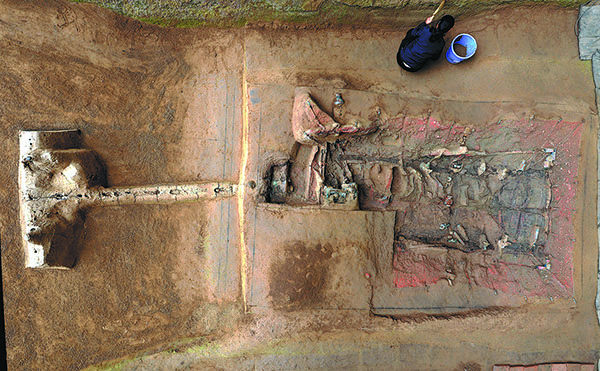
A precious four-wheeled carriage, the first of its kind found in China, has been discovered at a tomb that is part of the mausoleum complex of Qinshihuang, China's first emperor, Qinshihuang's Mausoleum Site Museum in Xi'an, Shaanxi province, announced recently.
It is one of nine large-scale tombs located to the west of the emperor's mausoleum. Excavations started in 2013. To date, archaeologists have excavated tomb passages, a burial room and three chariot burial pits.
According to Jiang Wenxiao, a researcher at the museum and also leader of the project, the tomb dates to the time between the late Warring States Period (475-221 BC) and the establishment of the Qin Dynasty (221-206 BC). It is set somewhat apart from the rest of the site and was surrounded by a ditch to its west and south. To the north was a precipice, and to the east there was a river.
The tomb is 100 meters long, and covers an area of 1,900 square meters. The central coffin has collapsed and is severely deteriorated, with only a few human bones remaining. It was taken to the laboratory for care, Jiang says.
A large amount of pottery, bronze vessels, jade, iron, gold and silver artifacts have also been unearthed in the tomb, some of which are very precious. For example, gold and silver camels found in the burial room are the earliest of their kind found in China.
According to Jiang, the two-humped camel was a rare sight in the Central Plains at that time. As a result, the artifacts may reflect communication between the Qin Dynasty and Xiyu (the western regions, a term to describe today's Xinjiang Uygur autonomous region and Central Asia in the past), and provide a reference for understanding cultural exchange before the Silk Road began operations during the Han Dynasty (206 BC-AD 220).
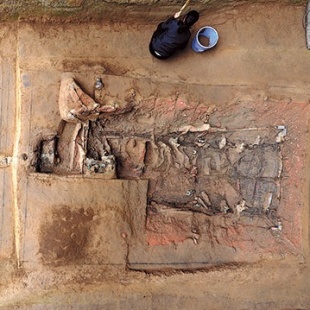
One of the highlights has been the discovery of the four-wheeled wooden carriage found in the tomb passage, which was well-preserved.
The carriage is 7.2 meters long, and still had an intact painted hood. After more than 2,000 years, its red color is still vibrant, Jiang says.
He says their preliminary judgment is that it was closely linked to the funeral process, and was possibly used to transport the coffin.
Carriages of other types and functions have also been unearthed at the tomb, including a wooden carriage found in a burial pit, which was driven by four horses. The horses' bones are intact and were found complete with their tack, showing a scene of the four horses pulling the carriage when the tomb owner was alive, says Jiang.
Another carriage probably pulled by sheep was also discovered. Although it was damaged, the bones of the accompanying sheep are well-preserved. This is also a rare discovery in China, Jiang says.
Although the occupant hasn't been identified, he must have been of high social status since his tomb can be regarded as the primary tomb that accompanies the resting place of the emperor, Jiang adds.
"This is currently one of the largest and highest-ranking Qin noble tombs to be discovered and excavated, and one of the best preserved," says Jiao Nanfeng, a researcher at the Shaanxi Academy of Archaeology, adding that it may provide valuable information about the burial practices of Qin aristocracy, and even of ancient China's emperors.
Earlier excavations of high-level Qin tombs include some to the east of the emperor's mausoleum in Shangjiao village, where 17 tombs were found in the 1970s, eight of which were excavated.
The occupants of the tombs are believed to be the emperor's sons and daughters. They have been killed during political struggles with their sibling, who became the second Qin emperor, according to Liu Qingzhu, a researcher with the Institute of Archaeology at the Chinese Academy of Social Sciences.
Zou Hong contributed to this story.