PV firms eye offshore energy potential
Though industry still exploring new tech, top players are now leading efforts to leverage sector advantages







As demand for renewable energy surges across the world, China's solar power companies are turning their attention away from onshore to harness the untapped opportunities and vast potential of offshore solar energy.
Offshore photovoltaics have been an important part of the national plan in China, the world's largest solar market, since 2022, although the industry is still exploring potential technologies, policy designs and procedures, said the Center for Energy and Environmental Policy Research of Beijing Institute of Technology.
Globally, offshore solar has yet to progress beyond a few pilot projects, as most solar panels are not designed to survive the harsh, corrosive environment of the sea. However, some of China's coastal provinces have big plans for their intertidal zones, said Zhao Tianyi, an analyst at BloombergNEF.
China has taken significant strides in offshore photovoltaics in recent years, especially in Shandong and Jiangsu provinces, she said.
Offshore solar projects involve the installation of solar panels on floating platforms or structures in bodies of water, such as oceans or large lakes. These projects offer several advantages, including increased energy production potential due to unobstructed sunlight, reduced land use, and the potential for more efficient cooling of solar panels.
Compared with solar projects onshore, the offshore ones have a higher capacity factor since the reflective water surface will cast light on the reverse side of bifacial modules, making it attractive for solar companies, Zhao added.
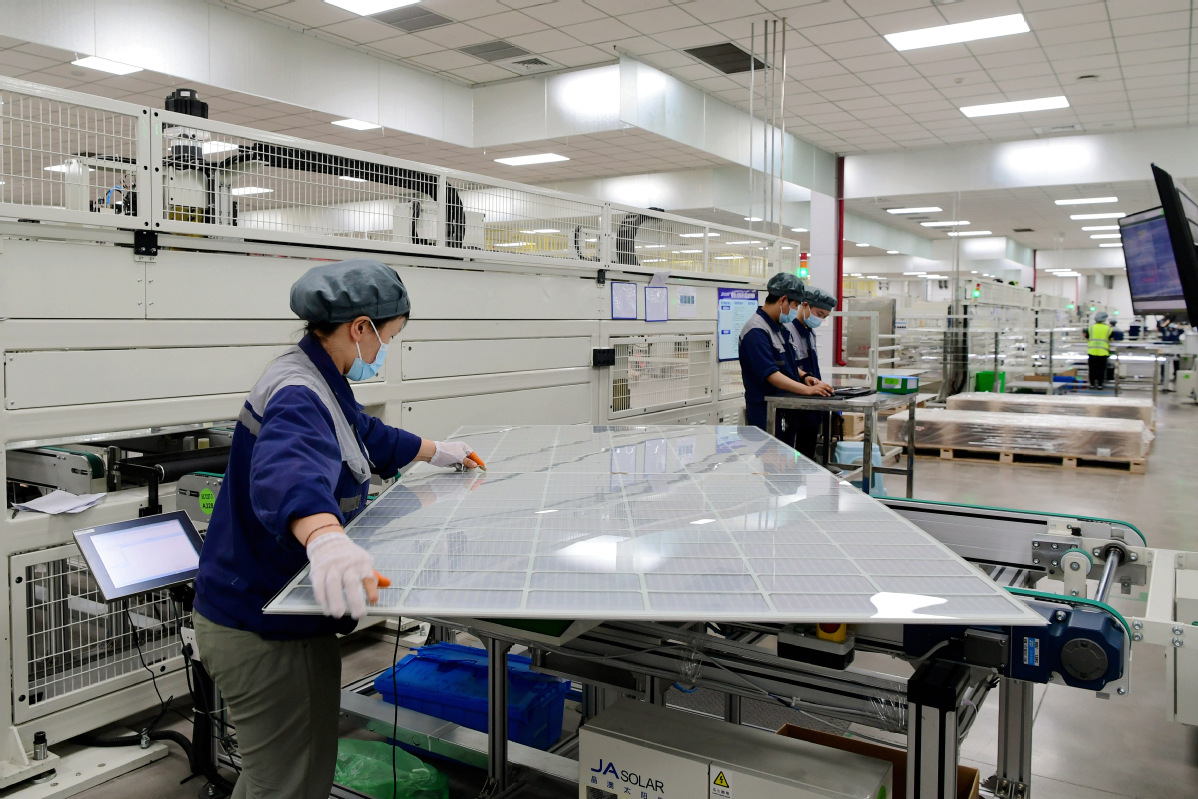
Leading Chinese solar companies, including JA Solar Technology, Longi Green Energy Technology Co Ltd and inverter maker Sungrow Power Supply Co Ltd, have been spearheading efforts to tap the advantages of offshore solar projects over the past few years, aiming to overcome challenges associated with onshore development and revolutionize the renewable energy landscape, said BloombergNEF.
JA Solar released two new PV module products designed specifically for offshore floating and fixed pile-based offshore solar projects in January, marking the first-tier photovoltaic manufacturer's debut in 2024 of such products for offshore solar development.
The prevalent designs in China are fixed-pile foundations that are primarily located in tidal flats and intertidal zones, rather than floating systems, which are considered more economical with less application limits and environmental damage.
This is part of the company's efforts to further explore offshore solar development as a means of diversifying its renewable energy portfolio. It also comes at a time when traditional onshore solar farms are facing challenges related to land availability, environmental concerns, and grid congestion.
These modules have currently been applied in the country's first offshore floating photovoltaic base in East China's Shandong province, operated by CIMC Offshore Solar Technology (Yantai), a joint venture between CIMC Raffles and Yantai government-owned Yantai Hi-tech Construction Investment and Development.
JA Solar is not alone. Module giant Longi Green Energy Technology Co Ltd has also been intensifying efforts to advance offshore solar projects. Recognizing the untapped potential of solar power at sea, Longi has strategically invested in research in photovoltaic modules that are corrosion- and wind-resistant to ensure their durability and performance against waves and seawater.
According to Zhang Jun, head of the product technology department at JA Solar, China has about 18,000 kilometers of mainland coastline, presenting a potential installed capacity of over 100 gigawatts for offshore photovoltaics. With the global coastline exceeding one million kilometers, the energy potential is even more significant.
"Offshore solar power stations in economically developed coastal regions enjoy vast advantages. They not only require less land for investment, but also achieve higher electricity generation compared with that of land-based ones," he said.
"Located close to the electricity demand centers along coastlines, they also reduce transmission distances and losses, while the utilization of offshore tidal flats and nearshore areas also addresses the issue of limited land and environmental concerns on land."
While offshore photovoltaics have significant potential, Zhang said it requires collective efforts to promote and tackle obstacles, including land expenses in certain maritime areas. Companies should also step up research and development to come up with products that can withstand high waves, strong winds and damage caused by salt water.
"Many countries and regions have introduced relevant policy support to reduce investment risks and increase returns through subsidies, tax incentives, or power purchase agreements," he said.
Apart from China, most offshore photovoltaic activities are in the Netherlands and Scandinavia, where firms are strong in offshore expertise.
Dutch company Oceans of Energy has operated a 500-kW offshore solar farm in the North Sea since 2020, which floats on a raft combining rigid and flexible structures that allow it to ride on the waves.
According to a recently released report by China Renewable Energy Engineering Institute on the current status and prospects of offshore photovoltaics, the development of offshore solar resources is expected to open up a new frontier for renewable energy, enabling countries with limited land to significantly expand their solar capacity.
While the offshore solar sector is still in its early stages in China, the growing interest from major solar companies underscores the potential for offshore solar projects to become key players in the global renewable energy landscape, said Wu Mudan, technical supervisor of the institute.
According to Wu, fixed pile-based offshore solar projects have been implemented in various provinces and cities across the nation, with continuously optimized costs and enhanced economic viability.
The floating type is currently in the demonstration phase, with some small-scale pilot projects located in Zhejiang, Fujian, Hainan and Jiangsu provinces, among others.