Coffee beans give village taste of the good life







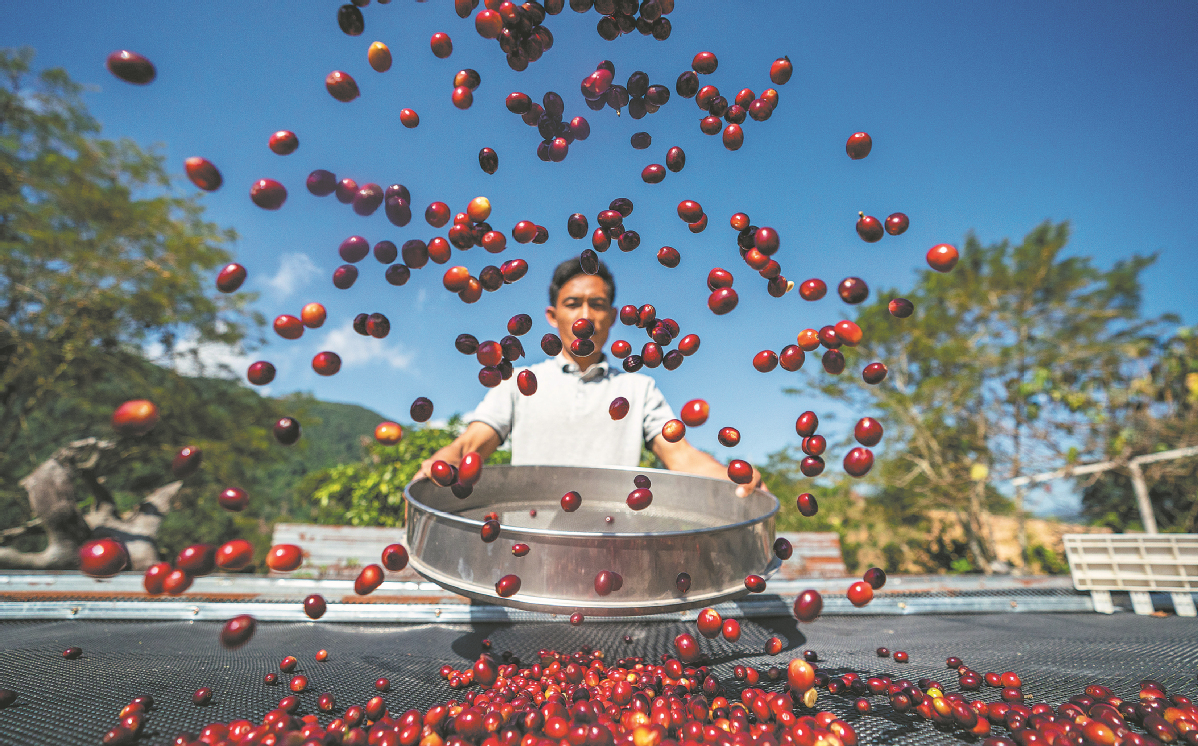
As Huang Xiuwu grinds coffee beans in his livestreaming studio and demonstrates the art of pour-over coffee, thousands of enthusiasts watch online and make orders.
Returning to his hometown of Changxing village in the Qiongzhong Li and Miao autonomous county in Hainan province in 2008, Huang later co-founded the Feipushan coffee company.
"By selling homegrown coffee beans and products, our company now boasts an annual revenue of about 1 million yuan ($140,774)," he says.
Huang's success is not down to luck, but is the result of his unwavering dedication to reviving a once-fading tradition.
Hainan, the birthplace of many overseas Chinese, has a rich history of coffee cultivation and consumption. The habit was introduced to Hainan by overseas Chinese decades ago, and residents of Changxing village were growing coffee as early as in the 1960s, thanks to their area's geographical advantages.
At a latitude of 18 degrees north and an altitude of 200 meters, the village has an ideal environment for growing coffee beans. A significant difference between daytime and nighttime temperatures, optimal humidity, sunlight, rainfall, fertile soil and natural spring water all contribute to the high-quality beans it produces.
However, when Huang first returned, he saw that coffee was in decline due to the meager profits brought in by selling beans alone — no more than raw materials for the coffee industry.
"After coming home, I learned how to grow coffee and planted 50 mu (about 3.33 hectares) of coffee plants, and the income was good," Huang says. "Gradually, this encouraged other residents to join me."
In 2013, he took the initiative of establishing a coffee cooperative. Together with village officials, he distributed free coffee seedlings and provided hands-on instruction, encouraging more people to grow the beans.
The increasing level of production and rising profits has sparked renewed local enthusiasm for growing coffee. "In 2008, about 200 mu of coffee was grown in our village, and now that has expanded to about 1,500 mu," Huang says.
After establishing the cooperative, he realized that selling coffee products would be more profitable than simply selling coffee cherries, the fruit from which the beans are harvested.
"Coffee cherries fetch only 10 yuan per kilogram, but the same weight of processed coffee beans can sell for 180 yuan," he says.
Huang introduced processing equipment to the village and worked with residents to establish his coffee company.
The processing plant provides jobs, and the brand has increased the added value of local coffee products, bringing greater economic benefit to the village. It purchases most of its coffee cherries locally, which ensures stable local incomes, and also produces flavored coffee beans and products, which are available not only in Hainan, but also in major cities like Beijing and Shanghai, generating even more profit.
In recent years, Hainan has implemented an action plan to develop a complete, high-efficiency tropical agriculture industrial chain, highlighting coffee as a key sector to promote its cultivation, processing and trade.
Huang currently participates in short-video and livestreaming training provided by the local government, and expects to gain more consumers by expanding the online market for his brand.
"I spend about two or three hours almost every afternoon broadcasting live online, sharing brewing techniques and talking about our coffee beans," he says. "We now have about 4,000 followers, and monthly online sales can reach about 12,000 yuan."
Huang intends to continue expanding coffee production locally, and is developing his livestreaming to bring in more sales, and to integrate the local coffee industry with tourism.
"I hope to build a coffee-themed guesthouse so that visitors can experience the joys of coffee cultivation, picking and brewing. My goal is to help popularize Hainan's coffee culture and increase incomes for local residents," he says.
Xinhua