Powering growth







Clean energy fueled China's economic growth in 2023
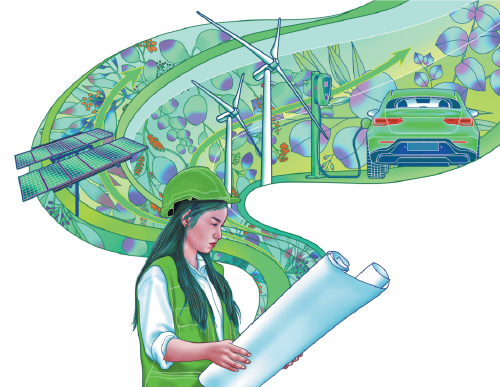
In 2023, China's clean energy sector significantly propelled the nation's economic growth, contributing an unprecedented 11.4 trillion yuan ($1.6 trillion), up 30 percent year-on-year to its GDP, and capturing the largest slice of the investment growth. The "new three" — solar panels, electric vehicles and batteries — were the primary beneficiaries of the investments. Our analysis adopts a broad definition of "clean energy "sectors, including renewables, nuclear power, electricity grids, energy storage, EV, and railways. These are technologies and infrastructure needed to decarbonize China's production and use of energy. Notably, the clean energy sector's growth coincides with a decline in the real estate sector for the second consecutive year. This shift not only positions clean energy as crucial for China's energy transition and climate goals, but also elevates its importance within the broader economic and industrial landscape.
China's clean energy surge hasn't solely been driven by policy pronouncements. Instead, it has stemmed from a unique confluence of policy signals, economic realities and strategic investment choices. While the 2060 carbon neutrality goal provided clear direction, the actual growth has significantly outpaced expectations. This remarkable acceleration can be attributed to several key factors.
First, the government's intensified regulation of the real estate sector, previously a powerful economic engine, created a void that needed to be filled. Clean technology, aligned with national environmental goals and benefiting from relaxed financial restrictions, emerged as a viable alternative. This shift was further fueled by local governments seeking new avenues for growth amid shrinking real estate revenues. Clean energy fits the bill, aligning with central government priorities and offering responsible investment opportunities.
Second, financial support has played a crucial role. The easing of financing constraints for private companies has allowed them to tap into the clean energy sector. This shift has been further amplified by local governments offering substantial support and convenience such as complete infrastructure for manufacturing facilities.
Third, market dynamics have also contributed significantly. The declining costs of clean energy, driven by technological advancements, aggressive industrial policies and diversified supply chains, have made renewables increasingly competitive with fossil fuels. This, coupled with the overall economic landscape, has created a strong market pull for continued investment in the sector.
Driven by ambitious environmental goals and evolving economic priorities, China's clean energy sector has undergone a remarkable transformation, which has significant implications for both China and the world.
For China, the pivot to the clean energy sector necessitates steady growth in areas such as renewable power installations and EV deployment. Continued clean energy expansion at the current pace, coupled with a return of energy demand to pre-COVID-19 levels, presents the strong possibility of China's carbon dioxide emissions peaking well before 2030. In 2023, there was a noteworthy development as the clean energy sector's expansion began to align closely with the trajectory of the country's power demand growth. This subtle shift marks a crucial turning point, potentially signifying that the growth of clean energy power generation will outweigh the overall rise in power demand. Consequently, the reliance on fossil fuels for power generation and the associated emissions are likely to decline. The strong growth in EVs is making a dent in China's gasoline demand for the first time. It demonstrates that China's pursuit of clean energy is not only driving new economic opportunities, but also contributing to the climate goals.
China's clean energy boom positions it as a global leader in the world energy transition. This leadership is helping the world move faster toward using renewable energy by making it cheaper and easier to adopt. The dramatic price drops of solar panels and batteries, driven by China's manufacturing boom, have made renewable energy more accessible and economically viable, potentially accelerating the global shift toward a zero-carbon energy system. Moreover, China's escalating investment in renewable energy projects abroad, coupled with its pivotal role in the supply of clean technologies, demonstrates a strategic approach to shape global energy transition policies. This highlights the global energy economy's reliance on collaborative efforts to achieve a sustainable future.
The clean energy sector investment boom has been built on China's investment-led economic model. While new clean energy technologies offer potential for expansion, eventually new sectors will need to attract investment, or China's investment-led economic model will require transformation.
China's dominance in global clean energy supply chains also presents a dilemma for other nations: leverage China's low-cost technologies or diversify and develop their own competitive supply chains, potentially further driving down global prices.
By the end of 2023, China's National Development and Reform Commission's mid-term evaluation report for the 14th Five-Year Plan (2021-25) revealed that China's progress in reducing energy consumption and CO2 emissions per unit of GDP didn't meet expectations. Yet, the record-breaking expansion of clean energy and electricity storage in 2023 provides an opportunity to bring things back on track. Most of China's climate targets for 2025 can still be met if this accelerated pace is maintained, and energy demand growth returns to pre-COVID-19 average level. The mid-term evaluation report also outlines strategies to reach these targets, emphasizing energy and emission control, reducing high-consumption and high-emission projects, limiting coal use, and shifting toward cleaner industrial and transportation methods. It highlights the crucial role of renewable energy deployment to achieve the climate goals, especially as energy consumption continues to rise.
China's clean energy boom presents both opportunities and challenges. It can help to achieve climate targets, drive economic growth, and reshape the global clean energy landscape. China's efforts provide valuable lessons and opportunities for the world as we collectively navigate the path toward a more sustainable future.
Qi Qin is a China analyst at the Centre for Research on Energy and Clean Air (CREA). Lauri Myllyvirta is the lead analyst at the CREA. The authors contributed this article to China Watch, a think tank powered by China Daily.The views do not necessarily reflect those of China Daily.
Contact the editor at editor@chinawatch.cn.