Student entrepreneur revolutionizes Braille display







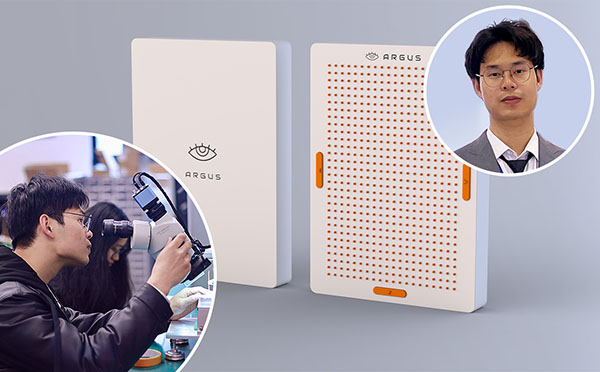
Li Cheng, 20, a college student and engineering enthusiast from Southwest China's Chongqing, is making waves by turning his entrepreneurial dreams into reality.
Leveraging his knowledge, insights, and empathy, Li has invented a groundbreaking Braille dot display tailored for the visually impaired community.
Named "Argus", the first batch of the Braille dot display is expected to be released this summer. The company Li founded, Chongqing Wujie-QH Tech Co, is now valued at approximately 20 million yuan ($2.78 million).
While sighted people use screens, such as those on iPads or Kindles, for reading, the visually impaired rely on "dot displays" to read through touch. Currently, literate visually impaired individuals depend primarily on printed Braille books for reading.
China has around 18 million visually impaired people, with 23.5 percent under the age of 30, according to the China Disabled Persons' Federation.
"The market demand is huge," said Li. He emphasized that once mass-produced, Argus could be a groundbreaking tool that can enhance literacy among the visually impaired, improve reading efficiency and scope, and enrich their spiritual lives.
"In the meantime, when the power of science and technology is combined with humanistic care, we are able to create a display that people can actually afford," he added.
According to Li, traditionally, core technical operations for similar devices utilize piezoelectric ceramics to convert electric signals into physical signals. However, this material is mainly imported and, therefore, very expensive.
In the past year, Li's team managed to reduce costs by 40 percent after rounds of trials and failures, and successfully reconstructing an actuator that overturns the previous physical approach to the electromagnetic approach. The first-generation Argus is priced between 8,000 to 10,000 yuan, with plans to introduce a more affordable entry-level version with basic functions.
Born in Shaoxing, Zhejiang province, Li dreamed of becoming an engineer since childhood. "I even fantasized about using the electronic waste collected from my dismantled electronic products to make a humanoid robot," he said.
Li has won numerous national and municipal-level engineering prizes and applied for seven invention patents. In 2020, he was enrolled in the Robotics Engineering Institute at Chongqing University. His talent and dedication earned him recognition under China's National Elite Institute of Engineering program, which was initiated by the Ministry of Education and the State-owned Assets Supervision and Administration of the State Council in August 2022.
With the support of the program, Li's project was officially launched in October last year, with a team of eight collaborating on various aspects of the product's development — its structure, electronics, overall assembly, design, private domain operations, and user research.
Li said his idea for Argus dated back to the end of his freshman year in 2021 when he was attending an XbotPark summer camp — a sci-tech-innovation-themed camp initiated by Li Zexiang, who is dubbed the "Father of DJI", the world's leading drone unicorn. One day, when he was reading a novel on his phone, a question struck his mind: "How do visually impaired people read?"
His curiosity led to research on the topic, including gathering information from websites and social media, and interacting with visually impaired people, who provided crucial insights about their daily challenges.
"Li is a very cheerful leader. The work atmosphere here is very relaxed and we exchange ideas often," said 22-year-old postgraduate student Fu Wenke, who is Li's college mate and joined Li's team in September last year. "With maturity, stability, and systematic approach, Li clearly maps out our goals and we are confident in what we are doing."
The team's efforts have been bolstered by Zhu Xiaoming, a 38-year-old software technician with years of experience. As a visually impaired individual himself, Zhu's input has been invaluable in ensuring that Argus meets the needs of its users.
"Despite being in the early stages of development, Argus has shown unique features in function, sense of touch, and responsiveness in displaying Braille," Zhu said. "It is a tool that can help people like me, who lack visual input, to learn more in multiple scenarios."
Currently, the program has received a 500,000-yuan seed investment from Mingyue Lake International Intelligent Industry Science and Technology Innovation Base, which is promoted by Li Zexiang and Chongqing Liangjiang New Area, the third national development zone in China after Shanghai Pudong and Tianjin Binhai. It has also secured 20 million yuan in an angel-round financing from a Shenzhen-based investment firm.
Looking ahead, Li plans to dedicate three to five years to further refining Argus. Overseas promotion is also scheduled for next year, with aspirations to integrate the core technology — high-density tactile sensing — into augmented reality (AR) or virtual reality (VR) applications and potentially develop household companion robots, with the aim of improving people's lives.